Advantages of trackable print media for marketers
Trackable print media turns physical collateral into measurable, updateable digital touchpoints by pairing printed assets with QR codes, dynamic short links, or personalised URLs (PURLs) that resolve to tracked destinations. From the first scan, you gain attribution data you simply cannot get from a static flyer. The core advantages are clear:
- Measurable attribution: tie every scan to a conversion, campaign, or audience segment
- Offline-to-online connection: move readers from paper to a landing page, form, or product page instantly
- Improved ROI visibility: compare cost per conversion against digital-only channels with real data
- Link permanence: dynamic codes stay live and updateable, protecting your print investment
- GDPR-compliant data handling: collect scan metadata lawfully under ICO-aligned practices
Print already earns attention that most digital formats cannot match. View rates of 70–90% and page dwell times of 2–3.5 seconds position print well above banner and social formats on attention supply. Add trackability, and that attention becomes measurable.
Table of Contents
- What does ‘trackable print media’ actually mean?
- What are the concrete advantages of trackable print media?
- How does trackable print work? Methods compared
- Which metrics should you track in a print campaign?
- Privacy and GDPR: what UK marketers must consider
- Common failures with trackable print media and how to avoid them
- How to run a trackable print campaign step by step
- How Qrlytics solves permanence and analytics for long-running print campaigns
- Key takeaways
- Why trackable print deserves a proper budget line
- Qrlytics: permanent QR tracking without the risk of broken codes
- Useful sources for further reading
- FAQ
What does ‘trackable print media’ actually mean?
A trackable printed asset is any physical piece that carries a scannable or typed identifier resolving to a tracked digital destination. The identifier captures data at the moment of interaction; the destination is where you measure what happens next.
Static vs dynamic trackability is the critical distinction:
- A static link or fixed QR code points to one URL permanently. You can count scans if the platform supports it, but you cannot change the destination after printing.
- A dynamic link uses a redirect layer. The printed code stays identical, but you update the destination URL at any time. This is what makes long-lived print campaigns viable.
Common implementations and when to use each:
- QR codes on direct mail, brochures, posters, and packaging — best for high-volume, visually prominent placements
- NFC tags embedded in premium print or point-of-sale materials — suited to tap-first environments where scanning feels slow
- PURLs (personalised URLs) on direct mail — ideal for one-to-one personalisation and audience segmentation
- Promo codes on any printed piece — simple to track via e-commerce or CRM, no smartphone required
What are the concrete advantages of trackable print media?
Measurable attribution and ROI
The most direct benefit of measurable print advertising is attribution. When a prospect scans a QR code on your brochure, you know which piece drove that visit, which device they used, and whether they converted. That data lets you calculate a genuine cost per conversion and compare it honestly against paid search or display.
Direct mail response rates around 9% for house lists already outperform many digital channels on raw response. Pair that with scan tracking and you move from anecdote to evidence.
Attention and memory encoding
Print occupies a mid-to-high attention band in frameworks developed by researchers including Lumen and Karen Nelson-Field. Physical handling increases focused processing, which means your message is more likely to be encoded in memory than the same creative served as a banner. Attention-supply research places print above the lowest-attention digital tiers on attentive seconds per thousand impressions. Trackable print lets you verify that attention is translating into action.

Compounding effect with digital channels
Print and digital are stronger together. Multichannel campaigns integrating print with digital can be up to 400% more effective online than digital alone. A scanned QR code fires a first-party signal you can use to trigger retargeting, personalise follow-up email, or feed a CRM workflow — all from a single printed piece.
Longevity and reduced waste
A static flyer becomes obsolete the moment the offer changes. A dynamic QR code on the same flyer lets you redirect to a new landing page without reprinting. That reduces print waste and protects the budget already spent on design and production.
Operational flexibility
Dynamic links also enable A/B testing: print two versions of a leaflet pointing to the same QR code, split the redirect destinations, and measure which landing page converts better. PURLs take this further by giving each recipient a unique URL, enabling precise audience profiling without a single digital ad.
How does trackable print work? Methods compared
Dynamic QR codes with a redirect layer are the default choice for any campaign that needs permanence and analytics. Here is how the main methods compare:
| Method | Permanence | Updateable after print | Tracking fidelity | Ease of use | Relative cost |
|---|---|---|---|---|---|
| Dynamic QR code | High (redirect layer) | Yes | Scans, device, time, location | High | Low–medium |
| Static QR code | Fixed URL only | No | Scans only (platform-dependent) | High | Very low |
| NFC tag | High | Yes (tag rewritable) | Taps, device, time | Medium | Medium–high |
| PURL | High | Partial (page content) | Full web analytics | Medium | Medium |
| Promo code | High | N/A | Redemptions via CRM/e-commerce | High | Low |
How dynamic redirects work: when a user scans a dynamic QR code, their device sends a request to a redirect server. That server logs the scan metadata (timestamp, device type, approximate location) and forwards the user to the current destination URL. You can update QR code links without reprinting by changing the destination in your dashboard. The printed code never changes; only the redirect target does.
Printing considerations worth noting:
- QR codes need a minimum quiet zone (white border) and sufficient contrast — dark code on a light background
- Minimum recommended print size is roughly 2 cm × 2 cm for reliable scanning
- NFC tags require careful placement to avoid interference from metallic substrates
- PURLs should be short and memorable if recipients are expected to type them
Which metrics should you track in a print campaign?
QR codes allow tracking of scans, device type, time of scan, and location — each metric revealing something different about campaign performance.
| Metric | What it reveals |
|---|---|
| Total scans | Raw reach and engagement with the printed piece |
| Unique scans | Unduplicated audience size |
| Scan rate (scans ÷ distribution) | Effectiveness of placement and creative |
| Device type | Mobile vs desktop split; informs landing-page design |
| Time of scan | Peak engagement windows for future send timing |
| Geographic heat map | Which locations or regions respond most strongly |
| Landing-page conversion rate | Whether the post-scan experience is working |
| Bounce rate and time on page | Quality of the landing-page match to the ad |
Beyond scan-level data, track form completions, purchases, or sign-ups attributed to the printed piece. Readership and placement multipliers help set realistic KPI baselines by accounting for pass-along readership and page-position effects — useful when briefing stakeholders on expected reach.
Pro Tip: Set up UTM parameters on every redirect destination so scan traffic appears as a distinct source in Google Analytics, keeping it separate from organic or paid sessions.
Privacy and GDPR: what UK marketers must consider
Tracking scan metadata is lawful when you choose an appropriate legal basis and minimise the personal data you collect. Scan-level data (timestamp, device type, approximate location) is often not personal data in isolation, but it can become so when combined with other identifiers.
ICO guidance is clear: UK marketers must identify a lawful basis before collecting any data that could identify an individual, provide a privacy notice at or before the point of collection, and retain data only as long as necessary. For large-scale or profiling campaigns, a Data Protection Impact Assessment (DPIA) is strongly recommended.
Compliance checklist for trackable print campaigns:
- Lawful basis: legitimate interests is common for aggregate scan analytics; consent is required where you are building individual profiles
- Privacy notice: include a short URL or QR code linking to your privacy page on the printed piece itself
- Data minimisation: collect only what you need — aggregate heat maps rather than individual scan logs where possible
- Retention limits: set a defined retention period and delete scan logs after it expires
- Opt-out mechanism: provide a clear way for users to request deletion of any personal data collected post-scan
- Cookie and tracking notices: post-scan landing pages must comply with UK PECR rules on cookies
Consult the ICO’s marketing guidance directly for your specific campaign type, and keep a DPIA on file for any campaign involving profiling or large-scale data collection.
Common failures with trackable print media and how to avoid them
Broken or expired links and poor landing-page experience are the two most frequent reasons print campaigns underperform. Both are preventable.
Link and code failures:
- Expired redirect URLs (often caused by subscription lapses on free QR platforms)
- Low-contrast or undersized QR codes that scanners cannot read
- No fallback URL if the primary destination goes offline
Landing-page failures:
- Pages not optimised for mobile, where the majority of scans arrive
- Landing page content mismatched to the printed ad’s promise
- No UTM or CRM integration, so conversions are invisible in reporting
Operational fixes:
- Test every code at proof stage, on multiple devices and in varying light conditions
- Use a QR design verification checklist before sending files to print
- Monitor redirect uptime post-distribution and set automated alerts for broken links
- Keep landing pages short, with a single clear call to action and pre-filled form fields where possible
Pro Tip: Set a calendar reminder to scan-test your codes at 30, 60, and 90 days post-distribution. Redirect failures often appear weeks after launch, not immediately.
How to run a trackable print campaign step by step
Follow this six-step workflow from brief to live measurement:
- Plan (Days 1–3): Define campaign goals, target audience, distribution method, and KPIs. Decide which tracking method fits (dynamic QR, PURL, promo code). Set UTM conventions for all redirect destinations.
- Create dynamic assets (Days 3–5): Generate dynamic QR codes or PURLs. Configure redirect destinations and connect to Google Analytics or your CRM. Use a QR code generation guide to get sizing and format right first time.
- Test (Days 5–7): Scan every code on iOS and Android. Verify redirects reach the correct destination. Check UTM parameters appear correctly in analytics. Test landing pages on mobile at 4G speeds.
- Print (Days 7–21): Allow standard UK print lead times of 5–10 working days for litho, 2–5 for digital print. Include a quiet zone around QR codes and confirm contrast ratios with your printer.
- Launch and distribute: Send or place materials. Record distribution volumes by segment or location for accurate scan-rate calculation.
- Monitor and iterate: Review scan analytics weekly. Update redirect destinations if offers change. Use geographic heat maps to reallocate budget toward high-response areas. Boost scan rates by testing placement, size, and accompanying copy on subsequent runs.
For integrating QR codes into printed collateral, the practical detail on file formats and proofing is worth reviewing before briefing your printer.
How Qrlytics solves permanence and analytics for long-running print campaigns
Qrlytics provides dynamic QR generation, guaranteed code permanence, and real-time analytics suited to print campaigns that need to stay live for months or years. The platform’s core proposition is straightforward: codes created during an active subscription remain functional permanently, regardless of future billing status. That removes the single biggest operational risk in trackable print.
Key proof points:
- Permanence guarantee: codes do not expire or deactivate if your subscription lapses, protecting printed materials already in circulation
- Dynamic URL updates: change the redirect destination at any time without touching the printed piece
- Real-time analytics: scan counts, unique scans, device type, time of scan, and geographic heat maps available in the dashboard
- GDPR-compliant tracking: aggregate and anonymised reporting options reduce personal data exposure
- No credit card required to start: accessible onboarding for teams that want to pilot before committing
These features map directly to the checklist above. The permanence guarantee prevents the link-expiry failure mode. Dynamic redirects enable content updates and A/B testing post-print. The analytics and tracking capabilities cover every core metric listed in the metrics section, from unique scans to location heat maps.
For campaigns where consistent brand print is a priority alongside trackability, pairing Qrlytics’s dynamic codes with a considered print production process gives you both reliability and measurability.
Key takeaways
Trackable print media delivers measurable attribution, higher attention, and long-lived campaign value when you use dynamic links, GDPR-aligned data practices, and rigorous QA before distribution.
| Point | Details |
|---|---|
| Dynamic links are non-negotiable | Static QR codes cannot be updated post-print; dynamic redirects protect your investment and enable content changes. |
| Print earns genuine attention | View rates and dwell times place print above most digital formats on attention supply. |
| GDPR compliance starts at design | Include a privacy notice on the printed piece, minimise data collection, and keep a DPIA for profiling campaigns. |
| Test before and after distribution | Scan every code at proof stage and again at 30, 60, and 90 days post-launch to catch redirect failures early. |
| Qrlytics for permanent analytics | Qrlytics guarantees code permanence and provides real-time heat maps and GDPR-friendly tracking for long-running print campaigns. |
Why trackable print deserves a proper budget line
Most marketers I speak with treat print as a legacy channel — something they do when a client insists, not something they plan strategically. That framing is costing them real performance. The attention-economy argument is not nostalgia. When Lumen and Nelson-Field’s research maps media formats to attentive seconds per thousand impressions, print sits in a band that most programmatic inventory cannot reach. The question is not whether print works; it is whether you are measuring it well enough to know.
The gap I see most often is not in the print itself but in what happens after the scan. Marketers invest in beautiful creative, then send respondents to a homepage that was never designed for that audience. The print earns the attention; the landing page wastes it. Fix the post-scan experience first, then scale the print spend.
For UK campaigns specifically, the combination of high-attention print, dynamic QR tracking, and GDPR-aligned analytics gives you a channel that is both measurable and trustworthy. This combination remains rare in 2026. Test it with a small pilot, measure honestly, and let the data make the budget case for you.
Qrlytics: permanent QR tracking without the risk of broken codes
Most QR platforms deactivate codes when a subscription lapses. For any printed piece with a shelf life longer than your billing cycle, that is an unacceptable risk. Qrlytics was built specifically to remove it.
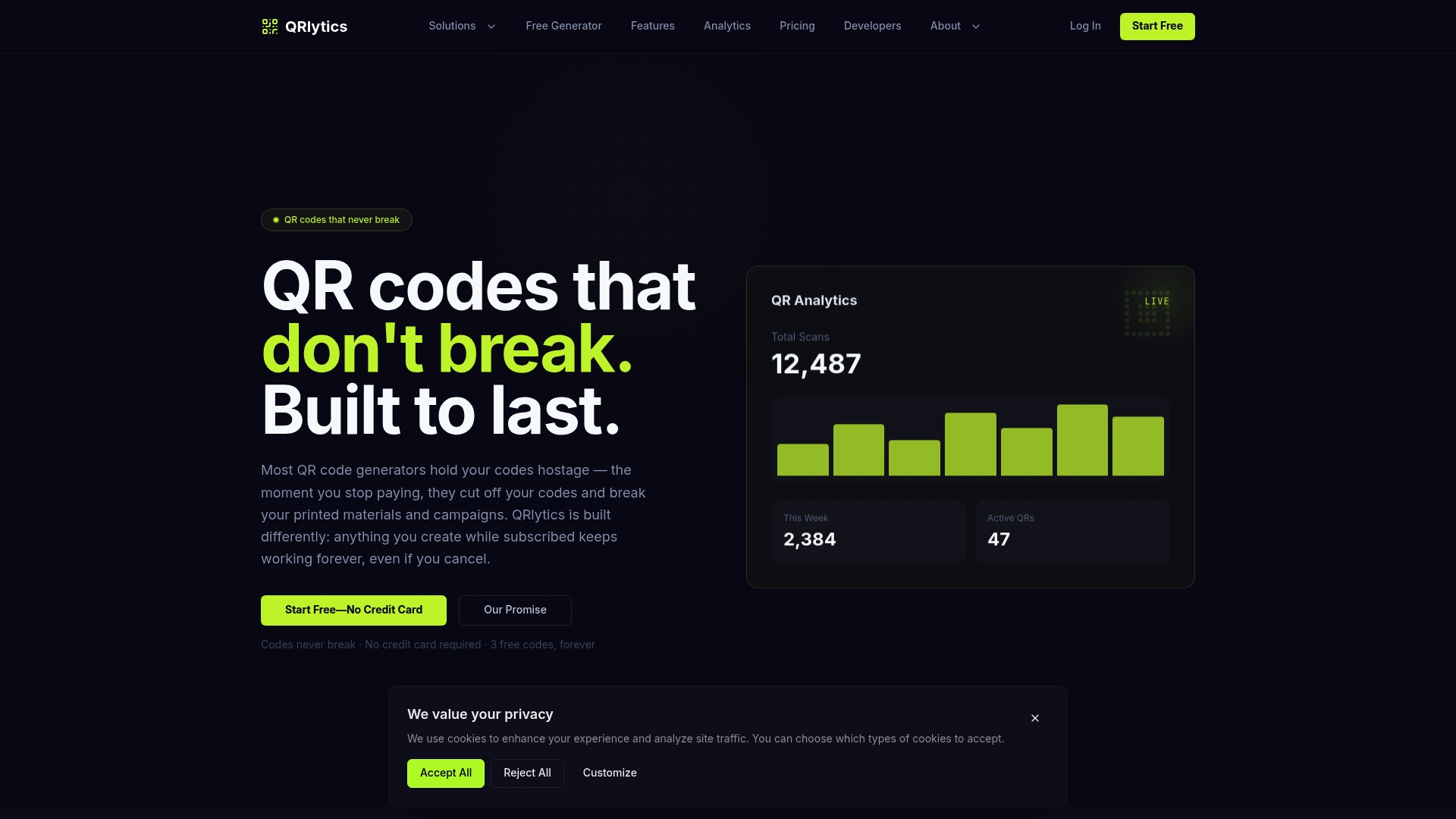
With Qrlytics, your codes stay live permanently once created during an active subscription. You get dynamic URL updates, real-time scan analytics, geographic heat maps, and GDPR-friendly settings — all without entering a credit card to get started. It is a practical, low-risk way to pilot trackable print on your next campaign.
Generate your first trackable QR code and see the analytics dashboard before committing to a full print run. If you want to explore the full platform first, visit Qrlytics to see how permanence, tracking, and compliance work together.
Useful sources for further reading
- Print advertising proves ROI in the attention economy — Print Power, attention-economy research and view-rate data
- Is print advertising still worth it? — MediaMax, direct-mail response-rate benchmarks
- How to measure the ROI of print advertising — Datum Creative Media, tracking methods and analytics set-up
- Print advertising effectiveness — Adscribed, readership multipliers and KPI baselines
- The ROI of print advertising — Kawaii Corporate, multichannel effectiveness data
- ICO marketing guidance — UK Information Commissioner’s Office, lawful basis and PECR rules
- QR code tracking: a practical guide for marketers — Qrlytics Blog, tracking set-up and privacy advice
- Printed material tracking: how to master QR code campaigns — Qrlytics Blog, campaign workflow detail
- The role of print in product launches — A3M, sector-specific print tactics
FAQ
What is trackable print media?
Trackable print media is any printed asset paired with a scannable or typed identifier — such as a QR code, NFC tag, PURL, or promo code — that resolves to a tracked digital destination, allowing you to measure scans, conversions, and audience behaviour.
How does a dynamic QR code differ from a static one?
A dynamic QR code uses a redirect layer, so you can update the destination URL after printing without changing the code itself. A static QR code points to a fixed URL that cannot be changed once printed.
Is tracking print scans GDPR-compliant in the UK?
Yes, when you identify a lawful basis, provide a privacy notice at the point of scan, minimise data collection, and set appropriate retention limits. The ICO’s marketing guidance is the authoritative reference for UK campaigns.
Which metrics matter most in a trackable print campaign?
Total scans, unique scans, scan rate per distribution, device type, and landing-page conversion rate are the core metrics. Geographic heat maps add value for campaigns distributed across multiple locations.
How does Qrlytics prevent codes from expiring on printed materials?
Qrlytics guarantees that codes created during an active subscription remain functional permanently, even if billing lapses later. This protects printed materials already in circulation and removes the most common operational risk in long-running print campaigns.