QR codes on shopping bag inserts: a retailer’s guide
TL;DR:
- QR codes on shopping bag inserts transform passive touches into measurable digital channels that increase repeat visits and data collection. Dynamic codes are essential because they can be updated without reprinting and provide analytics, making them more effective than static codes for post-purchase engagement. Proper design, placement, and landing page experience are critical to maximizing scan success and conversion rates.
Put simply: a QR code on a shopping bag insert turns a passive physical touchpoint into a measurable digital touchpoint that drives repeat visits, data capture and personalised follow-up. If you’re a retailer or marketer asking why QR codes in shopping bag inserts are worth the effort, the short answer is that in 2026, 57% of consumers actively scan QR codes on product packaging, and bag inserts are one of the most cost-effective places to put one.
Three reasons they work:
- Measure what was previously invisible. Every scan records device type, location, time and frequency, turning a printed insert into a live data source.
- Drive a specific action. A single, focused CTA (redeem a coupon, join a loyalty programme, leave a review) converts passive readers into active customers.
- Collect first-party data. With third-party cookies declining, scan-triggered sign-up flows give you consented, owned customer data at the moment of highest engagement.
Qrlytics is built specifically for this use case: dynamic codes, permanent redirects and GDPR-aware analytics, so your inserts keep working long after the print run.
Table of Contents
- Static vs dynamic: which type of QR code should you use?
- Core benefits and retail use cases for bag-insert QR codes
- What to link your bag-insert QR code to
- Design and printing best practices for bag-insert QR codes
- Tracking, analytics and GDPR: what to measure and how to stay compliant
- How long it takes and what it costs to add QR codes to bag inserts
- Three campaign templates you can run right now
- When QR codes on bag inserts do not work
- Key takeaways
- What retailers consistently underestimate about bag-insert QR campaigns
- Qrlytics makes bag-insert QR campaigns reliable from day one
- Useful sources and further reading
- FAQ
Static vs dynamic: which type of QR code should you use?
A QR code is a square matrix barcode that any modern smartphone camera can read instantly, opening a URL, triggering a download or displaying content without a separate app. When a shopper scans one on your insert, their phone decodes the pattern and sends them straight to your chosen destination.
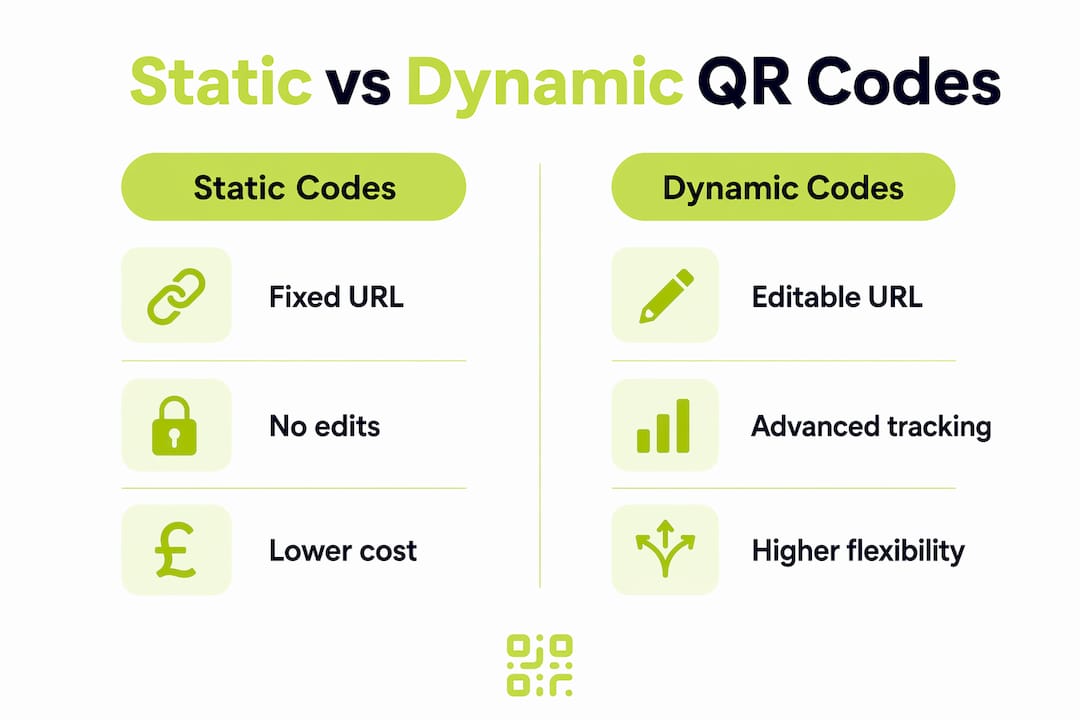
The critical distinction for bag inserts is between static and dynamic codes. A static code bakes the destination URL directly into the pattern; change the URL and you must reprint. A dynamic code stores a short redirect URL instead, so you can update the destination at any time through your platform dashboard without touching the printed insert. Dynamic codes also log every scan, giving you the analytics that make the channel measurable.

For any printed campaign, dynamic is the only sensible choice. The GS1 Digital Link standard extends this further, embedding product identifiers alongside URLs so a single code can serve both retail scanning systems and consumer-facing content. Worth knowing if you sell through major UK retailers.
Core benefits and retail use cases for bag-insert QR codes
Bag inserts reach customers at peak receptivity: they have just bought from you, the product is in their hands, and they are already engaged. That context makes QR codes on bag inserts unusually effective compared with cold-audience advertising.
High-impact use cases include:
- Next-purchase discount. A scannable coupon code drives immediate repeat purchase and gives you a clean redemption metric.
- Styling and care guides. Link to a short video or formatted guide; reduces returns and builds product confidence.
- Loyalty programme enrolment. Scan-to-join removes friction from sign-up and lifts repeat purchase rates by shortening the path to membership.
- Product pages and cross-sells. Direct customers to complementary items while purchase intent is still high; supports upsell opportunities without extra shelf space.
- Warranty and product registration. Captures structured customer data (name, email, purchase date) with clear consent.
- Authenticity verification. A scan-to-authenticate flow confirms provenance and deters counterfeit resale, particularly valuable for fashion and electronics.
- Review requests. Scan-to-review with a small loyalty reward consistently outperforms email review requests in conversion timing.
QR codes can also hold significantly more data than a standard 1D barcode, making them better suited to richer content and digital product information, which is why retailers are increasingly treating them as the default post-purchase communication channel.
What to link your bag-insert QR code to
The destination matters as much as the code itself. A fast, single-action mobile page converts; a slow, cluttered one does not. Landing page experience is the primary determinant of whether a scan becomes a measurable outcome.
| Destination type | Ideal CTA | Expected mobile experience | Suggested success metric |
|---|---|---|---|
| Discount / coupon | Redeem now | Auto-applied code at checkout | Coupon redemption rate |
| Loyalty sign-up | Join and earn | One-screen form, email + name | Enrolment conversion rate |
| Care / styling guide | Watch the video | Vertical video or formatted guide | Time on page, return visits |
| Product review | Leave a review | Pre-filled star rating, one-tap submit | Review submission rate |
| Warranty registration | Register your product | Short form, confirmation email | Registration completion rate |
| Authenticity check | Verify your item | Instant pass/fail result page | Scan-to-verify rate |
| Feedback survey | Share your thoughts | Three questions maximum | Survey completion rate |
A few practical notes. Keep each landing page to one clear action; adding a secondary CTA typically halves conversion on mobile. Page load time under three seconds is the threshold most users tolerate before abandoning. Personalised QR journeys that tailor the destination by product category or purchase channel consistently outperform generic landing pages.
Design and printing best practices for bag-insert QR codes
Getting the code onto the insert correctly is where many campaigns fail before they start. Follow this checklist before sending files to print.
- Minimum size: 2.5 cm × 2.5 cm. Smaller codes are unreliable on mid-range smartphone cameras, especially in lower light.
- Quiet zone. Maintain a clear white border of at least four modules (the small squares) around the code on all sides. Crowding the code with text or imagery causes scan failures.
- High contrast. Dark code on a light background is the standard. Avoid placing the code on patterned, textured or reflective finishes; reflective surfaces and folded areas are the most common causes of failed scans in the field.
- Error-correction level H. This allows up to 30% of the code to be obscured or damaged while remaining scannable, which matters if you brand or logo-stamp the centre.
- Placement. Position the code away from folds, staples and perforations. Centre-of-insert or bottom-right corner placement tends to scan most reliably.
- Include a short CTA. “Scan to get 10% off your next order” printed beneath the code lifts scan rates measurably compared with an unaccompanied code.
- Brand the code thoughtfully. Adding your logo to the centre module is fine at error-correction level H, but test it on the actual substrate before approving the print run.
Pro Tip: Always print a physical proof on the exact paper stock and finish you plan to use, then test it with at least three different smartphones in normal lighting. What scans cleanly on screen can fail on a matte-laminated insert.
For more tactics on increasing scan rates, placement angle and CTA wording make a bigger difference than most retailers expect.

Tracking, analytics and GDPR: what to measure and how to stay compliant
Dynamic codes give you a live data feed from every insert in circulation. The metrics worth tracking fall into three tiers.
| Metric | Business question it answers | Practical threshold |
|---|---|---|
| Total scans | Is the insert being noticed? | Benchmark against print run volume |
| Unique scans | How many distinct shoppers engaged? | Unique / total ratio indicates repeat interest |
| Location / heatmap | Which regions or stores drive most engagement? | Identify top-performing distribution points |
| Device type | Are customers on iOS or Android? | Informs landing-page optimisation |
| Scan-to-conversion | Are scans turning into actions? | Varies by CTA; coupon redemption typically 10% |
| Time of scan | When do customers engage post-purchase? | Informs follow-up timing |
Real-time QR data lets you adjust the redirect destination mid-campaign if early scans reveal a mismatch between the offer and what customers actually want.
GDPR in the UK. The UK GDPR, overseen by the ICO, applies whenever your landing page collects personal data. Practical steps: display a clear privacy notice on every data-capture page, state the specific purpose for which you are collecting information, provide an opt-in tick box (not pre-ticked), and link to your full privacy policy. Scan metadata (device type, approximate location, timestamp) that cannot identify an individual is generally not personal data under UK GDPR, but any form that captures name, email or purchase history is. Consult the ICO guidance for your specific use case.
Permanence matters. A broken redirect wastes every printed insert. Choose a platform that guarantees redirect continuity regardless of billing status. Qrlytics is built on this principle: codes created during an active subscription remain functional permanently, so a batch of inserts printed today will still work in three years. When evaluating any QR platform, ask directly: “What happens to my redirects if I pause or cancel my subscription?”
For broader campaign measurement, integrating QR scan analytics with your existing reporting cycle gives you a cleaner picture of post-purchase ROI.
How long it takes and what it costs to add QR codes to bag inserts
The timeline from decision to live campaign is shorter than most retailers assume.
- Day 1–2: Generate dynamic codes on your chosen platform and set up redirect URLs.
- Day 2–5: Build or adapt the landing page; test on mobile for speed and single-action focus.
- Day 3–6: Create insert artwork, embed the code, and submit a print proof.
- Day 5–10: Approve physical proof, confirm scan reliability on the actual substrate.
- Day 10–20: Print run completed (varies by volume and supplier lead time).
- Day 20+: Distribute with orders or in-store bags; analytics go live immediately.
On costs, the incremental printing expense for adding a QR code to an existing insert design is typically negligible, as the code is part of the artwork file. The meaningful costs are platform fees for dynamic code management (most providers charge a monthly subscription) and any landing-page build time. Running a small pilot of 500–1,000 inserts with a single offer before committing to a full print run is the most reliable way to validate scan rates and conversion before scaling.
Three campaign templates you can run right now
Template 1: Next-purchase coupon
CTA on insert: “Scan for 15% off your next order.” Landing page: Single-screen page with auto-generated discount code, email capture optional. Target metric: Coupon redemption rate within 30 days of purchase. Distribution: Works equally well in-store bag and e-commerce shipment; shipment insert typically scans within 24–48 hours of delivery.
Template 2: Style and care hub
CTA on insert: “Scan to see how to style and care for your new piece.” Landing page: Short vertical video plus a formatted care guide; no form required. Target metric: Time on page and return visit rate; secondary metric is reduction in care-related returns. Distribution: Best suited to fashion, homeware and beauty; include in every order regardless of channel.
Template 3: Scan-to-review with loyalty reward
CTA on insert: “Leave us a review and earn 50 loyalty points.” Landing page: Direct link to your Google Business Profile or Trustpilot page, with a loyalty points confirmation screen after submission. Target metric: Review submission rate and loyalty programme enrolment uplift. Distribution: Time the insert for delivery 3–5 days after purchase, when satisfaction is highest. Lead generation with QR codes works best when the ask arrives at the right moment in the post-purchase window.
When QR codes on bag inserts do not work
QR codes underperform in predictable circumstances. Knowing them in advance saves wasted print spend.
Avoid these situations:
- Low-connectivity environments. If your bags are distributed at outdoor markets, festivals or rural pop-ups with poor mobile signal, scan rates will be low regardless of design quality.
- Demographics unlikely to scan. Older customer segments in some categories show lower QR adoption; test before assuming universal uptake.
- Reflective or heavily folded materials. Foil-finish inserts and tightly folded leaflets are common scan failure points; test on the exact substrate.
- Slow or cluttered landing pages. A page that takes more than three seconds to load, or presents multiple competing actions, will lose the majority of scanners before they convert.
Security risks to manage:
Insecure redirects are a genuine concern. Always use HTTPS on every destination page. Avoid short-link providers that may expire or be reassigned. If you notice unexpected scan spikes from unusual locations, check your redirect destination immediately; dynamic codes let you update the target URL within minutes if a redirect is compromised. Verify your landing pages regularly, particularly after platform updates.
Key takeaways
QR codes on shopping bag inserts work because they convert a one-time physical impression into a trackable, updatable digital channel that captures first-party data and drives measurable repeat engagement.
| Point | Details |
|---|---|
| Use dynamic codes | Dynamic codes let you update the destination after printing and provide full scan analytics. |
| One action per landing page | A single focused CTA consistently outperforms multi-option pages on mobile conversion. |
| Test before mass printing | Always proof on the actual substrate; reflective and folded surfaces cause scan failures. |
| GDPR compliance | Capture only necessary data, display a clear purpose statement, and link to your privacy policy on every data-capture page. |
| Qrlytics for permanence | Qrlytics guarantees redirects remain active after subscription changes, protecting your printed investment. |
What retailers consistently underestimate about bag-insert QR campaigns
The measurement surprises me most. Retailers expect scans to cluster around the purchase date, but the data regularly shows a long tail: a meaningful share of scans arrive two to four weeks after purchase, often triggered by the customer finally using the product. That timing insight alone changes how you structure your offer. A 48-hour coupon expiry, which seems generous at the point of sale, cuts off a significant portion of your potential converters.
The second surprise is geographic distribution. Heatmap data from bag-insert campaigns frequently reveals that certain stores or fulfilment regions generate disproportionately high scan rates, not because the insert design differs, but because the customer profile does. Once you see that pattern in the first 100–500 scans, you can tailor the redirect destination by region or even by store, which is something dynamic codes make straightforward.
The practical implication: do not lock your landing page content for the first month. Treat the initial scan data as a brief, update the destination to reflect what you learn, and measure the uplift. The insert is already printed; the digital side is entirely flexible.
Qrlytics makes bag-insert QR campaigns reliable from day one
Printed inserts are a long-term commitment. A batch printed today may still be in circulation six months from now, which means your QR platform needs to be just as durable as the paper it sits on.
Qrlytics is built for exactly this. Every code you create is dynamic, so you can update the redirect URL at any time without reprinting. Scan analytics cover device type, location heatmaps, unique versus repeat scans, and time-of-scan data, giving you the metrics that matter for post-purchase campaigns. Tracking is GDPR-aware by design, with data minimisation built into the platform rather than bolted on.
The feature that sets Qrlytics apart from standard free generators is permanence: codes created during an active subscription stay functional regardless of billing changes, protecting every print run you have ever done.
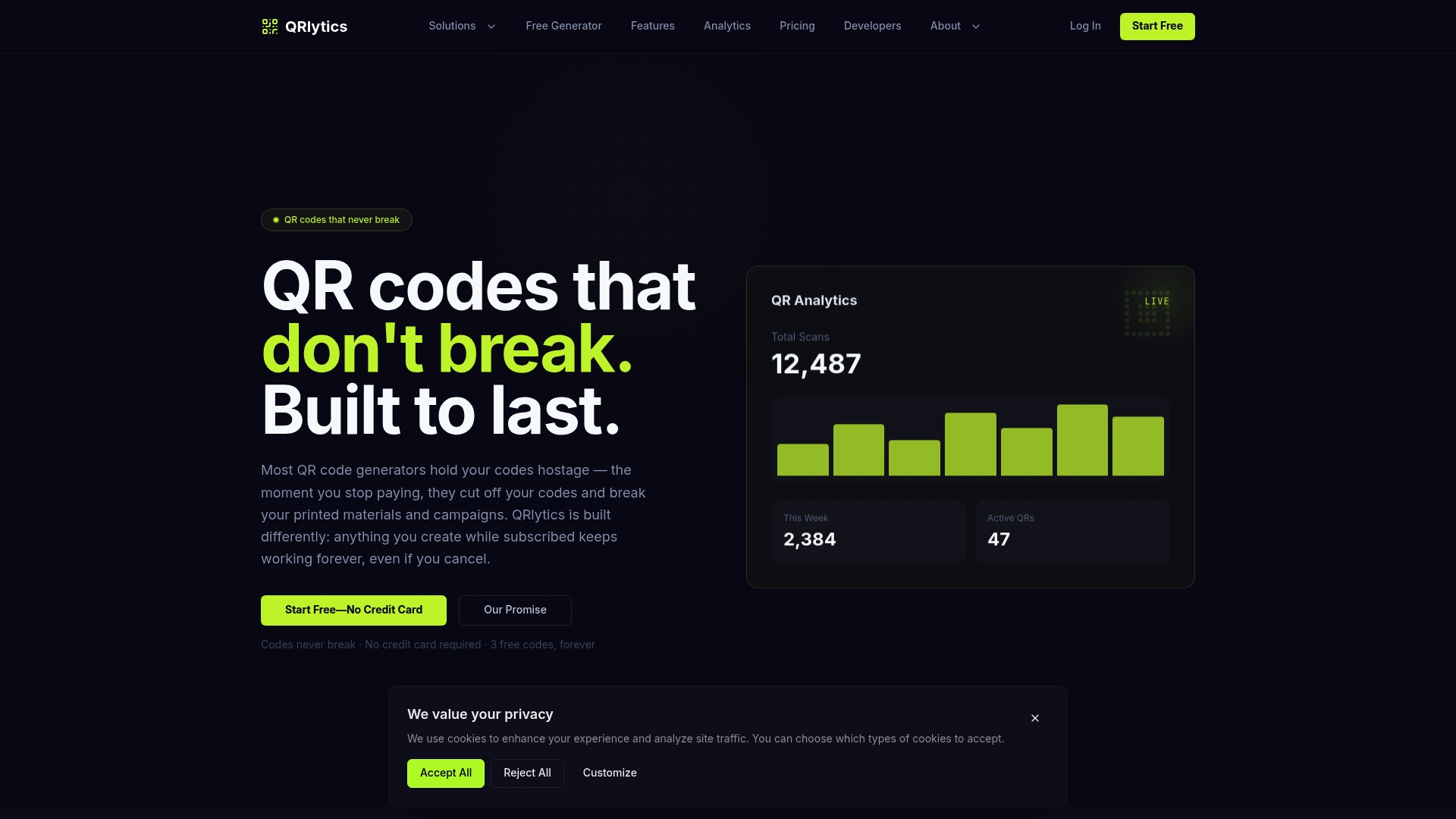
Start with the free QR code generator to pilot your first bag-insert campaign at no cost, or move straight to the dynamic QR code generator for full analytics and redirect management. No credit card required to get started.
Useful sources and further reading
- QR Codes on Packaging: Setup Guide + Cost per Unit | Cubit Packaging — Practical setup guidance covering static vs dynamic codes, placement, and per-unit cost considerations for packaging campaigns.
- What is a QR Code? | Fortinet — Clear technical overview of how QR codes work, storage capacity, and security considerations.
- Ad inserts with QR and AR | Adzze — Explains how bag-insert QR codes bridge print and digital, including AR and video use cases.
- How brands use QR codes to boost engagement | US Chamber of Commerce — Case examples of QR campaigns producing measurable scan volumes and first-party data outcomes.
- QR codes for product authentication | The QR Code Generator — Guidance on scan-to-authenticate flows for brands concerned with counterfeit risk.
- 10 things not to do when using QR codes | The Halo Group — Practical pitfalls list covering placement, connectivity and design errors.
- 8 Benefits of QR codes for businesses | Krofile — Covers landing-page experience as a conversion driver and broader business benefits.
- ICO — UK GDPR guidance — The authoritative source for UK data protection law; consult before collecting any personal data via QR-triggered forms.
FAQ
Do luxury brands actually use QR codes on their packaging?
Yes. Several premium fashion brands embed QR codes in packaging and inserts for authenticity verification and product care content, though the implementation varies by brand and market.
Where should you avoid placing QR codes?
Avoid reflective surfaces, tightly folded areas, and any location with poor mobile connectivity. These are the most common causes of scan failure in retail environments.
Why are retailers moving from barcodes to QR codes?
QR codes store significantly more data than 1D barcodes and can link directly to digital content, promotions and product information, making them far more versatile for post-purchase engagement.
How can a QR code help identify a fake product?
A scan-to-authenticate flow directs the customer to a verification page that confirms the product’s provenance and serial number. Counterfeit items either lack a code or redirect to an unverified page.
What happens to my QR codes if I change platform?
With static codes, the destination is fixed and cannot be updated. With dynamic codes on a platform like Qrlytics, redirects remain active and editable, and codes created during an active subscription stay functional permanently.