Improving upsell rates with QR codes: 8 proven tactics
TL;DR:
- QR codes offer a quick, trackable way to connect physical moments with personalized digital upsell offers. AI-powered product suggestions significantly increase conversion rates by providing tailored recommendations at key customer journey points. Using strategic placement and framing prompts as helpful suggestions rather than sales tactics enhances upsell success and encourages ongoing campaign refinement.
QR codes are the most direct, trackable tool for upselling because they connect a physical moment to a personalised digital offer in under three seconds. The standard industry term for this practice is QR-driven upsell activation, and it works by triggering product recommendations at the exact moment a customer is most receptive. Improving upsell rates with QR codes is not about adding more prompts. It is about placing the right prompt, framed the right way, at the right point in the customer journey. Success is measured by revenue per customer growth, specifically average order value and SKU penetration, not by scan volume alone.
1. How AI-powered recommendations with QR codes lift upsell conversion

AI-driven product suggestions are the single biggest performance lever in QR upsell campaigns. AI recommendations lift conversion by 15–25% over static upsell modules. That gap exists because AI matches suggestions to individual purchase history and context, while static lists show the same products to every customer.
The practical difference shows up in the language. A static module says “You may also like.” An AI-driven pairing says “This goes beautifully with our smoked salmon starter.” The second prompt feels like advice from a knowledgeable waiter, not a generic algorithm. That distinction is why personalised product pairings outperform static suggestions by 15–25% in controlled industry tests.
For marketing professionals, the implementation path is straightforward. Connect your QR code destination URL to a landing page that pulls product recommendations from your CRM or e-commerce engine. The QR code itself does not need to be complex. The intelligence sits in the destination, not the code.
- Side dish suggestions triggered after a main course selection lift upsell rates by 15–20%
- Wine and beverage pairings prompted at the right moment produce lifts of 10–30%
- Premium upgrade prompts (larger size, better material, extended warranty) generate 8–12% uplift
Pro Tip: Use dynamic QR codes so you can update the destination URL when your AI recommendations change seasonally, without reprinting any physical materials. Qrlytics supports dynamic URL updates for exactly this reason.
2. Strategic QR code placement for maximum upsell uptake
Placement determines whether a QR upsell prompt feels helpful or intrusive. The rule is simple: place codes at peak brand affinity moments, not during active decision-making. Packaging inserts and post-purchase emails are two of the highest-performing placements because the customer has already committed to a purchase and their trust in your brand is at its highest point.
The moments to avoid are equally clear. Disruptive prompts during browsing or checkout reduce upsell acceptance. A QR code that appears mid-checkout creates friction at the worst possible moment. Save the upsell for after the primary decision is made.
High-performing placement locations include:
- Packaging inserts placed inside the box, visible when the customer opens their order
- Post-purchase confirmation emails sent within one hour of a completed transaction
- Triggered SMS messages sent 24–48 hours after delivery, when the customer has used the product
- Table cards or receipts in hospitality settings, presented after the main course is served
- Product hang tags on physical retail items, scanned at the point of use rather than point of sale
Each of these placements shares one characteristic. The customer is satisfied, not stressed. That emotional state makes them far more open to an additional recommendation.
3. Framing upsells as recommendations, not sales pressure
The language of your upsell prompt determines its conversion rate more than almost any other variable. Recommendation framing converts 2–3 times better than direct “add for £X” prompts. The reason is psychological. A recommendation feels like service. A price prompt feels like a sales tactic.
Effective recommendation language follows a consistent pattern. It names a specific pairing, explains why it works, and leaves the decision entirely with the customer. “Pairs beautifully with our aged cheddar” outperforms “Add cheese for £2.50” every time. The first sentence creates desire. The second creates resistance.
Framing principles that consistently improve conversion:
- Use “pairs beautifully with” or “customers who ordered this also loved” rather than “add to basket”
- Reference a specific benefit (“keeps your coffee hot for six hours”) rather than a generic feature
- Avoid pop-ups or forced add-ons that interrupt the customer’s natural flow
- Present premium upgrades as an enhancement, not an upsell (“the full experience includes”)
Pro Tip: Test two versions of your upsell landing page copy using Qrlytics dynamic codes. Point one code to version A and another to version B, then compare scan-to-purchase conversion rates in your analytics dashboard.
Framing upsell prompts as helpful recommendations rather than intrusive offers significantly reduces customer resistance. This is not a soft principle. It is a measurable conversion driver.
4. Timing your QR upsell prompts within the customer journey
Timing and placement are related but distinct. Placement is where the code appears physically. Timing is when the customer encounters it relative to their purchase stage. The most effective QR upsell campaigns treat the customer journey as a sequence of receptive moments, not a single transaction.
QR codes should orchestrate continuous customer journeys from first purchase through upsell to loyalty. A customer who buys a coffee machine is not ready for a descaler upsell at checkout. They are ready for it three weeks later, when the machine needs its first clean. A triggered SMS with a QR code at that moment converts at a far higher rate than any checkout prompt.
The practical framework for timing is to map your product’s natural usage cycle and place QR upsell touchpoints at the moments when the customer is most likely to feel a need. For subscription products, that moment is just before renewal. For consumables, it is when the product is running low. For one-time purchases, it is when the customer has had enough time to appreciate the value of what they bought.
5. Tracking QR upsell performance: the metrics that matter
Scan volume is a vanity metric for upsell campaigns. The metrics that prove success are average order value, SKU penetration, and premium tier adoption. Tracking these metrics from QR code traffic requires connecting your scan data to your point-of-sale system or CRM.
The connection works through UTM parameters or unique redirect URLs assigned to each QR code. When a customer scans a code and completes a purchase, the UTM tag tells your analytics platform which code drove that sale. Qrlytics provides scan analytics and campaign tracking that feed directly into this workflow.
| Metric | What it measures | Why it matters |
|---|---|---|
| Average order value | Revenue per transaction from QR-driven sessions | Shows whether upsells are increasing spend per visit |
| SKU penetration | Percentage of customers buying more than one product category | Indicates breadth of upsell success across the range |
| Premium tier adoption | Rate of upgrade from standard to premium option | Measures effectiveness of upgrade-framed prompts |
| Scan-to-purchase rate | Percentage of scans that result in an additional purchase | Core conversion metric for QR upsell campaigns |
Continuous measurement enables continuous improvement. Run a monthly review of these four metrics, identify the lowest-performing placement or message, and test one change at a time. That discipline compounds over time into a measurably higher upsell rate.
6. Choosing the right QR upsell strategy for your context
Different upsell methods suit different products, channels, and customer relationships. The table below maps the most common QR upsell strategies to their strengths and optimal scenarios.
| Strategy | Typical conversion lift | Best used when |
|---|---|---|
| Paired suggestions (“goes well with”) | 2–3x vs. direct prompts | Customer has just selected a primary product |
| Premium upgrades (“the full version includes”) | 8–12% uplift | Customer is satisfied with a standard product and open to enhancement |
| Frequently ordered together | 15–20% uplift on complementary items | Customer has a clear primary purchase and a natural accessory exists |
| Complementary product prompts (dessert, add-on service) | 10–30% depending on category | Post-purchase or post-consumption moment, high brand affinity |
| Loyalty-linked upsells (“your next order qualifies for”) | Varies; strongest for repeat customers | Customer is already in a loyalty programme and motivated by reward |
The paired suggestion strategy is the most broadly applicable. It works in hospitality, retail, e-commerce, and professional services. The premium upgrade strategy requires a clear product hierarchy. The loyalty-linked approach requires an existing programme but delivers the strongest long-term results because it ties upselling to customer lifetime value rather than a single transaction.
For most marketing professionals starting out, paired suggestions with recommendation framing is the lowest-risk, highest-return entry point. Build from there once you have baseline data.
7. Keeping QR codes functional across long-running campaigns
A QR upsell campaign printed on packaging, table cards, or product inserts can run for months. If the code breaks or the destination URL becomes inactive, every customer who scans it hits a dead end. That failure is invisible to you but immediately visible to the customer.
Dynamic QR codes solve this problem. They separate the printed code from the destination URL, so you can update the landing page, the offer, or the product recommendation without reprinting anything. Qrlytics guarantees that codes created during an active subscription remain functional permanently, regardless of billing status. That reliability matters for campaigns embedded in physical materials with long shelf lives.
The practical implication for upsell campaigns is that you can launch a campaign on packaging printed in january and update the offer in june without any physical change to the product. The code stays the same. The destination evolves with your strategy.
8. Building a feedback loop between QR scans and campaign refinement
QR codes should be part of a continuous feedback loop linking scan behaviour to actual sales data. Most marketers treat a QR upsell campaign as a one-off touchpoint. The ones who see compounding results treat it as a system that gets smarter with every scan.
The feedback loop has four steps. First, deploy the campaign with UTM-tagged QR codes. Second, collect scan and purchase data over a defined period, typically four to six weeks. Third, identify which placements, messages, and product pairings drove the highest scan-to-purchase rate. Fourth, update the lowest-performing elements and redeploy. Qrlytics campaign tracking tools make steps two and three straightforward by surfacing scan volume, location data, and device type in a single dashboard.
The marketers who treat this loop as a monthly discipline consistently outperform those who set campaigns live and leave them unchanged. The data is available. The question is whether you act on it.
Key takeaways
QR-driven upsell activation works best when AI-powered recommendations, precise placement, and recommendation framing combine to increase average order value without raising acquisition costs.
| Point | Details |
|---|---|
| AI recommendations outperform static lists | AI-driven suggestions lift conversion by 15–25% over generic “you may also like” modules. |
| Placement at affinity moments is critical | Post-purchase emails, packaging inserts, and triggered SMS outperform checkout prompts consistently. |
| Framing drives conversion more than discounting | Recommendation language converts 2–3 times better than direct price-based add-on prompts. |
| Track AOV and SKU penetration, not scan volume | Scan counts are a vanity metric; revenue per customer is the measure that proves upsell ROI. |
| Dynamic codes protect long-running campaigns | Updateable destination URLs mean your upsell offer can evolve without reprinting physical materials. |
The honest truth about QR upselling that most guides skip
Most articles on QR code upselling focus on the technology. The real challenge is restraint. Every marketing professional I have worked with has been tempted to add more prompts, more products, more touchpoints. The data consistently shows the opposite approach works better.
The campaigns that perform are the ones that treat the customer as someone who deserves a genuinely useful suggestion, not someone to be nudged toward a higher basket value. Those two orientations produce different copy, different placement decisions, and different results. The first produces a prompt that feels like service. The second produces one that feels like a pop-up ad.
The other thing most guides miss is the compounding effect of the feedback loop. A QR upsell campaign that is reviewed and refined monthly does not improve linearly. It improves exponentially, because each refinement builds on the last. The marketers who commit to that discipline for six months end up with campaigns that are almost unrecognisable from their starting point, and their upsell rates reflect it.
The uncomfortable truth is that most businesses deploy a QR upsell campaign once and never revisit it. If you do nothing else from this article, build the monthly review into your calendar. That single habit separates the campaigns that plateau from the ones that keep improving.
— The
Qrlytics makes QR upsell campaigns measurable from day one
Running a QR upsell campaign without reliable analytics is like running a paid search campaign without conversion tracking. You are spending effort with no way to know what is working.
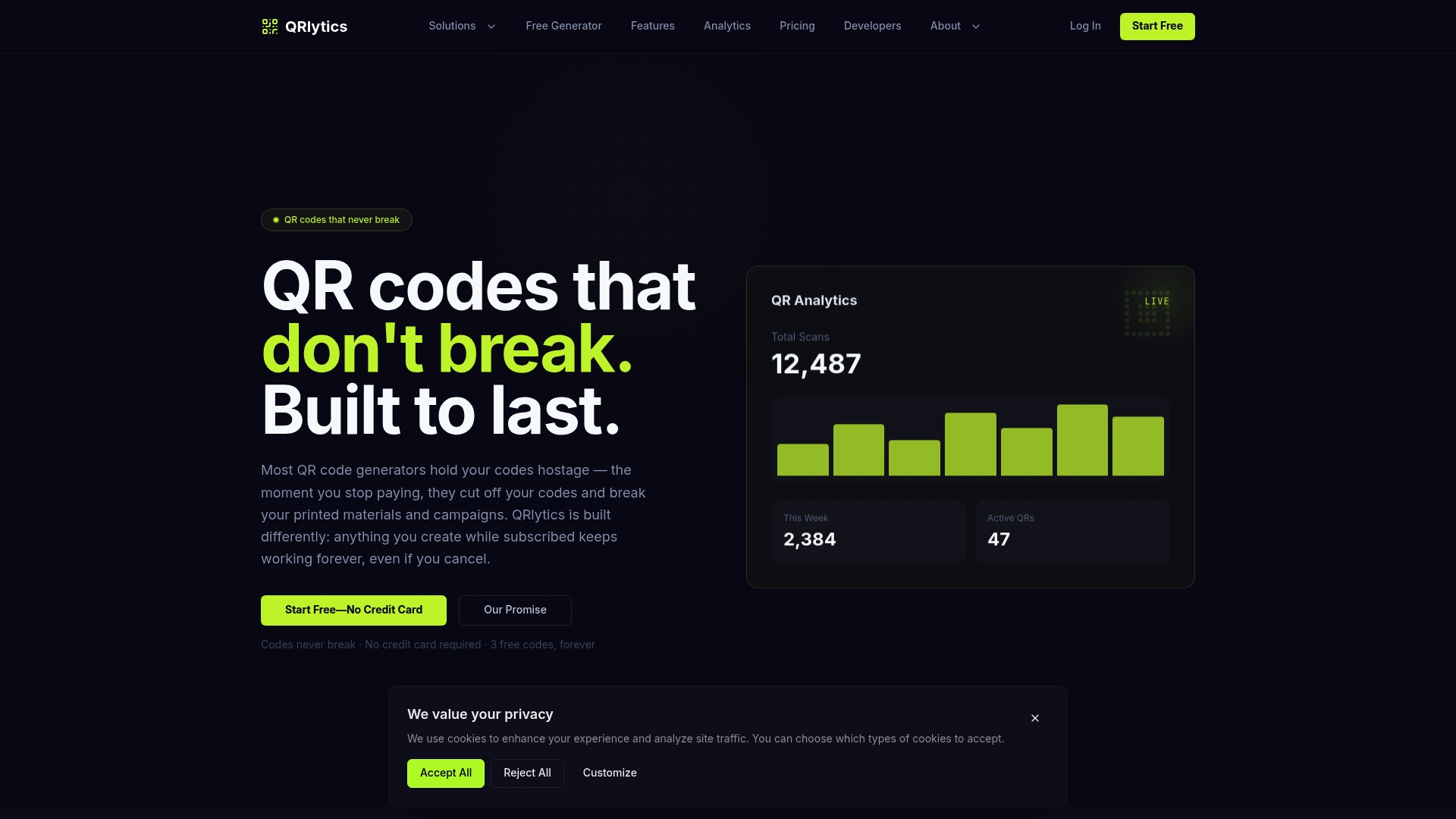
Qrlytics gives you dynamic, trackable QR codes with real-time scan analytics, GDPR-compliant data collection, and the ability to update destination URLs without reprinting. Every code you create during an active subscription stays functional permanently, so your packaging and printed materials never become a liability. You can create your first QR code instantly, with no credit card required. For campaigns that need full tracking and dynamic updates, the dynamic QR code generator gives you complete control over every scan, every redirect, and every data point your upsell strategy depends on.
FAQ
What is the most effective QR code upsell strategy?
Paired product suggestions framed as recommendations convert 2–3 times better than direct price-based prompts. Place the QR code at a post-purchase moment for the highest receptivity.
How do I measure QR code upsell success?
Track average order value, SKU penetration, and scan-to-purchase rate by connecting your QR code UTM data to your POS or CRM system. Scan volume alone does not indicate upsell performance.
Do AI-driven recommendations really improve QR upsell rates?
Yes. Industry testing shows AI-driven product pairings lift conversion by 15–25% over static “you may also like” modules, because they match suggestions to individual purchase context rather than showing generic lists.
When should I avoid placing a QR upsell prompt?
Avoid placing upsell prompts during active browsing or at the checkout stage. Disruptive prompts at those moments reduce acceptance rates and create a negative customer experience.
Can I update a QR upsell offer after it has been printed?
Yes, with dynamic QR codes. The printed code stays the same while you update the destination URL to reflect new offers, seasonal recommendations, or revised product pairings without reprinting any materials.