Why QR codes for allergen information matter in the UK
QR codes give food businesses a way to deliver instant, updateable, product-specific allergen data at the exact moment a customer needs it — reducing the risk of reactions, increasing transparency, and accelerating recalls. GS1 UK has found that ambiguous on-pack wording leaves many consumers uncertain about what they are eating, and over half of UK allergy sufferers have experienced a reaction from mislabelled or unclear food packaging. QR codes powered by the GS1 Digital Link standard, endorsed by organisations including Anaphylaxis UK, sit alongside Natasha’s Law obligations — they complement on-pack labelling rather than replace it. Qrlytics provides the managed QR infrastructure that makes this practical for UK food businesses of every size.
Key takeaways
QR codes for allergen information reduce reaction risk, increase transparency, and speed recalls — but only when backed by a managed platform with permanent links, version control, and a physical backup for customers without smartphones.
| Point | Details |
|---|---|
| Legal position | QR codes complement Natasha’s Law; on-pack allergen declarations remain mandatory. |
| Over half affected | GS1 UK research shows over half of UK allergy sufferers have had a reaction from unclear packaging. |
| Dynamic over static | Dynamic QR codes with GS1 Digital Link encoding support batch-level traceability and targeted recalls. |
| Minimum print standard | GS1 recommends a minimum code size of 16mm × 16mm with end-of-line verification for every printed code. |
| Qrlytics for permanence | Qrlytics provides permanent redirects, dynamic updates, and GDPR-aware analytics for compliant allergen QR pages. |
Table of Contents
- Why QR codes improve allergen safety and consumer confidence
- How do QR codes for allergen information actually work?
- How do QR codes fit UK food law and Natasha’s Law?
- Step-by-step: how to implement QR allergen codes in your business
- What does the evidence say about QR allergen pages?
- What are the risks of using QR codes for allergen data?
- What should you include behind the QR scan?
- Why professional QR management matters for food businesses
- The case for acting now, not waiting
- Qrlytics makes permanent, compliant QR allergen pages straightforward
- Sources
- FAQ
Why QR codes improve allergen safety and consumer confidence
The primary benefit is speed. A customer with a nut allergy can scan a code at the shelf or table and see a full ingredient breakdown, cross-contact controls, and batch-specific notes before they order or buy. That level of detail simply cannot fit on a label.
- Instant access at point of decision. Scanning takes seconds and delivers information that would otherwise require a staff member to retrieve a folder or check a system.
- More detail than on-pack PAL statements. Vague “may contain” warnings leave consumers guessing. A QR-linked page can explain why a precautionary allergen label (PAL) exists — for example, whether it reflects shared equipment or a shared factory — so consumers can make a more informed choice.
- Updatable content. When a recipe changes or a supplier switches an ingredient, the QR destination updates immediately. Printed labels stay static until the next print run.
- Faster recalls. Food Safety News reports that QR codes speed recall communication by making batch- and item-specific information available instantly, with multilingual reach.
- Higher consumer confidence. An academic study on QR use on food products found that consumers who scanned product QR pages reported higher comprehension and purchase confidence compared with static labels.
For restaurants, the same logic applies to digital menus. A QR menu that links to a live allergen matrix means front-of-house staff are always pointing customers to current information, not a printed sheet from last season. For packaged goods, the QR page can carry recall-ready batch data that a barcode alone cannot surface.
How do QR codes for allergen information actually work?
There are two code types, and the difference matters operationally.
Static QR codes encode a fixed URL. Once printed, the destination cannot change. They suit one-off use cases where the allergen data will never need updating, but they are a poor fit for food products with variable batch or expiry data.
Dynamic QR codes encode a short redirect URL. The destination behind that redirect can be updated at any time without reprinting the code. This is the right choice for packaged food, menus, and any product where ingredients or suppliers change.
The GS1 Digital Link standard takes dynamic codes further by encoding the product’s GTIN (Global Trade Item Number), batch/lot number, and expiry date directly into the QR structure. A single scan can therefore resolve to a product-specific, batch-specific landing page — giving consumers and recall teams precise traceability.
The typical data flow runs: ERP or recipe database → QR management platform → printed code on pack or menu → consumer’s phone → live allergen landing page. GS1 guidance for fresh-food suppliers recommends tying QR generation directly to product master data and implementing 100% end-of-line verification.
How do QR codes fit UK food law and Natasha’s Law?
Natasha’s Law (the Food Information (Amendment) (England) Regulations 2021) requires full ingredient and allergen labelling on food prepacked for direct sale (PPDS). The Food Information Regulations 2014 cover pre-packed and loose foods sold in food businesses. Neither regulation prohibits QR codes, but neither allows them to substitute for the required on-pack declaration.
The legal position is clear: QR codes are a permitted supplementary tool, not a replacement for statutory labelling.
- On-pack allergen declarations remain mandatory for PPDS products.
- A QR code can carry additional detail — batch notes, cross-contact context, multilingual versions — but the 14 major allergens must still appear in the physical label’s ingredients list in bold or contrasting type.
- For loose food and restaurant menus, allergen information must be available at the point of choice. A QR-linked menu satisfies this if the linked content is accurate and accessible at that moment.
KitchenNmbrs guidance is explicit: operators remain legally responsible for accuracy and must offer an alternative for guests without smartphones. Staff knowledge is not optional — a customer who cannot scan must still receive accurate allergen information verbally or in print.
Lancashire County Council’s prosecution of food businesses for failing to protect allergy sufferers illustrates what is at stake when allergen information is inaccurate or inaccessible.
Step-by-step: how to implement QR allergen codes in your business
Follow this workflow to move from intention to a live, verified system.
- Establish your source data. Centralise all recipe and ingredient data in one system — an ERP, recipe management tool, or structured spreadsheet. Every QR destination pulls from this single source of truth.
- Choose your QR type. Use dynamic QR codes for any product or menu item that may change. Use GS1 Digital Link if you need batch/expiry traceability or retail interoperability.
- Generate codes via a managed platform. Tie code generation to your product master data so a new batch automatically updates the destination. A guide to generating QR codes effectively covers the workflow in detail.
- Print inline and meet minimum technical standards. GS1 recommends a minimum size of 16mm × 16mm, sufficient colour contrast (dark module on light background), and error-correction level H for food environments where codes may be partially obscured.
- Verify at end of line. Scan every printed code before the product leaves the facility. Confirm the destination loads, the allergen data is current, and the page is mobile-ready.
- Set an update and audit protocol. Define who is responsible for updating the destination when a recipe or supplier changes, set a maximum response time (e.g. within 24 hours of a change), and log every update with a timestamp.
Pro Tip: Tie your QR generation process directly to your ingredient change approval workflow. If a supplier substitution requires sign-off, that same sign-off should trigger a QR destination review — so the two processes cannot fall out of sync.
What does the evidence say about QR allergen pages?
GS1 UK’s research paints a clear picture of the problem QR codes address. Over half of UK allergy sufferers have had a reaction from mislabelled or unclear packaging — a figure that reflects both the scale of the issue and the inadequacy of current static labelling for many consumers.
Sarah Knight of The Allergy Team has argued that QR codes can replace vague PAL statements by linking to production-line detail, giving consumers the precision they need to make safe decisions. GS1 UK pilots with fresh-food suppliers have demonstrated that dynamic QR codes encoding batch and expiry data enable targeted recalls — pulling only the affected batch rather than an entire product line.
| Evidence source | Key finding |
|---|---|
| GS1 UK press release | Over half of UK allergy sufferers report a reaction from unclear or mislabelled packaging |
| Academic study (ResearchGate) | Consumers scanning QR pages reported higher comprehension and confidence than those reading static labels |
| Food Safety News | QR codes speed recall communication with batch-specific, multilingual updates |
| GS1 UK pilot data | Dynamic codes with batch/expiry encoding enable targeted, item-level recalls |
What are the risks of using QR codes for allergen data?
QR codes introduce operational risks that businesses must plan for before going live.
- Digital divide. Not every customer owns a smartphone or has mobile data. You must provide an alternative — a printed allergen sheet, a verbal briefing from trained staff, or a tablet at the counter.
- Broken or stale links. A QR code that resolves to a 404 page or outdated allergen data is worse than no QR code at all. Monitor destinations continuously and set a service-level target for fixing broken links.
- QR spoofing. Malwarebytes notes that malicious codes can redirect users to spoofed sites. Use a reputable managed platform, display your domain clearly on the landing page, and brief staff to report any suspicious code replacements.
- Over-reliance. Staff who assume the QR page covers everything may skip verbal allergen checks. Training must reinforce that the QR is a supplement, not a substitute for human knowledge.
- GDPR and analytics. Scan analytics can reveal consumer behaviour patterns. Any tracking must be transparent, proportionate, and GDPR-compliant. A QR data privacy guide covers how to run privacy-safe analytics without collecting unnecessary personal data.
What should you include behind the QR scan?
A trustworthy allergen QR page contains more than a list of ingredients. Build your landing page around these fields:
- Product identifier: GTIN or dish code, so the page is unambiguously tied to one SKU or menu item.
- Full allergen declaration: all 14 major allergens, clearly flagged as “contains” or “may contain”, with context for any PAL statement.
- Batch/lot number and best-before or use-by date (for packaged goods).
- Supplier and manufacturing site details, including any shared-line or shared-facility notes.
- Cross-contact controls: what steps are taken to prevent unintended allergen transfer.
- Last updated timestamp and version number, so consumers and auditors can confirm currency.
- Contact details for allergen queries.
- Alternative access note: a short line directing customers without smartphones to ask a member of staff or request a printed copy.
For accessibility, follow web accessibility best practices — use clear icons alongside text, ensure sufficient contrast, and test the page on multiple devices and screen sizes.
Why professional QR management matters for food businesses
A free QR generator can produce a code in seconds, but it cannot guarantee that code will still resolve in two years when the product is still on shelf. For allergen information, a broken link is a safety failure.
Professional QR management platforms offer capabilities that matter specifically in food contexts:
- Permanent redirects: codes remain active regardless of subscription changes, so printed packaging is never stranded.
- Dynamic destination updates: change the allergen page URL or content without reprinting a single label.
- API integration: connect directly to your ERP or recipe database so allergen data updates propagate automatically.
- Scan analytics and heat maps: understand where and when customers are scanning, which supports audit readiness and helps identify high-risk touchpoints.
- Role-based access control: limit who can update destination URLs, creating an internal audit trail.
For a deeper look at how QR codes work in customer-facing environments, including placement at counters, tables, and shelf-edge labels, the principles translate directly to allergen use cases.
The case for acting now, not waiting
The combination of Natasha’s Law, rising allergy prevalence, and the GS1 Digital Link rollout means the window for early adoption is open. Businesses that implement QR allergen pages now build operational muscle — version control, update workflows, staff training — before regulators or retailers make it a requirement. The safety argument is already compelling on its own: over half of UK allergy sufferers have experienced a reaction linked to unclear labelling. Adding a QR layer that delivers precise, updatable, batch-specific information is one of the most direct steps a food business can take to reduce that risk. Keep physical backups in place, train your team, and pilot with one product line or one menu section before scaling.
Qrlytics makes permanent, compliant QR allergen pages straightforward
The single biggest operational risk with QR allergen codes is a link that stops working after a subscription lapses or a platform changes. Qrlytics eliminates that risk: codes created during an active subscription remain functional permanently, so your printed packaging never becomes a liability.
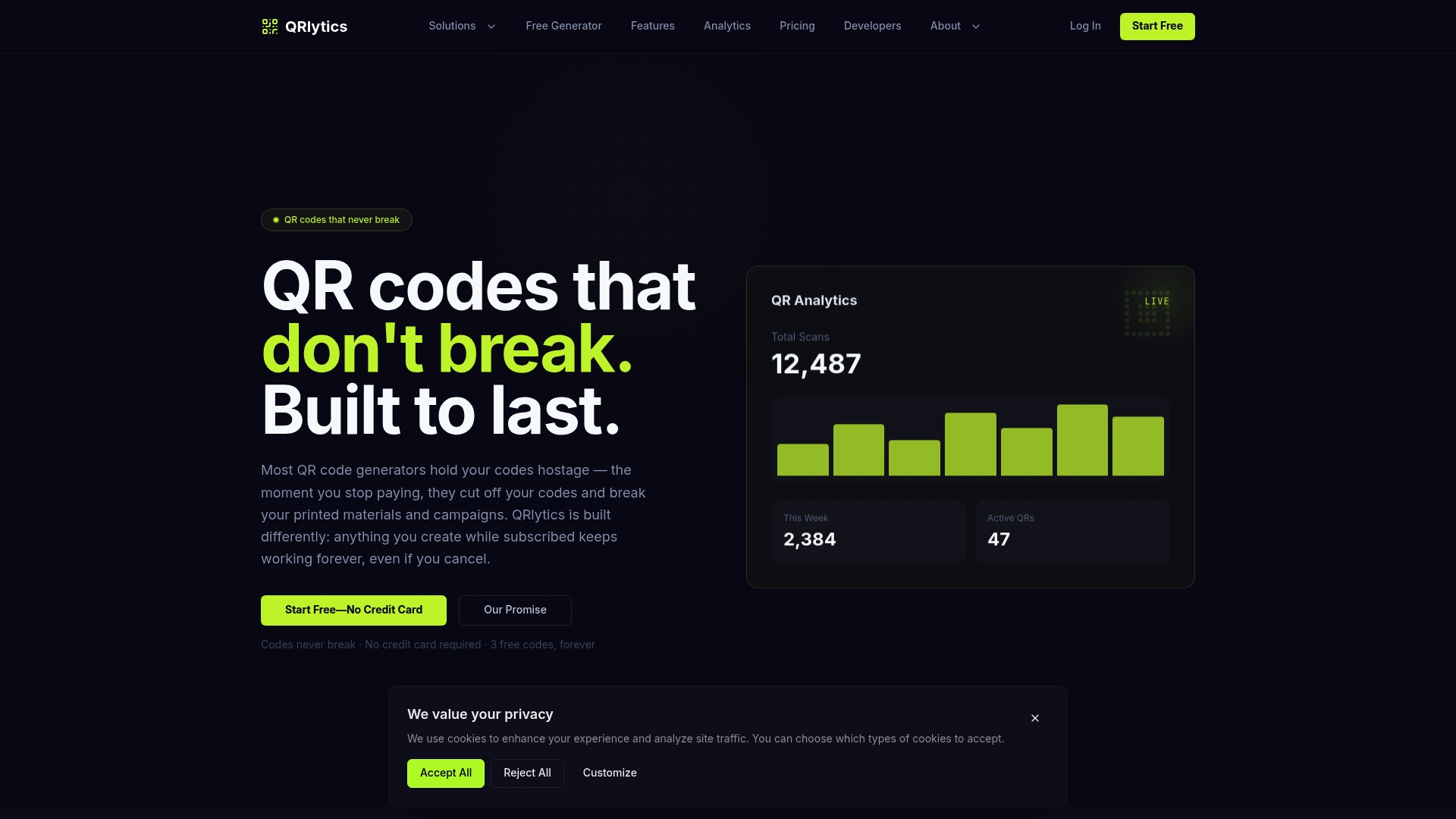
Beyond permanence, Qrlytics gives food businesses dynamic QR codes that update destinations instantly when recipes or suppliers change, a full API for ERP and recipe-database integration, GDPR-aware scan analytics, and an audit trail of every destination change with timestamps. These are precisely the features the implementation workflow above requires. No credit card is needed to start — generate your first allergen QR code free and test the full workflow before committing to a plan.
Sources
- QR codes powered by GS1: keeping allergen sufferers informed and protected
- QR codes are an important food safety tool
- Communicate allergen information via… | KitchenNmbrs
FAQ
What is a common mistake when providing allergen information via QR code?
The most common mistake is failing to update the QR destination when a recipe or supplier changes, leaving customers scanning a page with outdated allergen data. A version-control protocol and audit trail prevent this.
Should you be cautious about scanning QR codes in food settings?
Consumers should scan codes from trusted, clearly branded sources and check that the URL displayed matches the business’s known domain. Operators should use a reputable managed platform and display their domain prominently on every allergen landing page to reduce spoofing risk.
Do QR codes replace on-pack allergen labelling under Natasha’s Law?
No. Natasha’s Law requires full allergen and ingredient labelling on the physical pack for PPDS products. QR codes are a compliant supplement that can carry additional detail, but they do not discharge the statutory on-pack obligation.
Why are QR codes particularly valuable for allergen information?
QR codes deliver more detail than a printed label can hold, update instantly when ingredients change, and support batch-level traceability for targeted recalls — all of which reduce the risk of a consumer encountering inaccurate allergen information at the point of purchase.