Supercode.com alternatives for UK marketers: shortlist 2026

For most UK marketers, Qrlytics is the strongest alternative to Supercode. It combines permanent code functionality, dynamic URL updates, and GDPR-ready analytics in a single platform that requires no credit card to start. If your primary need is something more specific, QRTiger and Scanova are credible secondary options worth trialling.
Quick shortlist:
- Qrlytics — best for UK teams needing persistent codes, real-time analytics, and GDPR compliance
- QRTiger — best for marketers who want extensive design templates and a broad range of QR types
- Scanova — best for campaign-level management with analytics dashboards
- QRCode Monkey — best for one-off print jobs requiring free SVG/vector downloads
- Feedback Guardian — best when your primary goal is collecting survey responses via QR codes
Supercode is a London-based QR marketing platform founded in 2019 that sits among a crowded field of active competitors. Users typically look for alternatives when they need stronger permanence guarantees, more granular analytics, or better GDPR controls than their current tool provides.
Key takeaways
The most important decision when choosing a Supercode alternative is whether the platform guarantees code persistence after a subscription lapses, because broken codes on printed materials carry costs that far exceed any subscription fee.
| Point | Details |
|---|---|
| Permanence is the critical differentiator | Confirm the vendor’s policy on redirect behaviour after subscription cancellation before signing. |
| GDPR compliance requires more than scan counts | Demand IP hashing, a data-processing agreement, and CSV export with no personally identifiable fields. |
| Vector export matters for print campaigns | Test SVG or EPS download during your free trial and send the file to your print supplier before committing. |
| API and bulk generation are non-negotiable at scale | Verify rate limits, authentication method, and uptime SLA for any campaign generating large code volumes. |
| Qrlytics leads for UK teams | Permanent-code policy, GDPR-ready analytics, dynamic redirects, and a free tier with no credit card required. |
Table of Contents
- What are the top Supercode.com alternatives worth considering?
- How do the main alternatives compare on features that matter?
- How do you choose the right QR-code platform for your UK business?
- What does QR-code platform pricing look like in the UK?
- Why permanence and GDPR compliance are the two checks you cannot skip
- Which alternative should you pick, and what are the next steps?
- UK marketers are increasingly prioritising permanence, GDPR data residency, and API reliability over feature count in 2026.
- Qrlytics: persistent codes, GDPR analytics, and a free start
- Sources
- FAQ
What are the top Supercode.com alternatives worth considering?
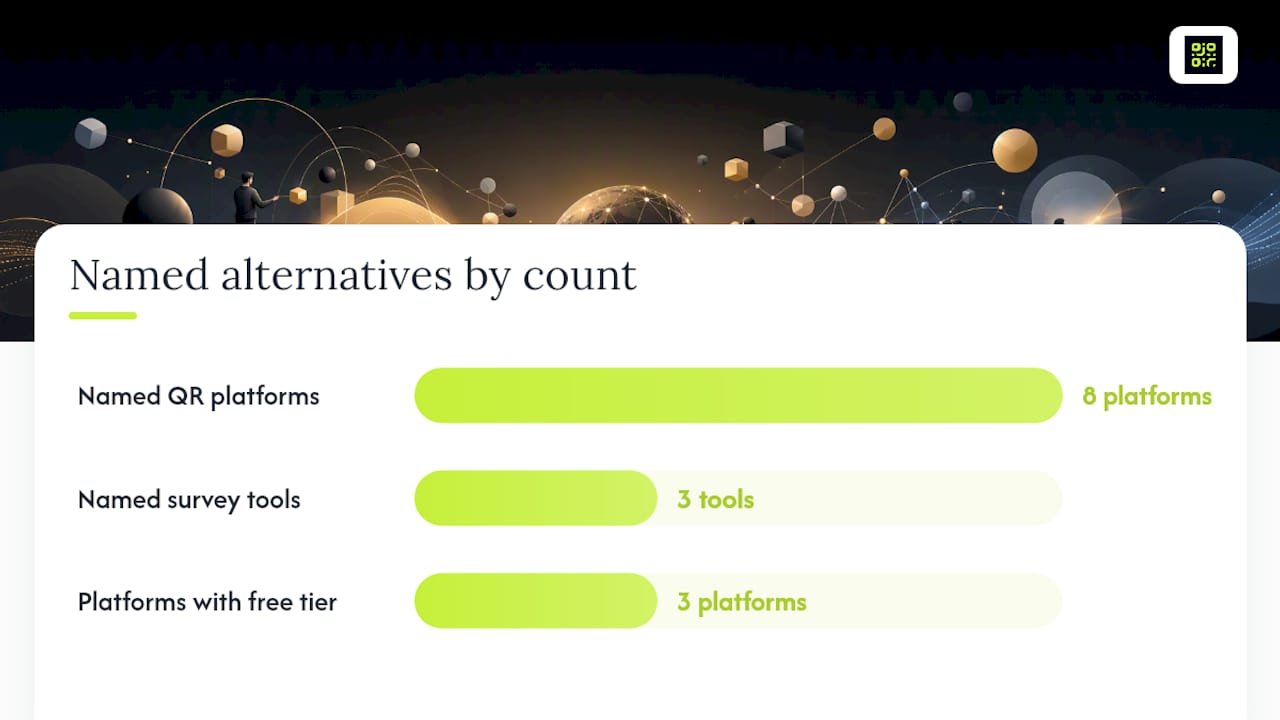
The platforms below cover the full range of use-cases you are likely to evaluate: core QR management, feedback collection, and marketing automation. A few entries here are survey or feedback tools that appear on G2’s alternatives list as valid substitutes depending on your primary need. They are not like-for-like QR management platforms, so the section notes that distinction clearly.
- Qrlytics — full QR management platform with permanent-code policy, dynamic redirects, GDPR-compliant analytics, global scan heatmaps, and API access. Free tier available, no credit card required.
- QRTiger — feature-rich generator with extensive design templates, multiple QR types, and marketing-focused tracking. Free tier with limited scans.
- Scanova — campaign management alongside code generation; analytics dashboards make it useful for teams running multiple concurrent campaigns. Comparison pages consistently list it as a recommended alternative.
- QR.io — strong customisation and straightforward analytics; suits businesses that prioritise branded code aesthetics.
- QR-Code-Generator (Egoditor) — well-established all-rounder for both static and dynamic codes with a broad feature set. Frequently compared against Supercode on dynamic updates, SVG export, and analytics reporting.
- QRCode Monkey — free-first generator with high-resolution SVG and PDF downloads; ideal for print-only, one-off projects.
- QRCode.AI — dynamic codes with AI-driven content features and analytics integration; suited to marketers experimenting with personalised dynamic content.
- Uniqode — modern platform with distinctive code styling and an emerging feature set for brands wanting more visual differentiation.
- QRStuff — straightforward generator covering a wide range of QR content types; useful for teams with simple, recurring generation needs.
- E-goi — marketing automation platform that includes QR code functionality alongside email, SMS, and push channels.
- Quikkly — action-code platform focused on linking physical media to digital experiences.
- PENG — QR and NFC campaign platform targeting retail and out-of-home marketing.
- Wedidit Solutions — agency-side QR and digital campaign services.
- Thinaire Transmedia Network — enterprise-focused connected-packaging and QR platform.
- Terasystems — QR and barcode management with a focus on operational and logistics use-cases.
- Nowverifyit — identity verification platform that uses QR codes as part of its authentication workflow; not a general QR generator.
- Feedback Guardian — purpose-built for customer feedback via QR codes; survey-first workflow with QR distribution built in.
- SurveySparrow — rich survey platform that integrates QR distribution; best when feedback collection is the primary goal rather than code management.
- Zonka Feedback — NPS and in-location feedback platform; well suited to retail and hospitality teams running in-store survey campaigns.
- SurveyStance — tablet and kiosk-based feedback collection; QR codes are one distribution channel among several.
- Google Trends — not a QR generator; useful for validating campaign topics and timing before you commit to a QR-driven distribution strategy.
- Egoditor — the company behind QR-Code-Generator; listed separately on some market trackers but refers to the same product.
Pro Tip: If your shortlist includes Feedback Guardian, SurveySparrow, or Zonka Feedback, confirm whether your primary need is QR code management or survey distribution. These survey tools outperform general QR platforms on response collection, but do not provide dynamic redirect, permanence guarantee, or print-quality vector export that QR management platforms offer.
How do the main alternatives compare on features that matter?
Vector export support (SVG/EPS) is one of the most frequently cited differentiators for print-quality codes, alongside dynamic URL updates and analytics depth. The table below covers the dimensions UK marketers most commonly evaluate.
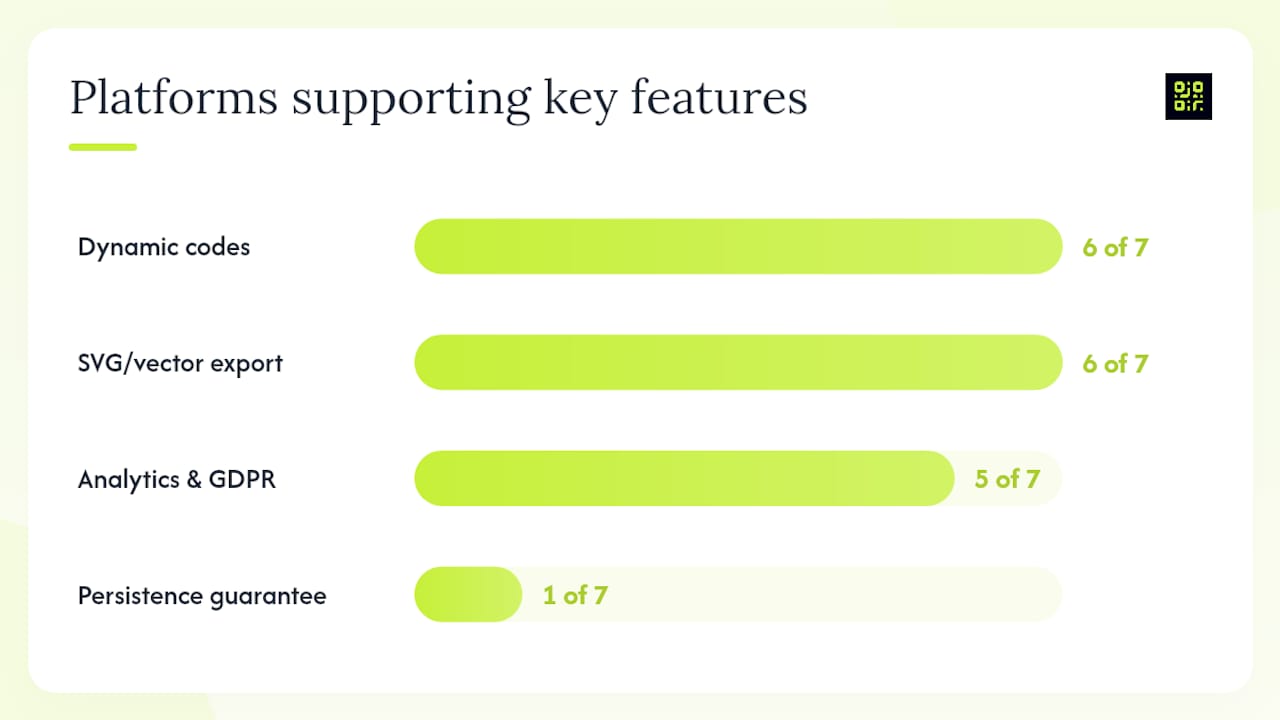
| Platform | Best for | Free tier | Dynamic codes | Persistence if subscription lapses | Analytics & GDPR | SVG/vector export | API / bulk | Ease of use |
|---|---|---|---|---|---|---|---|---|
| Qrlytics | UK teams needing permanent codes + GDPR analytics | Yes, no credit card | Yes | Codes remain active permanently | Real-time, GDPR-compliant, heatmaps, CSV export | Yes | Yes, API access | Simple onboarding |
| QRTiger | Design-led marketing campaigns | Yes, limited scans | Yes | Not publicly guaranteed | Yes, marketing analytics | Yes | Yes | Moderate |
| Scanova | Campaign management + dashboards | Yes, limited | Yes | Not publicly guaranteed | Yes, analytics dashboards | Yes | Yes | Moderate |
| QR.io | Branded code aesthetics | Yes, limited | Yes | Not publicly guaranteed | Basic analytics | Yes | Limited | Simple |
| QR-Code-Generator (Egoditor) | Static + dynamic all-rounder | Yes | Yes | Not publicly guaranteed | Yes | Yes | Yes | Simple |
| QRCode Monkey | Free print-ready vector export | Yes, generous | Static only | N/A (static) | No analytics | Yes (SVG/PDF) | No | Very simple |
| QRCode.AI | AI-driven dynamic content | Yes, limited | Yes | Not publicly guaranteed | Yes, with AI features | Yes | Limited | Simple |
| Uniqode | Distinctive code styling | Yes, limited | Yes | Not publicly guaranteed | Yes | Yes | Yes | Moderate |
| QRStuff | Simple recurring generation | Yes, limited | Yes (paid) | Not publicly guaranteed | Basic | Limited | No | Very simple |
| Feedback Guardian | Survey collection via QR | Yes | Limited | Not applicable | Survey analytics | No | No | Simple |
| SurveySparrow | Feedback at scale | Yes, limited | Limited | Not applicable | Survey analytics | No | Limited | Moderate |
| Zonka Feedback | In-location NPS surveys | Yes, limited | Limited | Not applicable | NPS analytics | No | Limited | Moderate |
A note on feedback and survey tools: Feedback Guardian, SurveySparrow, and Zonka Feedback are legitimate alternatives when your primary goal is collecting responses and NPS feedback. For campaigns needing dynamic redirects, permanence, or print-quality vector assets, a full QR management platform such as Qrlytics or QRTiger is required.
The real cost of a broken code: Industry analysis consistently identifies link persistence as the most critical differentiator in QR platform selection. When a code on a printed brochure, product label, or outdoor poster stops redirecting, the cost is not just a lost scan. It is the full reprint and redistribution cost of every physical item carrying that code. For campaigns with significant print runs, that cost far exceeds the annual subscription fee of a reliable management platform.
By category:
- QR management platforms (Qrlytics, QRTiger, Scanova, QR.io, Uniqode): strong on dynamic codes and analytics; vary significantly on permanence guarantees and GDPR depth.
- Free/lightweight generators (QRCode Monkey, QRStuff): excellent for one-off static print jobs; not suited to ongoing campaign management or analytics.
- Feedback-specialist tools (Feedback Guardian, SurveySparrow, Zonka Feedback): purpose-built for survey workflows; limited on core QR management features.
- Marketing automation platforms (E-goi, PENG, Quikkly): QR is one channel among many; useful if you need multi-channel orchestration rather than dedicated QR management.
How do you choose the right QR-code platform for your UK business?
A structured decision process saves you from trialling five platforms when two would have been enough. Work through these steps before you sign up for anything.
- Define your primary use-case. Are you managing ongoing campaigns with printed collateral, collecting customer feedback, or generating one-off codes for a single event? The answer eliminates entire categories immediately.
- Check permanence policies. Ask the vendor directly: what happens to redirect links if your subscription lapses or a payment fails? A platform that cannot answer this clearly is a risk for any printed material. Qrlytics publishes a clear permanent-code policy; not all competitors do.
- Evaluate analytics and GDPR controls. UK businesses operating under UK GDPR need scan data that is pseudonymised or anonymised, with clear data-minimisation options and the ability to export or delete records. GDPR-compliant analytics should include IP hashing, no storage of personally identifiable information without consent, and a data-processing agreement from the vendor.
- Test vector exports and design options. Download an SVG or EPS file during your trial. If the platform cannot produce a clean vector file, your print supplier will tell you the same thing after you have already committed.
- Verify API access, bulk generation, and SLA. For campaigns generating hundreds or thousands of codes across locations, check rate limits, authentication method, and the vendor’s uptime commitment. An undocumented SLA is a red flag for enterprise use.
Vendor questions worth asking in procurement:
- What is your documented policy if a customer’s subscription lapses? Do redirects remain active?
- Where is scan data stored, and is it processed under UK GDPR or EU GDPR?
- What is your uptime SLA for redirect performance?
- Can we export analytics as a CSV, and does that export include any personally identifiable fields?
- Do you provide a data-processing agreement (DPA)?
Red flags that should remove a provider from your shortlist:
- No published permanence or code-lifetime policy
- Analytics that store raw IP addresses without hashing or pseudonymisation
- No SVG or EPS export option
- No DPA available on request
- API documentation that is incomplete or behind a sales call
For a practical walkthrough of how to generate and manage QR codes as part of a campaign, Qrlytics’s marketing guide covers the full process from code creation to analytics review.
What does QR-code platform pricing look like in the UK?
Most platforms follow a freemium model: a free tier with limited codes or scans, then monthly or annual paid plans. Annual billing typically offers a meaningful discount over monthly. Enterprise pricing is almost always negotiated separately.
Common pricing shapes:
- Free tiers usually cap at 1–5 active dynamic codes, limited scan counts per month, and no API access. Static codes are often unlimited on free tiers since they carry no redirect infrastructure cost.
- Small-team paid plans typically start in the range of £8–£25 per month (billed annually), unlocking more dynamic codes, basic analytics, and sometimes vector export.
- Mid-tier plans in the £25–£80 per month range generally add bulk generation, API access, advanced analytics, and white-label or branding options.
- Enterprise plans are custom-quoted and include SLA commitments, dedicated support, and higher API rate limits.
Qrlytics offers a free tier with no credit card required, making it straightforward to test dynamic redirects, analytics, and vector export before committing to a paid plan.
QRCode Monkey stands out on the free tier specifically for vector export: it provides SVG and PDF downloads at no cost, which is useful for one-off print jobs. It does not offer analytics or dynamic redirects on the free tier, so it serves a different need.
Small businesses using QR codes for tip collection or in-store engagement often find that a free or entry-level plan covers their needs initially, with the upgrade trigger being the need for scan analytics or dynamic URL updates rather than code volume.
Why permanence and GDPR compliance are the two checks you cannot skip
B2B marketers move from casual generators to management platforms primarily because they need granular, GDPR-compliant analytics to measure campaign ROI. The second driver is permanence: a code printed on 10,000 leaflets that stops redirecting after a billing issue is not a minor inconvenience. It is a material marketing loss.
Providers without solid infrastructure risk deactivating codes when subscriptions lapse or payment issues occur. This is a documented pattern in the market, not a theoretical risk. The practical consequence is that businesses running long-cycle campaigns (product packaging, venue signage, annual reports) need a vendor whose architecture preserves redirection independently of billing status.
Permanence verification checklist:
- Find the vendor’s terms of service and search for “code deactivation”, “subscription lapse”, or “link expiry”
- Ask for a written statement or DPA clause confirming redirect behaviour after cancellation
- Test redirection resilience: create a code, downgrade to free, and check whether the redirect still resolves
- Look for cryptographic authentication certificates, which confirm the redirect chain has not been tampered with
GDPR compliance checklist:
- Confirm scan data is pseudonymised (IP hashing) or anonymised at collection
- Verify the vendor offers a data-processing agreement
- Check whether analytics CSV exports contain any personally identifiable fields
- Confirm data is stored within the UK or EEA, or that appropriate transfer mechanisms are in place
- Test data-deletion functionality: can you delete a code’s scan history on request?
Pro Tip: Before signing any annual contract, run a 7–14 day live test campaign. Create a dynamic code, redirect it to a test URL, export the analytics CSV, and inspect it for personally identifiable data to ensure privacy and compliance. Then test the SVG export with your print supplier. This single test eliminates most of the risk before you commit. Qrlytics’s advanced campaign tracking guide walks through exactly this process.*
Which alternative should you pick, and what are the next steps?
For most UK marketing teams, Qrlytics is the recommended choice. It is the only platform in this shortlist with a published permanent-code policy, GDPR-ready analytics including heatmaps and CSV export, dynamic URL updates, and API access, all available from a free tier with no credit card required. Why advanced QR platforms outperform casual generators is a question of infrastructure, not features: the difference shows up when a billing issue occurs or when a campaign runs longer than the original subscription term.
By use-case:
- Ongoing campaigns with printed collateral: Qrlytics. Permanence guarantee and GDPR analytics are the deciding factors.
- Feedback and NPS collection: Feedback Guardian or Zonka Feedback. These tools are purpose-built for survey workflows and outperform general QR platforms on response collection.
- Free one-off print jobs: QRCode Monkey. The SVG export is genuinely free and print-ready.
- Multi-channel marketing automation: E-goi or PENG, if QR is one channel within a broader automated workflow rather than the primary focus.
- Design-led campaigns: QRTiger, for its template depth and branding options.
Immediate next steps:
- Sign up for Qrlytics’s free tier and create one dynamic code
- Run a 7–14 day test campaign with a real URL redirect
- Export the analytics CSV and check the data fields
- Download an SVG file and send it to your print supplier for a test print
- Review the permanence policy in the terms of service before upgrading
UK marketers are increasingly prioritising permanence, GDPR data residency, and API reliability over feature count in 2026.
The clearest shift visible among UK marketing teams this year is a move away from feature-counting and towards infrastructure questions. A year ago, the typical evaluation conversation centred on design options and QR type variety. Now, the first questions in procurement are about permanence, GDPR data residency, and API reliability.
That shift is partly regulatory. UK GDPR enforcement has made marketing teams more cautious about any tool that collects scan data without a clear data-processing agreement. It is also partly operational: teams that experienced code failures on printed materials have made permanence a non-negotiable rather than a nice-to-have.
The trade-off most teams wrestle with is ease of use versus enterprise controls. Lighter tools like QRCode Monkey or QRStuff are genuinely faster to use for a one-off task. But they offer no analytics, no dynamic redirects, and no permanence guarantees. Teams that start with them tend to migrate to a management platform once their first campaign scales beyond a handful of codes.
The pragmatic resolution most teams reach: use a free tier of a management platform like Qrlytics for all campaign codes, and reserve lightweight generators only for truly static, one-off assets where no tracking is needed. That approach gives you the infrastructure of an enterprise tool without the cost overhead for simple tasks.
Qrlytics: persistent codes, GDPR analytics, and a free start
Every concern this article has covered, from broken codes on printed collateral to GDPR-compliant scan data, points to the same requirement: a platform built on infrastructure that treats permanence as a policy, not a feature toggle.
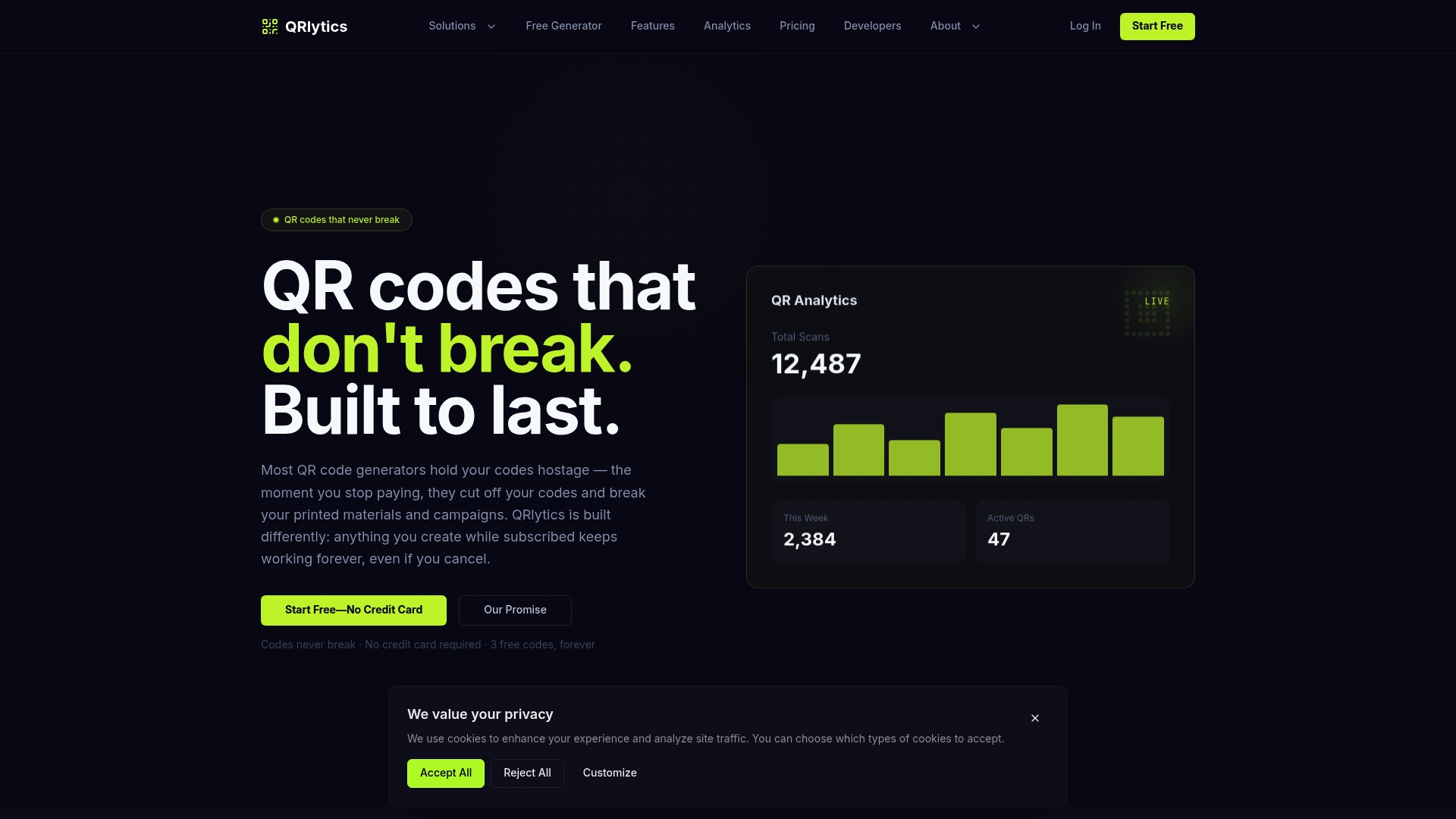
Qrlytics guarantees that codes created during an active subscription remain functional permanently, regardless of billing status. Dynamic URL updates mean you can change the destination of a printed code without reprinting anything. Scan analytics are GDPR-ready by design: IP hashing, CSV export, global heatmaps, and a data-processing agreement available on request. Vector export, API access, and lifecycle scheduling are included on paid plans.
Start on the free tier with no credit card. Create a dynamic code, run a short test campaign, and export your first analytics CSV before you commit to anything.
Sources
External research:
- QR-Code Generator VS Supercode - compare differences & reviews?
- Supercode - 2026 Company Profile & Competitors - Tracxn
- Scanova.io VS Supercode - compare differences & reviews?
- Top 10 Supercode Alternatives & Competitors in 2026
Qrlytics further reading:
FAQ
Are there any QR code platforms that are genuinely free?
Yes. QRCode Monkey offers free SVG and PDF vector downloads for static codes with no account required. Qrlytics provides a free tier for dynamic codes with analytics, also with no credit card needed. Free tiers on management platforms typically cap the number of active dynamic codes and monthly scans.
What is a super code, and how does it differ from a standard QR code?
“Super code” is a marketing term used by Supercode to describe a dynamic QR code with campaign tracking and customisation features. It is not a distinct technical standard. Any dynamic QR code platform, including Qrlytics, QRTiger, or Scanova, produces codes with equivalent or greater functionality.
How do you replace or update a QR code without reprinting materials?
With a dynamic QR code, you update the destination URL in the platform dashboard and the printed code continues to redirect to the new destination. The physical code itself never changes. This is why dynamic codes on a platform with a permanence guarantee are the correct choice for any printed collateral.
Is there a better alternative to QR codes for physical-to-digital marketing?
QR codes remain the most widely supported and cost-effective physical-to-digital link for UK marketing. NFC tags offer a tap-based alternative but require compatible hardware and higher per-unit cost. For most printed campaigns, a well-managed dynamic QR code on a reliable platform is the practical standard.