QR data privacy: Safer marketing campaigns guide
TL;DR:
- Most marketing teams overlook the privacy implications of QR code data collection, risking reputational and legal issues.
- Using GDPR-compliant platforms, practicing data minimization, and providing clear disclosures help ensure responsible and effective QR campaigns.
Most marketing teams spend weeks designing a QR code campaign and almost no time thinking about what happens to the data those codes collect. QR codes are now printed on everything from restaurant menus to product packaging, yet the privacy implications are routinely underestimated. Consumers are increasingly aware of how their data is used, and regulatory frameworks such as the UK GDPR place clear obligations on organisations that collect behavioural data. This guide explains exactly how QR code tracking works, where the privacy risks sit, and how your team can run campaigns that are both insightful and responsible.
Table of Contents
- What is QR data privacy and why does it matter?
- Static vs dynamic QR codes: Privacy implications
- What data gets tracked with QR codes?
- Best practices for privacy-friendly QR marketing
- Our take: Navigating the QR privacy paradox
- Take your QR marketing to the next level
- Frequently asked questions
Key Takeaways
| Point | Details |
|---|---|
| Balance insight and privacy | Marketers need to collect campaign data responsibly to build trust and remain compliant. |
| Choose the right QR code type | Understand static and dynamic codes to make informed privacy and functionality decisions. |
| Communicate transparently | Always disclose what you track and why, using clear privacy notices at the scan point. |
| Use privacy by design | Select QR solutions that enable anonymisation, opt-out, and easy compliance with regulations. |
What is QR data privacy and why does it matter?
QR data privacy refers to the rights and controls surrounding personal and behavioural information collected when someone scans a QR code. Every time a user scans a code, data can be generated and stored, sometimes without the user knowing anything about it. For marketing teams, this creates both an opportunity and a responsibility.
Consumer concern about data collection is rising steadily. Building online trust with your audience now depends on how transparently your business handles data, including the data generated by a simple QR scan. Brands that handle this well stand out; those that ignore it face reputational and legal risk.
Legal frameworks make this practical rather than theoretical. The UK GDPR, along with European counterparts and various international equivalents, place strict requirements on how personal data is gathered, stored, and used. Running GDPR compliant QR codes in your campaigns is not optional if you are operating in regulated markets.
Several common misconceptions make this worse. Many marketers assume a QR code is just a link and therefore harmless. Others believe that because no login is required, no personal data is collected. Neither assumption holds up.
As one privacy debate frames it, QR tracking can be viewed as a “privacy disaster” if data is over-collected without purpose, or as a genuinely useful tool when designed with anonymised, aggregate data in mind. The difference lies entirely in how the platform is configured and what the team chooses to collect.
Typical data points collected during a QR scan include:
- IP address and approximate location (can be used to infer region or city)
- Device type and operating system
- Scan time and date
- Referral source (where the user scanned from, such as a printed poster or a digital screen)
- Browser or app used to open the URL
Each of these is relatively innocuous on its own. Combined over time, they can form a detailed behavioural profile of a real person, which is precisely why the privacy conversation matters.
Static vs dynamic QR codes: Privacy implications
Understanding the difference between static and dynamic QR codes is essential before you make decisions about your campaigns.
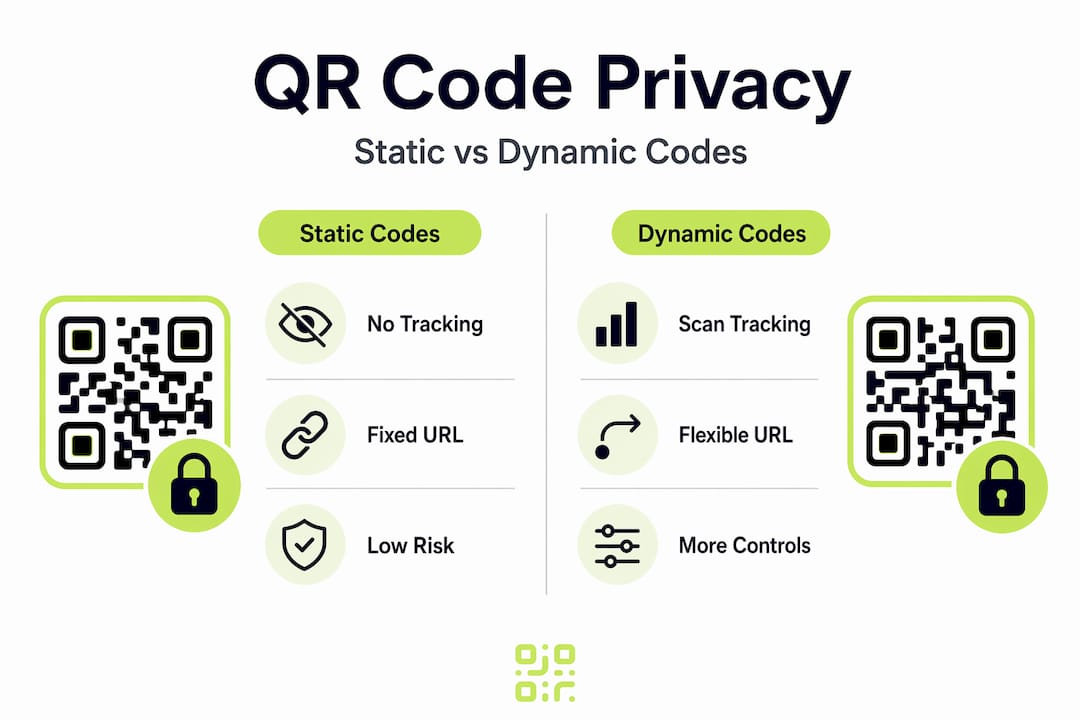
A static QR code encodes the destination URL directly into the code itself. Once printed, it cannot be changed. Every scan goes directly to the same fixed address, and because there is no intermediary server, no scan data is processed or stored by the code provider.

A dynamic QR code works differently. The code points to a short redirect URL managed by a platform. When someone scans it, their request passes through the platform’s server, which logs the scan event and then sends the user to the destination. This is where tracking QR code scans becomes possible.
| Feature | Static QR code | Dynamic QR code |
|---|---|---|
| Editable destination | No | Yes |
| Scan tracking | None | Full analytics available |
| Privacy impact | Lower (no server processing) | Higher (scans processed server-side) |
| Access revocation | Not possible | Code can be disabled instantly |
| Campaign flexibility | Very limited | High |
The security risks of static QR codes are often overlooked. Because the full destination URL is baked in, a screenshot of the code is as good as the original. This creates sharing and access risks, particularly for ticketing or access control. Dynamic codes can be disabled after use, which gives your team meaningful control.
There is also the threat of quishing, a form of phishing where a malicious QR code is placed over a legitimate one, for example as a sticker on a restaurant table or parking meter. QR code security risks for enterprises include these malicious overlays as a growing concern. Dynamic codes from a verified platform give you an additional layer of post-print control because you can update or disable a code if tampering is detected.
Pro Tip: Choose static codes only when tracking is genuinely unnecessary and the destination will never change, for example a permanent link to a public document. For all campaign use cases, use a dynamic QR code generator so you retain the ability to update destinations, disable codes, and review access at any point.
What data gets tracked with QR codes?
The specifics of what gets collected depend heavily on which platform you use and how it is configured. Here is a practical breakdown.
| Data type | Minimal/essential collection | Advanced collection |
|---|---|---|
| Scan count | Yes | Yes |
| Time and date of scan | Yes | Yes |
| Approximate location (city level) | Sometimes | Yes, including heat maps |
| Device type | Sometimes | Yes, with model details |
| IP address | Rarely stored long-term | Often logged |
| User identity | No | Only if linked to a login |
| Referral campaign source | No | Yes, via UTM parameters |
The key distinction is between aggregate, anonymised statistics and personal or device-specific data. Aggregate data tells you that 450 people scanned your code in Manchester on a Tuesday afternoon. That is enormously useful for campaign planning and carries minimal privacy risk. Personal data links that scan to a specific individual or device over time, and that is where analytics in marketing must be handled with care.
Here is how QR scan data typically moves from user action to your analytics dashboard:
- User scans the code with their smartphone camera or a QR reader app.
- The device sends a request to the platform’s redirect server via the encoded short URL.
- The server logs the scan event, capturing the data points it is configured to store (time, location, device, etc.).
- The server redirects the user to the final destination URL, usually in under a second.
- The analytics dashboard updates with the new scan entry, aggregating data with previous scans.
- Your marketing team reviews the data to assess campaign performance and audience behaviour.
Under UK and EU GDPR, IP addresses are generally considered personal data because they can be used, in combination with other information, to identify an individual. If your platform logs and retains full IP addresses, that falls within the scope of the regulation. You should confirm with your platform provider how IP data is handled, whether it is anonymised, how long it is retained, and whether users can request deletion.
The reality, as the privacy debate around QR tracking makes clear, is that the tool itself is neutral. It is the decisions made during campaign setup that determine whether tracking is privacy-respecting or invasive. Choosing a platform with built-in data minimisation and GDPR compliance features is one of the most practical steps you can take. Using QR codes with analytics from a compliant provider gives you insight without unnecessary data exposure, and link redirection for QR campaigns can be configured to balance tracking depth with user protection.
Best practices for privacy-friendly QR marketing
Privacy-friendly QR campaigns do not mean campaigns with less data. They mean campaigns where data is collected intentionally, handled responsibly, and used for legitimate purposes. Here is how to build that into your process.
Core principles to follow:
- Data minimisation: Only collect what you genuinely need. If city-level location is sufficient, do not store full IP addresses. If scan count is what matters, disable device-level tracking.
- Clear consent and disclosure: Tell users what will be collected before or at the point of scanning. This can be a short notice near the QR code or a landing page that explains tracking before proceeding.
- Use trusted platforms: Choose QR providers that publish their data handling policies clearly and offer GDPR-compliant options. Check whether they store your users’ data on servers in compliant jurisdictions.
- Periodic access reviews: Regularly audit which campaigns are active, which codes are still deployed, and whether older campaigns need to be disabled or their data deleted.
- Privacy by design: Build privacy considerations into the campaign from the start, not as a final check before launch.
Transparency with users is underrated as a trust builder. A simple notice that reads “Scanning this code records anonymised usage data to improve our services” takes seconds to include on a printed display and significantly reduces the risk of user complaint or regulatory scrutiny.
Opt-out options are increasingly expected. While QR codes do not offer an in-built opt-out mechanism, you can address this by providing a direct URL alternative and a clear route for users to request data deletion. This is good practice regardless of your specific regulatory context.
Pro Tip: Dynamic codes offer a powerful privacy feature that static codes cannot match. You can set temporary destinations, update the redirect URL after printing, and disable the code entirely if privacy concerns arise. Combine this with a clear privacy commitment in your campaign materials and you significantly reduce compliance exposure.
A simple template privacy notice for your QR campaigns might read: “This QR code uses anonymised scan analytics to measure engagement. No personally identifiable information is stored. For details, visit [your privacy policy URL].” Short, honest, and effective.
Managing your online reputation as a brand increasingly includes how you handle data. Customers notice when brands are upfront, and they remember when they are not.
It is also worth reviewing how dynamic codes handle scan tracking in your chosen platform. Ensure that the settings align with your privacy policy before any campaign goes live.
Our take: Navigating the QR privacy paradox
Most conversations about QR privacy land in one of two camps. Either every form of QR tracking is treated as surveillance and inherently suspect, or privacy concerns are dismissed as a technical detail for the legal team to sort out after launch. Both positions create real problems.
The first approach leads to under-utilised technology. Teams that refuse to use any form of QR analytics because of vague privacy concerns end up flying blind on campaign performance. They have no idea which formats are working, which locations are driving engagement, or whether their printed materials are reaching anyone at all. That is a significant strategic disadvantage.
The second approach is where brands get into genuine trouble. Treating privacy as a checkbox rather than a design principle means campaigns go live without proper disclosure, data is retained far longer than necessary, and when a customer asks a reasonable question about what was collected, there is no clear answer.
Neither extreme delivers lasting results. The brands that build genuine trust are those that make privacy visible and functional, treating it as a feature of their campaigns rather than a limitation.
The ongoing debate between QR tracking as “privacy disaster” versus privacy-enabling tool is, in our view, a false choice. The real question is whether your team has made deliberate decisions about what to collect and why.
Data minimisation is often framed as a constraint but it is actually a competitive advantage. Campaigns that collect only what they need are simpler to manage, cheaper to store, and far easier to defend to a regulator or an unhappy customer. They also tend to produce cleaner, more actionable insights because the signal-to-noise ratio is better.
Making opt-out genuinely easy is another area where brands consistently underinvest. Users who feel respected tend to engage more, not less. Visible privacy options communicate confidence and competence, and that is precisely the kind of brand signal that builds long-term loyalty. Pairing that with advanced QR code tracking designed with privacy controls from the outset is the approach we consistently recommend.
Take your QR marketing to the next level
If this guide has shown you anything, it is that privacy-conscious QR marketing and high-quality analytics are not in conflict. You can run campaigns that are both genuinely insightful and demonstrably compliant.
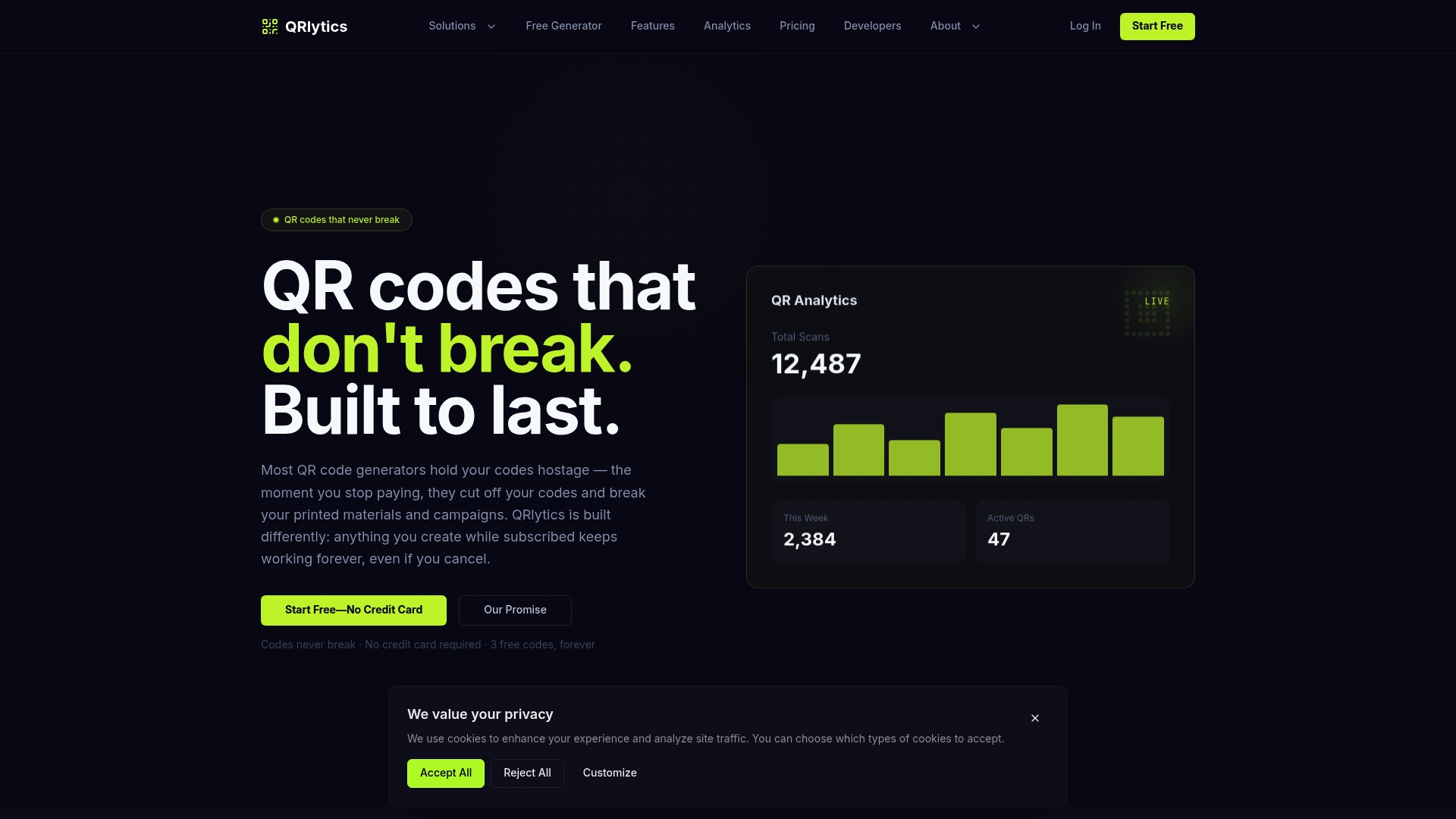
QRlytics is built precisely for this balance. The platform offers dynamic QR code generation with full destination editability, so your printed materials never become liabilities when campaigns change. The analytics suite delivers real-time, GDPR-aware scan data including heat maps and device breakdowns, giving your team the insight it needs without over-collection. And with QR code tracking services designed around transparency, you can confidently show customers and regulators exactly how your data is handled. Start without a credit card and see what responsible, measurable QR marketing looks like in practice.
Frequently asked questions
Are dynamic QR codes less private than static ones?
Dynamic QR codes process scans through a server and may collect more data, but they also allow you to disable access, update destinations, and manage compliance far more effectively than static codes ever could.
What types of data should marketers avoid collecting with QR codes?
Marketers should avoid collecting unnecessary personal identifiers such as full IP addresses or device fingerprints, and instead focus on anonymised, aggregate data that measures campaign performance without profiling individual users.
Can users see what data is collected when they scan a QR code?
By default, users have no visibility into what tracking occurs during a scan, which is exactly why marketers should provide a clear, brief disclosure near the QR code or on the landing page users reach first.
How can businesses ensure their QR code campaigns meet privacy regulations?
Businesses should apply data minimisation, obtain clear consent where required, and use QR platforms with transparent, built-in privacy controls that are aligned with GDPR and other applicable frameworks.