Role of QR codes in product recalls: a practical guide
TL;DR:
- QR codes enable instant, batch-specific recall notifications by linking products to digital data. Dynamic QR codes update in real time, ensuring operational agility and traceability during recalls. Proper governance and reliable infrastructure are essential to maximize their safety and regulatory benefits.
QR codes are defined as machine-readable optical labels that link physical products to live digital data, and their role in product recalls is to replace slow, error-prone manual processes with instant, batch-specific communication. Product safety professionals and supply chain managers now rely on QR codes as the primary mechanism for tracing affected inventory, alerting retail staff, and directing consumers to recall instructions. The GS1 Digital Link standard has formalised this approach, enabling a single QR code to carry a product’s GTIN, batch number, expiry date, and country of origin. Platforms like Bitly and GS1 UK have demonstrated how dynamic QR codes transform packaging into live gateways that update without reprinting. The importance of QR codes in recalls is not theoretical. It is operational, regulatory, and measurable.
How QR codes improve product recall efficiency
Traditional recall workflows depend on phone trees, email chains, and paper notices. Each step adds hours. A QR code changes that equation entirely.

GS1 Digital Link enabled codes support a “kill switch” feature that instantly displays a “STOP – RECALLED” alert to frontline staff. This reduces communication delays from hours or days to minutes. For a supply chain manager coordinating a recall across hundreds of retail locations, that speed difference is the gap between a contained incident and a public health crisis.
The traceability benefit is equally significant. QR code batch tracking connects specific production runs to digital records, so one scan directs customers, retail staff, and logistics partners to batch-specific recall instructions. This removes the ambiguity that causes confusion during large-scale recalls. Staff no longer need to cross-reference spreadsheets or wait for updated guidance from head office.
A single QR code can also encode multiple identifiers including GTIN, serial number, lot number, and expiry date. That consolidation surpasses what traditional barcodes can carry. It supports full lifecycle traceability and simplifies compliance auditing.
| Method | Communication speed | Traceability depth | Update capability |
|---|---|---|---|
| Traditional barcode | Hours to days | Limited to product level | Requires relabelling |
| Static QR code | Minutes | Batch and lot level | Requires reprinting |
| Dynamic QR (GS1 Digital Link) | Seconds | Full lifecycle identifiers | Real-time, no reprint |
Pro Tip: Encode your QR codes at batch level, not just product level. A product-level code tells you what was recalled. A batch-level code tells you exactly which units to pull and where they are.
Dynamic versus static QR codes: which works better in recalls?
The distinction between static and dynamic QR codes is critical for product safety professionals. A static QR code encodes a fixed URL. Once printed, the destination cannot change. A dynamic QR code points to a redirect URL that you control, meaning the destination can be updated at any time without altering the printed code.
During a recall, guidance evolves rapidly. Return instructions change. Scope expands. New contact numbers go live. Dynamic QR codes enable mid-recall message updates, allowing you to expand scope or revise return instructions even after products have left the warehouse. That operational agility is not available with static codes.
The risks of poor QR code management are real and regulatory in nature:
- Broken destinations: Poorly maintained QR code destinations produce 404 errors, effectively misbranding products and risking regulatory penalties.
- Offline vulnerability: If a dynamic code’s redirect service goes offline, the recall information becomes inaccessible at the exact moment it is needed most.
- Subscription dependency: Many free QR code services deactivate codes when a subscription lapses. A code that worked during product launch may fail during a recall two years later.
- URL instability: Changing your website structure or CMS without updating redirect rules breaks recall links across all distributed inventory.
The practical conclusion is clear. Dynamic QR codes are the correct choice for recall communications, but only when backed by a reliable, always-on redirect infrastructure. A QR code fallback strategy provides a safety net when primary destinations fail, routing users to a secondary page rather than an error screen.
How QR codes fit within regulatory labelling requirements
QR codes cannot replace mandatory printed safety labels. This is a firm regulatory position, not a recommendation. Under the EU General Product Safety Regulation (GPSR), essential safety instructions must be physically present on the product or its packaging. QR codes serve as secondary access to enriched information, not as a substitute for the primary label.
The reasoning is straightforward. Mandatory label text must be available at the point of use without internet connectivity. A consumer in a location with no signal, or an elderly person without a smartphone, must still be able to read the core safety warning. QR codes supplement that requirement. They do not satisfy it.
What QR codes can provide as supplementary content is genuinely valuable:
- Multilingual safety instructions that would be impractical to print in full on packaging.
- Extended usage guidance, video demonstrations, or technical data sheets.
- Live recall status pages with batch-specific return instructions.
- Contact details for consumer helplines and authorised repair centres.
- Regulatory certificates and conformity documentation for professional buyers.
The practical hierarchy is: mandatory printed information first, QR code content second. Your recall process must function without the QR code. The QR code makes it faster, clearer, and more accessible.
Pro Tip: Test your QR code recall pages in offline mode before a crisis occurs. If the page requires JavaScript-heavy loading or fails on a slow 3G connection, redesign it. Recall situations are not ideal browsing conditions.
Practical implementation strategies for QR codes in recalls
Effective implementation starts with placement decisions. QR codes belong on the product itself, on outer packaging, on delivery documentation, and on any recall notice you issue. Each placement serves a different audience: the consumer at home, the warehouse operative, the retailer’s stock room team, and the logistics partner scanning inbound pallets.
Encoding decisions matter as much as placement. Batch-level data encoded via GS1 Digital Link means that a single scan at any point in the supply chain returns the correct, current information for that specific production run. This removes the need for staff to manually look up lot numbers or cross-reference recall lists.
Key implementation considerations for your team:
- Stable redirect URLs: Use a platform that guarantees redirect continuity regardless of billing status. A lapsed subscription that breaks recall codes creates both a safety risk and a regulatory liability.
- Digital content governance: Assign ownership of recall landing pages to a named team member. Pages must be updated within hours of a recall decision, not days.
- Scan analytics: Trackable landing pages provide scan volumes, geographic distribution, and user actions. This data tells you whether your recall communication is reaching affected consumers or missing entire regions.
- Consumer-facing design: Recall landing pages must load quickly on mobile, display the key action in the first screen, and require no account login.
| Implementation element | Why it matters | Risk if neglected |
|---|---|---|
| Batch-level encoding | Precise traceability | Wrong units recalled |
| Stable redirect infrastructure | Continuous access | Broken links, regulatory penalty |
| Scan analytics | Measure reach and response | Blind spots in recall coverage |
| Mobile-optimised landing pages | Consumer accessibility | Low engagement, missed returns |
QR code tracking gives your team the data to assess whether a recall campaign is working in real time. Geographic heat maps, for instance, can reveal that a specific region has low scan rates, prompting targeted follow-up through retailers or media.
Adoption of QR codes for recall communication is also a competitive advantage in brand terms. Demonstrating transparency and operational competence during a recall reduces negative brand perception. Consumers and retail partners notice when a brand handles a recall with clarity and speed.
Key takeaways
QR codes reduce product recall response times from hours to minutes when implemented with dynamic redirect infrastructure and batch-level GS1 Digital Link encoding.
| Point | Details |
|---|---|
| Dynamic codes are essential | Static QR codes cannot be updated mid-recall; dynamic codes allow real-time message changes without reprinting. |
| Batch-level encoding improves traceability | Encoding GTIN, lot number, and expiry date in one code removes manual cross-referencing during recalls. |
| QR codes supplement, not replace, labels | EU GPSR requires mandatory safety text to be physically printed; QR codes provide extended or multilingual content only. |
| Stable infrastructure prevents broken links | Codes backed by reliable redirect services remain functional even if billing or platform status changes. |
| Scan analytics close communication gaps | Geographic and volume data from QR scans reveal where recall messages are not reaching consumers. |
What I have learned from watching recalls go wrong
The most common failure I see is not a technology failure. It is a governance failure. A brand invests in QR codes at product launch, encodes them correctly, and then allows the underlying redirect infrastructure to decay. The marketing team moves on. The domain gets restructured. The subscription to the QR platform lapses. Two years later, a recall is triggered, and every code on every unit in the field returns a 404 error.
The second failure is treating QR codes as a consumer-facing tool only. The real power of QR codes in recalls sits with frontline retail staff and warehouse operatives. A warehouse picker who scans a pallet and immediately sees “STOP – RECALLED” in large text prevents that stock from reaching consumers. That is where the operational value is concentrated, and most recall strategies underinvest in it.
The third thing I have observed is that brands which handle recalls well tend to have tested their QR infrastructure before a crisis. They run quarterly checks on redirect destinations. They have a named owner for every recall landing page. They know their scan analytics baseline, so when a recall triggers a spike in scans from an unexpected region, they notice it within hours.
QR codes for product safety are not a set-and-forget tool. They require the same governance discipline as any other critical safety system. The technology is reliable when the process behind it is reliable.
— The
Qrlytics: dynamic QR codes built for recall-critical environments
Product recalls expose every weakness in your QR code infrastructure. Codes that break, redirect to outdated pages, or return errors are not just inconvenient. They create regulatory risk and erode consumer trust at the worst possible moment.
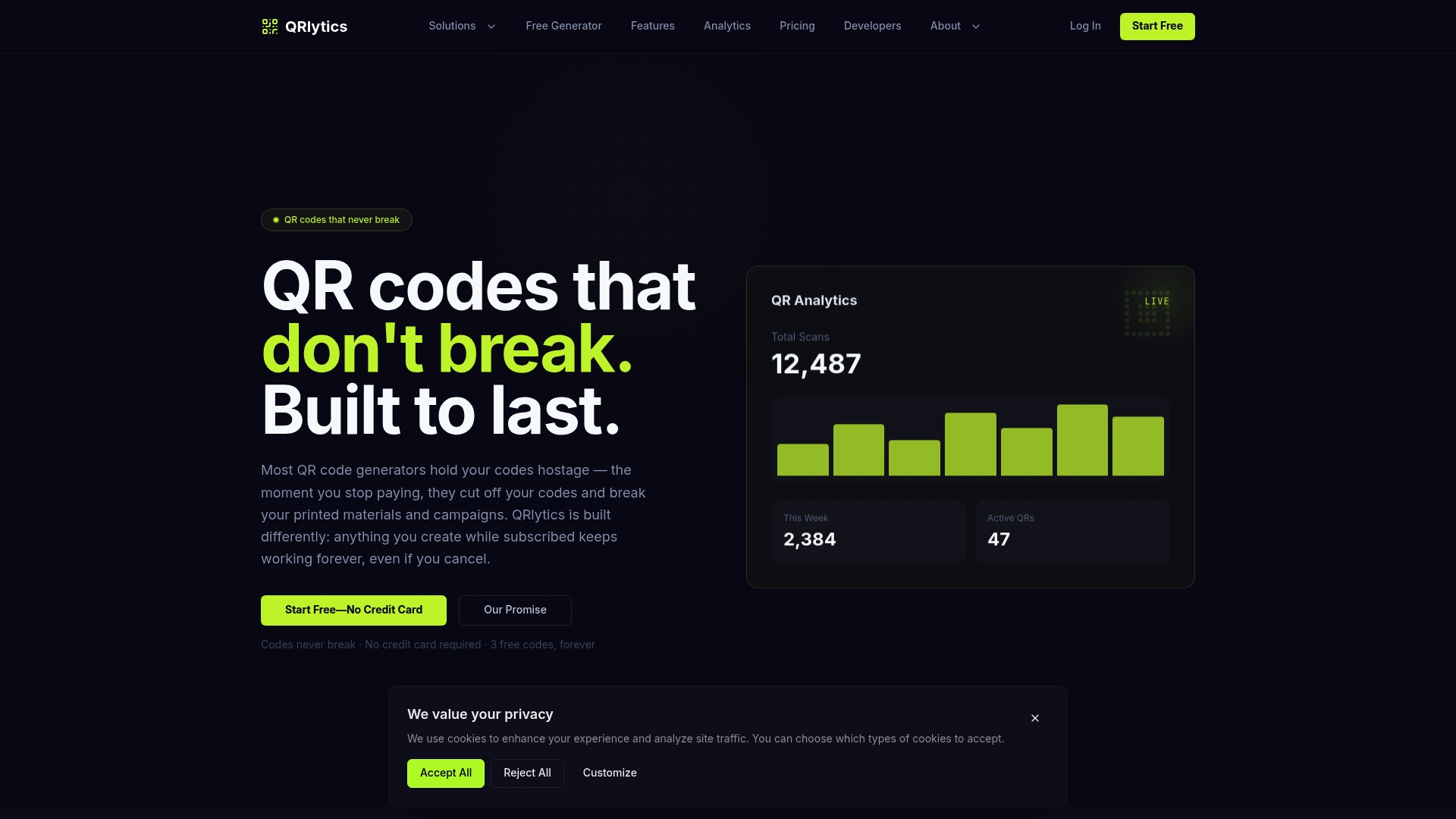
Qrlytics provides dynamic QR code generation with guaranteed redirect continuity. Codes created during an active subscription remain functional permanently, regardless of billing status. You can update redirect destinations in real time, without reprinting a single label. Built-in scan analytics give your team geographic and volume data to measure recall reach and identify gaps. No credit card is required to get started. If your recall strategy depends on QR codes, it depends on the infrastructure behind them.
FAQ
What is the role of QR codes in product recalls?
QR codes connect physical products to live digital recall data, enabling instant batch-specific alerts for staff and consumers. Dynamic QR codes allow recall instructions to be updated in real time without reprinting packaging.
Can QR codes replace printed safety labels during a recall?
No. Under the EU GPSR, mandatory safety information must be physically printed on the product or packaging. QR codes provide supplementary content such as multilingual instructions or extended recall guidance.
What is GS1 Digital Link and why does it matter for recalls?
GS1 Digital Link is a standard that allows a single QR code to encode multiple product identifiers including GTIN, batch number, and expiry date. It supports a “kill switch” feature that displays an immediate recall alert to frontline staff upon scanning.
What happens if a QR code destination goes offline during a recall?
If the redirect URL becomes inaccessible, the code returns an error and recall information is lost at the point of need. A fallback URL strategy and a reliable redirect platform prevent this failure.
How do scan analytics improve recall outcomes?
Scan analytics provide data on scan volumes, geographic distribution, and user actions across recall landing pages. This data identifies regions with low engagement, allowing teams to direct targeted follow-up communication where it is needed most.