Scan-to-action marketing: how to turn scans into sales
TL;DR:
- Scan-to-action marketing uses QR codes to turn physical and broadcast touchpoints into immediate, trackable user actions. It enhances attribution by providing precise placement-level data and enabling mid-campaign routing updates. Reliable, dynamic codes and optimized landing pages are essential for maximizing conversion rates and campaign effectiveness.
Scan-to-action marketing is a QR-driven tactic that turns physical or broadcast touchpoints — print, packaging, receipts, out-of-home displays, and Connected TV — into immediate, measurable mobile actions. A viewer sees a QR code paired with a clear call-to-action (CTA), scans it, and lands on a destination designed to complete one specific objective: a purchase, a sign-up, a chat thread, or a loyalty reward.
The practical payoff is attribution. Channels that were previously brand-only — a TV spot, a poster, a product box — become performance channels with scan counts, conversion rates, and revenue-per-scan figures you can actually report on.
Every scan-to-action campaign rests on four components:
- QR asset — the scannable code, ideally dynamic so the destination can be updated after print or broadcast
- CTA copy — a short, single-verb instruction with an explicit benefit (“Scan to unlock 20% off”)
- Routing and landing — a fast redirect to a mobile-optimised page built around one conversion objective
- Tracking — scan events, UTM parameters, and downstream conversion data tied back to each placement
Table of Contents
- Why scan-to-action marketing matters for modern campaigns
- How scan-to-action works end to end
- Real scan-to-action CTA examples across industries
- Design and placement best practices for QR and CTA pairings
- How to measure and attribute scan-to-action campaigns in the UK
- Step-by-step campaign checklist from concept to live
- Scan-to-action in Connected TV and why dynamic codes change offline measurement
- Key takeaways
- Practitioner notes: what actually trips up scan-to-action campaigns
- Qrlytics gives your scan-to-action campaigns a reliable foundation
- Useful sources and further reading
- FAQ
Why scan-to-action marketing matters for modern campaigns
Traditional awareness channels have always had a measurement problem. A billboard impression or a TV spot generates reach, but connecting that reach to a sale has historically required survey-based attribution or probabilistic modelling. Scan-to-action converts those channels into performance channels by giving each placement a unique, trackable entry point.

The intent signal is also stronger than most digital formats. A person who picks up their phone and scans a code has made a deliberate choice. That deliberate action separates scan traffic from passive ad impressions, and it tends to produce higher downstream conversion rates as a result.
Key benefits for UK marketers:
- Placement-level attribution — each QR code carries its own UTM parameters and campaign token, so you know exactly which poster, pack, or TV break drove the scan
- Dynamic routing — dynamic QR codes let you update the destination URL after print without reprinting, which protects physical assets and lets you optimise mid-campaign
- Omnichannel measurement — scan events join your existing analytics stack alongside web sessions and paid media data, giving you a single view of the funnel
- Higher intent, lower waste — scan traffic self-selects; you are not paying to re-target people who never engaged
Statistic callout: QR-activated CTV ad breaks can redirect scans via edge redirects often faster than 50 ms, enabling near-instant handoff from a TV screen to a mobile landing page.
Permanent-code guarantees matter here too. If a QR code on printed packaging stops resolving because a subscription lapses, every scan becomes a dead end. Reliable routing is not a nice feature; it is the foundation the rest of the campaign sits on.
How scan-to-action works end to end
Understanding the technical flow helps you spot where campaigns break down and where you can reduce friction.
Static vs dynamic QR codes
A static QR code encodes the destination URL directly into the pattern. Change the URL and you must reprint the code. A dynamic code encodes a short redirect URL instead; the actual destination lives in a routing service you control. For any campaign involving print, packaging, or broadcast, dynamic codes are the practical choice because they let you fix a broken link, swap a landing page, or redirect traffic to a seasonal offer without touching the physical asset.
The routing flow
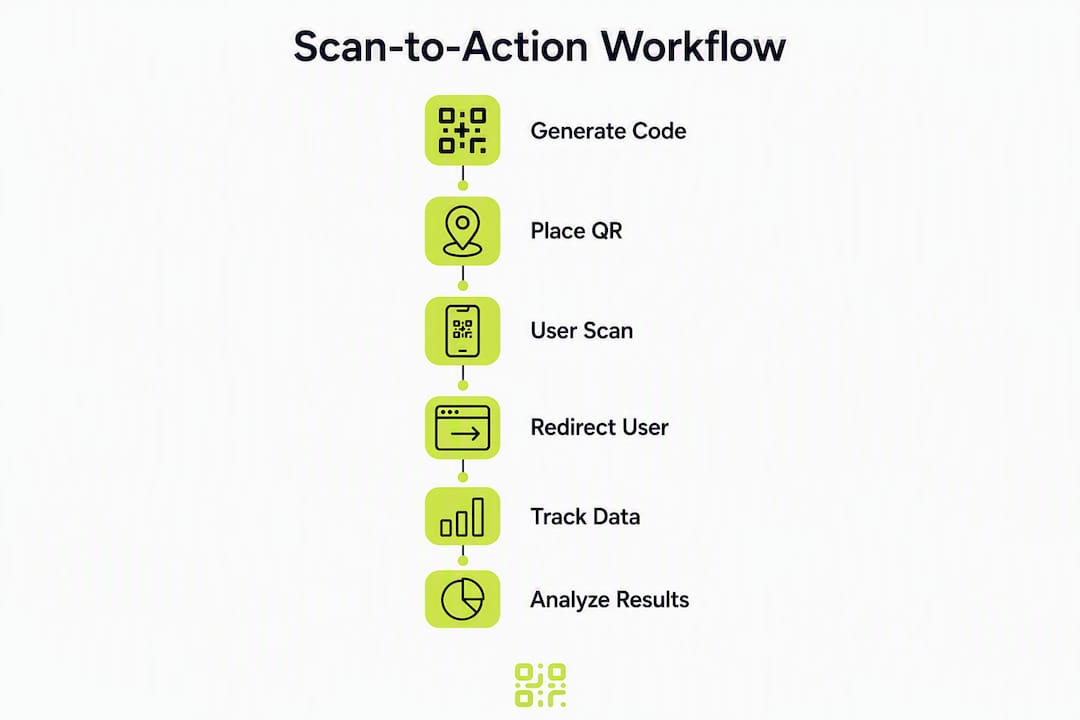
When someone scans a dynamic code, the sequence runs like this:
- The camera app reads the short redirect URL from the QR pattern
- The routing service resolves the redirect, applies device detection and any geo-logic, and issues a 301 or 302 to the final destination
- The user lands on a mobile-optimised page built around a single conversion action
- The scan event, timestamp, device type, and campaign token are logged for analytics
Personalised QR journeys can extend this by using URL parameters to carry context — a product SKU, a store location, or a campaign variant — so the landing page greets the user with relevant content rather than a generic homepage.
UX considerations
Page load speed is the single biggest drop-off point after the scan. A landing page that takes more than two seconds to render on a mobile connection will lose a significant share of the intent you just captured. Keep the page uncluttered, load the primary CTA above the fold, and ask for the minimum information needed to complete the action.

Pro Tip: Use URL parameters to pre-fill form fields with data the QR code already knows — a store ID, a product reference, or a campaign code. Pre-populating forms removes manual typing and measurably improves completion rates, particularly for B2B and operational use cases.
Real scan-to-action CTA examples across industries
The CTA line is where most campaigns either earn the scan or lose it. The copy must state one action and one reward in as few words as possible. Here are patterns that work across common placements:
| Placement | CTA example | Primary intent |
|---|---|---|
| Retail shelf / POS | “Scan to unlock 20% off today” | Purchase conversion |
| F&B packaging | “Scan to get the recipe” | Engagement / brand affinity |
| Restaurant table card | “Scan to order and pay” | Frictionless transaction |
| Event badge / lanyard | “Scan to connect on LinkedIn” | Lead capture / networking |
| Direct mail | “Scan to book your free consultation” | Lead generation |
| Receipt | “Scan to leave a review and get £5 off” | Loyalty / UGC |
| CTV ad break | “Scan to shop the look” | Shoppable commerce |
| CTV ad break | “Scan to chat with an expert” | Conversational lead capture |
| Product packaging | “Scan to verify authenticity” | Trust / compliance |
| OOH poster | “Scan for directions to our nearest store” | Footfall / navigation |
| Gamified CTV overlay | “Scan to enter the prize draw” | Engagement / data capture |
QR codes linked to checkout pages, map directions, or gamified content consistently outperform generic “visit our website” CTAs because they promise a specific, immediate outcome. The scan-to-chat pattern — routing a scan into a WhatsApp, SMS, or web chat thread — is particularly effective for high-consideration purchases where the buyer wants to ask a question before committing.
CTA copy rules:
- One verb, one benefit, no ambiguity (“Scan to get” beats “Find out more”)
- State the reward explicitly; vague curiosity hooks underperform
- Add urgency only when it is genuine (“today only”, “while stocks last”)
- Keep the line under eight words where possible
- Always include a short fallback URL for anyone who cannot scan
What to avoid:
- “Scan here” with no stated benefit
- Two actions in one CTA (“Scan to sign up and download the app”)
- Tiny print that makes the CTA unreadable at distance
- A destination that does not match the CTA promise
Design and placement best practices for QR and CTA pairings
Getting the physical or on-screen execution right is where many campaigns quietly fail. A well-written CTA attached to a poorly sized or poorly placed QR code will not convert.
Size and contrast:
- Minimum 2.5 cm × 2.5 cm for close-range print (packaging, receipts, table cards)
- For CTV and large-format screens, the code must be large enough to scan from a typical viewing distance; industry guidance recommends a minimum visible size with high contrast and a display window of 6–10 seconds so viewers have time to pick up their phone
- Use a quiet zone (white margin) of at least four modules around the code; removing it to save space is one of the most common causes of scan failure
- Dark code on a light background scans more reliably than inverted colours
CTA placement relative to the QR code:
Put the CTA copy directly above or below the code, never beside it. The eye should land on the instruction first, then the code. On CTV, overlay the CTA text on or immediately adjacent to the code so both are visible in a single glance.
Landing page rules:
- Mobile-first layout, single conversion objective per page
- Primary CTA button visible without scrolling
- No navigation menu that invites the user to wander
- Page weight under 1 MB where possible; a frictionless funnel with minimal steps between scan and action consistently correlates with higher completion rates
Pro Tip: Test at least two CTA phrasings before committing to a print run. A/B test digitally first — swap the destination on a dynamic code and split traffic by time-of-day or geography — then lock in the winner before going to print.
How to measure and attribute scan-to-action campaigns in the UK
Good measurement starts with the right KPIs and a tracking architecture that respects UK GDPR.
Primary KPIs
| KPI | How to calculate it |
|---|---|
| Scans per thousand impressions (SPM) | (Total scans ÷ estimated impressions) × 1 |
| Scan-to-qualified-landing rate | Qualified landings ÷ total scans |
| Time to first interaction | Median seconds from scan event to first page interaction |
| Downstream conversion rate | Conversions ÷ qualified landings |
| Revenue per scan | Total attributed revenue ÷ total scans |
Attribution mechanics
Each dynamic QR code should carry a unique campaign token embedded in the redirect URL. When the routing service resolves the redirect, it logs the token alongside the scan timestamp, device type, and — where consent is given — approximate location. Appending UTM parameters to the final destination URL passes campaign data into Google Analytics 4 or your analytics platform of choice, allowing you to join scan events to downstream session and conversion data.
For placement-level attribution, generate a separate dynamic code per placement (poster A vs poster B, TV break 1 vs TV break 2). De-duplicate scans within a short session window — typically 30 seconds — to avoid counting repeated scans of the same code as separate events.
UK GDPR considerations
Under UK GDPR, setting cookies or collecting personal data at the point of scan requires a lawful basis, which in most marketing contexts means prior consent or a legitimate interest assessment. The cleanest architecture routes scans through a first-party subdomain before the final redirect, scoping any cookies to your own domain and simplifying consent management. Where you do not need to identify the individual, event-level logs with tokenised identifiers are sufficient for attribution and keep your data minimisation obligations straightforward.
A practical QR tracking guide covers the full analytics wiring in more detail.
This article provides general information, not legal advice. Confirm your specific data-handling obligations with a qualified privacy professional or the ICO’s guidance.
Step-by-step campaign checklist from concept to live
Phased checklist
- Define strategy and KPIs — agree on the primary conversion objective, the placements, and the metrics you will report against
- Write CTA copy — draft two or three variants per placement; test digitally before print
- Generate dynamic QR codes — one code per placement, each with a unique campaign token; use a dynamic QR code generator that supports URL updates post-launch
- Build landing pages — mobile-first, single objective, pre-filled fields where possible
- Wire up tracking — UTM parameters on destination URLs, scan-event logging, GA4 or equivalent connected
- QA and device handoff tests — scan from multiple devices and operating systems; test at the intended viewing distance for OOH and CTV; verify the fallback short URL resolves correctly
- Launch and monitor — check scan volumes and landing rates within the first 24 hours; flag anomalies early
- Optimise — swap underperforming CTA variants using dynamic routing; update destinations for seasonal offers without reprinting
Suggested timeline
| Phase | Typical duration |
|---|---|
| Strategy and KPI alignment | 3–5 days |
| Creative and CTA copy | 5–7 days |
| QR generation and routing setup | 1–2 days |
| Landing page build | 5–10 days |
| QA and device testing | 2–3 days |
| Launch and initial monitoring | Ongoing from day 1 |
Typical cost considerations
Costs vary by scope, but the main line items for a basic UK campaign are: a QR platform subscription (covering dynamic codes, analytics, and routing), creative and copywriting time, landing page development, and media or print placement costs. The QR platform is usually the smallest line item; the landing page build and media spend dominate. For campaigns using existing landing pages and a modest print run, the incremental cost of adding scan-to-action is low relative to the attribution data it generates.
Scan-to-action in Connected TV and why dynamic codes change offline measurement
Connected TV is where scan-to-action advertising has moved from novelty to a genuine media product. The pattern is straightforward: a QR code appears on screen during an ad break, paired with a CTA, and the viewer scans it with their phone. What makes it technically demanding is the handoff window. A viewer watching TV has their phone nearby but not in hand; the code must be on screen long enough to be noticed and scanned, and the redirect must resolve fast enough that the viewer’s intent does not evaporate.
Edge redirects that resolve extremely quickly are the standard target for CTV deployments. At that speed, the gap between scan and landing page render is imperceptible to the user, preserving the intent-to-action bridge that makes the format valuable. Slower redirects introduce hesitation; hesitation produces drop-off.
On the sell side, this has changed how CTV inventory is packaged. Publishers can now offer outcome-linked pricing: a base CPM plus a per-scan or per-qualified-landing bonus. That model only works when the scan data is deterministic, which is where dynamic codes with signed tokens become essential. A signed token embedded in the redirect URL ties each scan to a specific ad break, a specific creative, and a specific campaign, without requiring any identity stitching on the viewer side. The result is clean, first-party attribution that satisfies both the advertiser’s measurement needs and the publisher’s reporting obligations.
For scan-to-chat funnels specifically, the routing logic carries campaign metadata into the messaging thread, so the first message the viewer receives is personalised to the ad they just watched. That continuity between the TV moment and the mobile conversation is what drives the conversion rates that make the format worth the additional setup.
Key takeaways
Scan-to-action marketing turns any physical or broadcast touchpoint into a measurable performance channel by pairing a QR code with a single, benefit-led CTA and a fast, mobile-optimised destination.
| Point | Details |
|---|---|
| Dynamic codes are non-negotiable | Static codes cannot be updated after print; dynamic codes protect your assets and enable mid-campaign optimisation. |
| CTA copy drives the scan | One verb, one explicit benefit, under eight words — vague CTAs consistently underperform specific ones. |
| Speed determines conversion | Edge redirects under 50 ms and sub-2-second page loads preserve intent; slow handoffs lose the scan. |
| Attribution needs a token per placement | Unique campaign tokens and UTM parameters per code give you placement-level data, not just aggregate scan counts. |
| Qrlytics for reliable UK campaigns | Qrlytics provides permanent-code guarantees, dynamic routing, GDPR-compliant tracking, and real-time analytics for UK marketers. |
Practitioner notes: what actually trips up scan-to-action campaigns
The most common failure mode is not the QR code itself. It is everything around it.
A tiny code on a busy background is the most frequent culprit. Designers compress the code to fit a layout, remove the quiet zone to save space, and then wonder why scan rates are low. The fix is non-negotiable: size and contrast come before aesthetics.
The second failure is a vague CTA. “Scan to learn more” tells the user nothing about what they will get. Specificity is what converts curiosity into a scan. If you cannot state the benefit in five words, the offer probably needs rethinking before the creative does.
Slow landing pages are the third. You can have a perfect QR code and a compelling CTA, and still lose the conversion if the page takes four seconds to load on a 4G connection. Test on a real device on a mobile network, not on your office Wi-Fi.
Operational tips worth knowing:
- Schedule-code campaigns using lifecycle settings so codes automatically redirect to a “campaign ended” page after the offer expires, rather than a broken or irrelevant destination
- Apply session de-duplication with a 30-second window to avoid inflating scan counts from repeated scans
- Use ephemeral codes for single-use vouchers or event access; use long-lived dynamic codes for packaging and print that will be in circulation for months or years
Quick wins for your next campaign:
- Pre-fill form fields using URL parameters — it removes friction and lifts completion rates noticeably
- Build single-purpose landing pages; a page with one CTA converts better than a page with five options
- Offer an immediate, tangible reward (a discount code, a free resource, a prize draw entry) visible above the fold; delayed or vague rewards reduce completion
Strong CTA design is not just about wording. The visual hierarchy, the placement relative to the QR code, and the reward structure all contribute to whether a viewer picks up their phone.
Qrlytics gives your scan-to-action campaigns a reliable foundation
The biggest risk in any scan-to-action campaign is a code that stops working. Printed materials have long lives — packaging stays on shelves for months, direct mail sits on desks, CTV creatives run across multiple flights. A QR code that breaks mid-campaign does not just lose conversions; it damages trust with every person who scans it and gets nothing.
Qrlytics is built around that problem. Codes created during an active subscription remain functional permanently, regardless of billing changes. Dynamic routing lets you update destinations after print, swap landing pages for seasonal offers, and redirect traffic from expired campaigns without touching the physical asset. Real-time analytics give you scan counts, device breakdowns, and global heat maps from the moment a campaign goes live. GDPR-compliant tracking and first-party routing keep UK campaigns on the right side of data-protection obligations.
For a new campaign, the recommended starting point is to generate a dynamic QR code, set your campaign tokens, route through a first-party subdomain, and connect real-time analytics before the first print run. You can also try the free QR generator to test a concept quickly, with no credit card required.
Useful sources and further reading
- QR code tracking: a practical guide for marketers — step-by-step analytics wiring for scan-to-action campaigns using Qrlytics
- Why QR code consistency matters for marketers — explains permanence, versioning, and why dynamic destination updates protect printed assets
- Lead generation with QR codes: 2026 guide — practical tactics for routing scans into chat threads, forms, and lead-capture flows
- Ways to boost QR code scans for marketers — tactical tips for improving scan rates across placements
- Qrlytics blog: QR code guides and tips — broader collection of implementation guides, use-case breakdowns, and platform updates
FAQ
Does a QR code need a CTA?
Technically no, but practically yes. A QR code without a CTA gives the viewer no reason to scan and no indication of what they will get. Adding a specific, benefit-led instruction consistently increases scan rates.
What is a good CTA example for a QR code?
“Scan to unlock 20% off” or “Scan to book your free consultation” are strong examples. Both state one action and one explicit reward, which is the formula that outperforms vague alternatives like “scan here” or “find out more.”
What are the most common CTA mistakes in scan-to-action campaigns?
The three most frequent errors are: a vague CTA with no stated benefit, a QR code that is too small or low-contrast to scan reliably, and a landing page that loads slowly or asks for too much information before delivering the promised reward.
Can Qrlytics help with GDPR-compliant scan tracking?
Yes. Qrlytics uses first-party routing and GDPR-compliant tracking so scan events are logged without relying on third-party cookies. Campaign tokens and event-level data give you placement attribution while keeping data minimisation obligations manageable under UK GDPR.
What is scan-to-action marketing used for in a job or business context?
In a business context, scan-to-action marketing is used to convert offline touchpoints — packaging, receipts, events, TV ads, direct mail — into measurable digital interactions. Marketers use it to attribute physical media spend to online conversions; operations teams use it to trigger workflows like work orders or compliance forms from a single scan.