QR code landing page examples that convert

TL;DR:
- A QR code landing page is a focused web page designed to generate measurable actions from scans, often using dynamic content, analytics, and a clear call to action. Successful pages should load quickly on mobile devices, maintain brand consistency, and utilize UTM tracking for attribution. Dynamic QR codes are preferable for ongoing campaigns, offering content updates and scan tracking that static codes cannot provide.
A QR code landing page is a dedicated web page that users reach by scanning a QR code, designed specifically to convert that scan into a measurable action. The best examples of QR code landing pages share three qualities: dynamic content that can be updated without reprinting, precise analytics tied to tools like Google Analytics 4, and a single clear call to action. Brands such as Lionsgate have demonstrated what is possible when these elements combine, generating 12,000 interactions across a single campaign. This article breaks down the standout examples, explains what makes each one work, and gives you a practical framework to replicate their results.
What makes a great QR code landing page
The industry distinguishes between two types of QR codes: static and dynamic. Static codes embed the destination URL directly into the code pattern, so the URL can never change. Dynamic codes store a short redirect URL inside the code and point it to any destination you choose, even after the code is printed and distributed. For any serious marketing campaign, dynamic codes are the only sensible choice.
Beyond the code type, four criteria separate effective QR code landing page designs from mediocre ones:
- Mobile-first load speed. Scans happen on smartphones. A page that takes more than three seconds to load loses a significant share of visitors before they read a single word.
- A single, prominent call to action. Every successful QR code landing page idea centres on one goal: sign up, claim an offer, view a menu, or download an asset. Multiple competing CTAs dilute conversion.
- Analytics integration. GA4 requires UTM tags on QR destination URLs and a tracking code installed on the landing page to attribute traffic correctly. Without both, your scan data is unreliable.
- Brand consistency. The visual design of the landing page should match the printed or digital material that carried the QR code. A mismatch in colour, tone, or messaging breaks user trust immediately.
Pro Tip: Before launching any QR campaign, scan your own code on three different devices and networks. Confirm the UTM parameters survive every redirect and appear correctly in your GA4 real-time report.
6 examples of QR code landing pages and why they work
1. Lionsgate’s location-based sweepstakes page
Lionsgate deployed dynamic QR codes across 65 U.S. cities, redirecting a single printed code to different sweepstakes or trailer pages depending on where the scan originated. The campaign generated 12,000 interactions without reprinting a single poster. This example proves that one physical asset can serve multiple audience segments simultaneously when the redirect logic is configured correctly. For marketers running national campaigns with regional variations, this approach removes the cost and complexity of producing separate printed materials for each market.

2. Restaurant menu pages with real-time updates
A restaurant chain using dynamic QR codes on table cards saved £10,000 in print costs and recorded over 8,000 scans while improving guest satisfaction scores. The landing page updated automatically to reflect time-of-day pricing and item availability, so breakfast menus appeared in the morning and dinner menus in the evening. Guests scanned the same code every visit and always saw current information. This is one of the most replicable QR code landing page ideas for hospitality businesses because the operational saving alone justifies the investment.
3. Digital business card contact pages
Professional services firms and sales teams use QR codes on physical business cards that link to a contact landing page. The key advantage over a printed card is that the destination URL can be updated whenever contact details, job titles, or company information changes. The landing page typically includes a one-tap option to save contact details directly to a phone’s address book, a short biography, and links to LinkedIn or a booking calendar. Because the code never changes, cards printed two years ago still deliver accurate information today.
4. Interactive sweepstakes pages with A/B testing
Dynamic codes enable A/B testing by splitting scan traffic randomly between two landing page variants during a live campaign. Marketers can test different headlines, imagery, or CTA button colours without touching the physical QR code. Once the data identifies the higher-converting variant, all traffic redirects to that page instantly. This approach is particularly effective for product launches where the creative direction is still being refined after materials have already been printed and distributed.
5. Product launch pages built with Adobe Express
Adobe Express offers QR code templates that link directly to branded landing pages, allowing marketers to deploy campaign pages across posters, social media, and packaging from a single workflow. The resulting pages are mobile-optimised by default and include customisable CTAs. For small marketing teams without dedicated developers, this combination of design tool and QR generator reduces the time from concept to live campaign significantly. The limitation is that Adobe Express codes are static by default, so plan your URL structure carefully before generating.
6. Campaign-specific pages with UTM tracking
The most analytically rigorous QR code landing pages treat each placement as a unique campaign URL with its own UTM source, medium, and campaign values. A retailer might use "utm_source=storefront, utm_medium=qr, and utm_campaign=summer26for an in-store display, while a magazine advertisement usesutm_source=magazine_name`. GA4 then separates the scan data by placement, revealing which physical location or publication drives the most conversions. This level of attribution is what transforms QR codes from a novelty into a measurable marketing channel.
Static vs dynamic QR codes: which suits your landing page?
The choice between static and dynamic codes has a direct impact on what your landing page can achieve. The table below summarises the key differences.
| Feature | Static QR code | Dynamic QR code |
|---|---|---|
| URL editable after printing | No | Yes |
| Scan tracking available | No | Yes |
| A/B testing capability | No | Yes |
| Cost | Lower | Higher (subscription) |
| Best use case | One-off, fixed-destination links | Ongoing campaigns, menus, events |
Static codes redirect to fixed URLs with no ability to update content after printing or track individual scans. This makes them appropriate for permanent assets such as a Wi-Fi password display or a fixed product manual. For any campaign where you need to measure performance, update content, or run tests, static codes create a hard ceiling on what you can learn and optimise. The subscription cost of dynamic codes is almost always recovered through the savings on reprinting alone, as the restaurant example above demonstrates.
Best practices for creating QR code landing pages
The examples above share a set of repeatable practices. Apply these when building your own pages.
- Use consistent UTM naming conventions. Consistent UTM source and medium naming improves data reliability and makes cross-campaign comparisons meaningful. Decide on your naming structure before your first campaign and document it.
- Verify UTM survival through redirects. Some URL shorteners and redirect chains strip UTM parameters. Always test the full scan-to-landing-page journey in GA4’s real-time view before launching.
- Design for mobile first. Use large tap targets, minimal form fields, and images compressed below 100KB. A landing page that loads in under two seconds on a 4G connection will outperform a visually richer page that loads in five.
- Match the landing page to the physical context. A code on a product package should land on a page about that product, not your homepage. Relevance between the scan trigger and the destination is the single biggest driver of conversion.
- Use real-time scan data to make timely adjustments. Tracking scan location, timing, and device type enables effective segmentation and allows you to redirect underperforming placements mid-campaign.
Pro Tip: Run your QR code landing page through Google’s PageSpeed Insights before launch. A score below 80 on mobile is a signal to compress images, defer non-critical scripts, or switch to a faster hosting provider.
You can also explore lead generation with QR codes to see how these practices translate into structured campaigns built around capturing and qualifying prospects.
Key takeaways
The most effective QR code landing pages combine dynamic redirect capability, mobile-optimised design, and GA4-integrated UTM tracking to turn every scan into attributable, actionable data.
| Point | Details |
|---|---|
| Dynamic codes outperform static | Dynamic codes allow URL updates, A/B testing, and scan tracking that static codes cannot provide. |
| UTM parameters are non-negotiable | Each QR placement needs a unique UTM string that survives all redirects to appear correctly in GA4. |
| Single CTA drives conversions | Landing pages with one clear goal consistently outperform pages with multiple competing actions. |
| Real-world examples prove ROI | Lionsgate’s 12,000-interaction campaign and restaurant savings of £10,000 show measurable returns. |
| Mobile speed determines success | Pages loading in under two seconds on mobile retain more visitors and convert at higher rates. |
Why most QR campaigns underperform, and what to do about it
Most QR code campaigns fail not because the code is wrong, but because the landing page was built as an afterthought. I have reviewed campaigns where a beautifully designed QR code on premium print stock linked to a desktop homepage that took eight seconds to load on mobile. The scan data showed strong engagement with the physical material, but the conversion rate was under one percent. The problem was never the QR code.
The second most common failure is analytics blindness. Marketers print codes, distribute materials, and then check a single aggregate scan count weeks later. Without UTM parameters and GA4 properly configured, you cannot tell whether your airport poster or your product packaging is driving results. Real-time QR data allows you to catch a failing placement within days and redirect the code to a better-performing page, extending the useful life of your printed materials rather than writing them off.
The third pitfall is using a QR code service that deactivates codes when a subscription lapses. If your printed materials are still in circulation and your codes stop working, you have no recourse. Choose a platform that guarantees code permanence regardless of billing status. That single decision protects every campaign you run.
— The Qrlytics Team
How Qrlytics helps you build and track QR landing pages
Qrlytics gives marketers a platform built around the principles this article describes. You can generate dynamic QR codes that update in real time, run A/B tests across landing page variants, and track every scan by location, device, and time through GDPR-compliant analytics. Codes created during an active subscription remain functional permanently, so your printed materials never become liabilities.
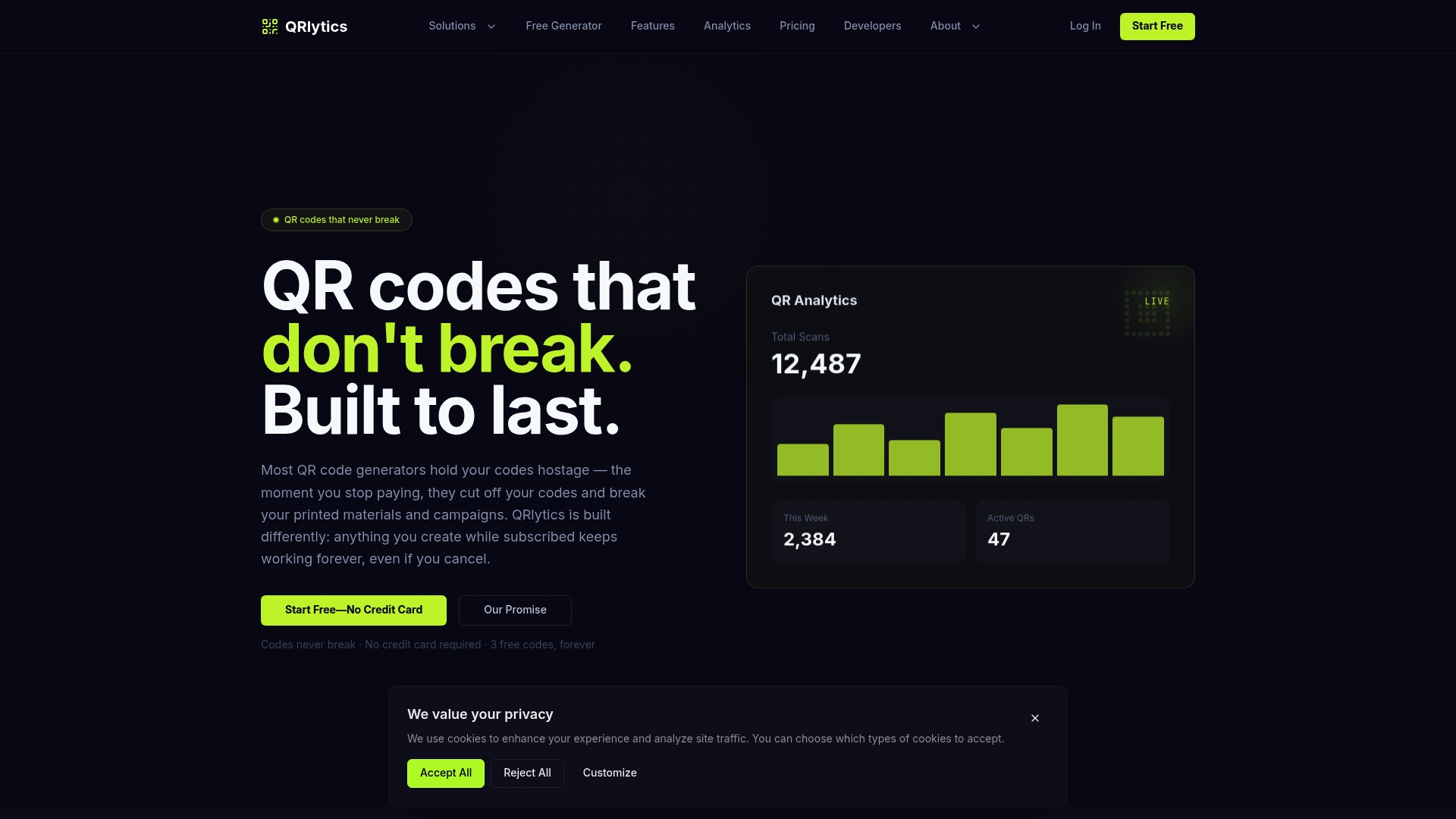
The platform integrates with GA4 and supports custom UTM parameters at the point of code creation, removing the manual step that most teams skip. You can start with the free QR code generator and no credit card is required. For campaigns that need full tracking and redirect control, the QR code tracking tools give you the attribution data to justify every pound of print spend.
FAQ
What is a QR code landing page?
A QR code landing page is a dedicated web page that a user reaches by scanning a QR code, designed to prompt a specific action such as signing up, viewing a menu, or claiming an offer. Unlike a homepage, it has a single focus aligned with the campaign that generated the scan.
Are dynamic QR codes worth the cost?
Dynamic QR codes are worth the cost for any campaign where content may change or where scan tracking is needed. The restaurant example in this article shows £10,000 in print savings from a single deployment, which far exceeds the cost of a dynamic code subscription.
How do I track QR code scans in GA4?
GA4 tracks QR scans when you add UTM parameters to the destination URL and install the GA4 tracking code on the landing page. Both steps are required. Without UTM tags, GA4 classifies QR traffic as direct, making it impossible to separate from other sources.
How many CTAs should a QR landing page have?
A QR code landing page should have one primary call to action. Multiple CTAs compete for attention and reduce the likelihood that a visitor completes any single action, particularly on mobile where screen space is limited.
Can I change the destination of a QR code after printing?
With a dynamic QR code, yes. The printed code contains a short redirect URL that you control through your QR platform. You can update the destination at any time without reprinting the code or the materials it appears on.