High-volume QR management: a practical guide for 2026
TL;DR:
- High-volume QR management centralizes the creation, tracking, and governance of thousands of codes to prevent errors and brand damage. It relies on bulk generation, API integrations, role-based controls, and real-time analytics for scalable campaigns. Proper governance, dynamic codes, and analytics ensure successful expansion and effective optimization.
High-volume QR management is the centralised, systematic process of creating, organising, tracking, and governing thousands of QR codes simultaneously across campaigns, departments, or events. The industry term for this practice is enterprise QR code management, though “high-volume QR management” accurately describes the operational challenge most marketing professionals, business owners, and event organisers face at scale. Where a single QR code on a flyer is trivial to manage, deploying 5,000 codes across a product catalogue, festival wristbands, or a retail network is a fundamentally different problem. It requires bulk generation tools, API integrations, role-based access controls, and real-time analytics. Without a structured approach, large-scale QR deployments risk broken links, brand damage, and wasted print budgets.
What tools and technologies enable high-volume QR code management?
The foundation of any high-volume QR code solution is bulk generation. Bulk creation tools allow you to upload a CSV or Excel file containing hundreds of destination URLs and generate a matching set of QR codes in one action. Enterprise platforms can batch upload 10,000+ QR codes in under three minutes. That speed matters when a campaign launch date is fixed and manual creation would take days.

API integrations take automation further. A well-documented API lets your existing marketing stack, your CRM, your e-commerce platform, or your event management software, push new QR codes or update destination URLs without anyone logging into a dashboard. This removes human bottlenecks from the workflow entirely.
The centralised dashboard is the control layer that ties everything together. It gives your team a single view of every active code, its scan volume, its destination URL, and its campaign tag. Without this, QR codes scatter across spreadsheets and email threads, and nobody knows which ones are live or broken.
Key technologies to look for in an efficient QR code system:
- Bulk CSV/Excel import for generating thousands of codes in one upload
- REST API access for automated creation and dynamic URL updates
- Dynamic QR codes that let you change the destination URL after printing, without reprinting the code
- Role-based access control to restrict who can edit, delete, or reassign codes
- Real-time analytics dashboards showing scan volume, device type, and geographic data
- GDPR-compliant tracking to meet data protection requirements across markets
Pro Tip: Set up your API integration before your campaign goes live, not after. Retrofitting automation into an already-running campaign is far harder than building it in from the start.
How does governance improve scalability and prevent common issues?
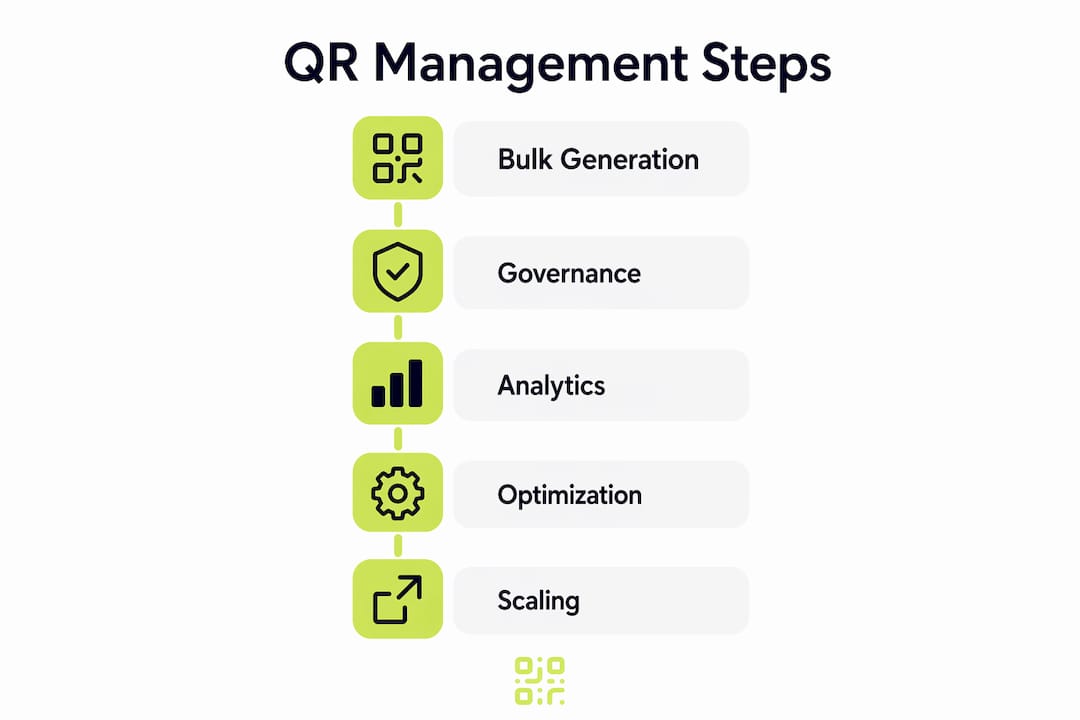
Governance is the part of high-volume QR strategies that most teams skip, and it is the reason campaigns fail at scale. Without it, you get QR code sprawl: hundreds of codes with inconsistent names, no clear ownership, and no way to audit which ones are still pointing at the right destination.
Structured governance prevents broken links and the operational chaos that comes from fragmented deployments. The shift from generating codes to governing them centrally is what separates teams that scale successfully from those that do not.
A practical governance framework covers five areas:
- Standardised naming conventions. Every code gets a name that includes the campaign, channel, and date. “Summer2026_RetailPoster_London” is findable. “QR_code_final_v3” is not.
- Campaign-based categorisation. Group codes by campaign, product line, or event. This makes bulk edits, audits, and reporting far faster.
- Role-based permissions. Limit editing rights to authorised users. Role-based access control prevents accidental or malicious redirects in public-facing campaigns, which can damage brand reputation and erode user trust.
- Cross-departmental collaboration protocols. Define who owns codes in each department and how handovers work when campaigns end or staff change.
- Real-time monitoring and alerts. Set up notifications for codes that stop resolving or show sudden drops in scan volume. Catching a broken link on day one of a campaign is recoverable. Catching it on day thirty is not.
Governance strategies that include standardised naming and campaign categorisation directly reduce the risk of link rot and the operational inefficiencies that compound over time. Treating QR codes as strategic digital infrastructure, rather than isolated print assets, is what makes the difference between a campaign that scales and one that collapses under its own complexity.
What analytics and tracking capabilities optimise QR campaigns?
Analytics are the feedback loop that turns a QR code from a passive link into a measurable marketing channel. Real-time scan analytics covering volume, location data, and device types give you the evidence to make campaign adjustments while a campaign is still running, not after it has ended.
The metrics that matter most at scale are:
| Metric | What it tells you |
|---|---|
| Scan volume by code | Which placements are working and which are not |
| Geographic distribution | Where your audience is physically engaging with your campaign |
| Device type breakdown | Whether to prioritise mobile-first landing pages |
| Time-of-day patterns | When to schedule follow-up pushes or content updates |
| Conversion rate by code | Which QR placements drive the most downstream action |
Dynamic QR codes are the practical tool that makes analytics useful. Because you can update destination URLs after printing, you can respond to what the data shows. If scan volume is high but conversion is low, you change the landing page. You do not reprint 10,000 posters. This flexibility extends campaign lifespan and protects your print budget.
Integrating QR scan data with your CRM or marketing platform gives you a fuller picture. Data-driven decision-making in large-scale marketing operations consistently produces better returns than campaign decisions made on instinct alone. When your QR data feeds into the same system as your email open rates and paid media performance, you can attribute revenue to specific physical touchpoints for the first time.
Pro Tip: Use geographic heat maps to identify underperforming locations early. If a code in one city is generating a fraction of the scans seen elsewhere, investigate the physical placement before assuming the audience is not interested.
What are practical steps to implement high-volume QR management?
Implementing an efficient QR code system does not require a complete overhaul of your existing marketing infrastructure. It requires a clear sequence of decisions and a platform that supports them.
- Assess your current scale and projected growth. Count how many QR codes you are currently running, how many campaigns you plan to launch in the next twelve months, and how many departments will need access. This number determines whether you need a basic platform or one with full API support and role-based access.
- Choose a platform built for bulk generation and dynamic codes. A platform that only generates static codes will force you to reprint every time a destination URL changes. Dynamic QR codes reduce reprinting costs and give campaigns a longer operational life.
- Establish governance policies before you generate a single code. Write your naming convention, assign code ownership by department, and define who has edit rights. Document this in a shared location your whole team can access.
- Train your team on the dashboard and analytics tools. The best platform is useless if your team defaults to spreadsheets. A short onboarding session covering bulk upload, dynamic URL editing, and scan reporting is enough to get most teams productive within a day.
- Monitor performance from day one. Set a weekly review cadence for scan volume and link health. Use real-time QR data to catch problems early and adjust campaign targeting based on what the numbers show.
- Review and retire codes systematically. At the end of each campaign, archive codes rather than deleting them. Historical scan data is valuable for planning future campaigns and benchmarking performance.
The QR code best practices that matter most at scale are consistency, oversight, and the willingness to treat your QR infrastructure as a living system rather than a set-and-forget deployment.
Key takeaways
High-volume QR management succeeds when bulk generation, governance, and real-time analytics work together as a single system rather than separate tasks.
| Point | Details |
|---|---|
| Bulk generation is the starting point | CSV imports and API workflows let you create thousands of codes without manual effort or errors. |
| Governance prevents campaign failure | Standardised naming, role-based access, and real-time monitoring stop broken links and unauthorised edits. |
| Dynamic codes protect your print budget | Updating destination URLs after printing removes the need to reprint when campaigns change. |
| Analytics drive better decisions | Scan volume, location, and device data let you adjust campaigns while they are still live. |
| Governance must come before generation | Setting naming conventions and permissions before launch is far easier than retrofitting them later. |
Why most QR campaigns fail before they scale
The uncomfortable truth about high-volume QR code management is that most teams treat it as a generation problem when it is actually a governance problem. I have seen organisations invest in capable platforms and still end up with broken links, because nobody agreed on who owned the codes or what the naming convention was. The technology is rarely the bottleneck. The process is.
The mindset shift that makes the biggest difference is treating QR codes as digital infrastructure rather than disposable print assets. A QR code on a product label or a conference badge is a live URL. It needs the same care as any other public-facing digital asset: ownership, monitoring, and a clear process for updates. When teams start thinking this way, governance stops feeling like overhead and starts feeling like basic quality control.
Role-based access control is the single most underrated feature in enterprise QR platforms. The risk of an unauthorised redirect on a public-facing campaign is not theoretical. It is a real brand and security risk that role-based permissions eliminate at almost no operational cost. If your current platform does not support it, that is the first thing to change.
The benefits of QR management at scale only materialise when analytics, governance, and dynamic code capabilities work together. Any one of them alone is insufficient.
— The
How Qrlytics supports high-volume QR code management
Qrlytics is built for teams that need to manage QR codes at scale without the operational risk of codes going dark or links breaking after a billing change. Every code created during an active subscription remains functional permanently, which removes one of the most common failure points in large-scale campaigns.
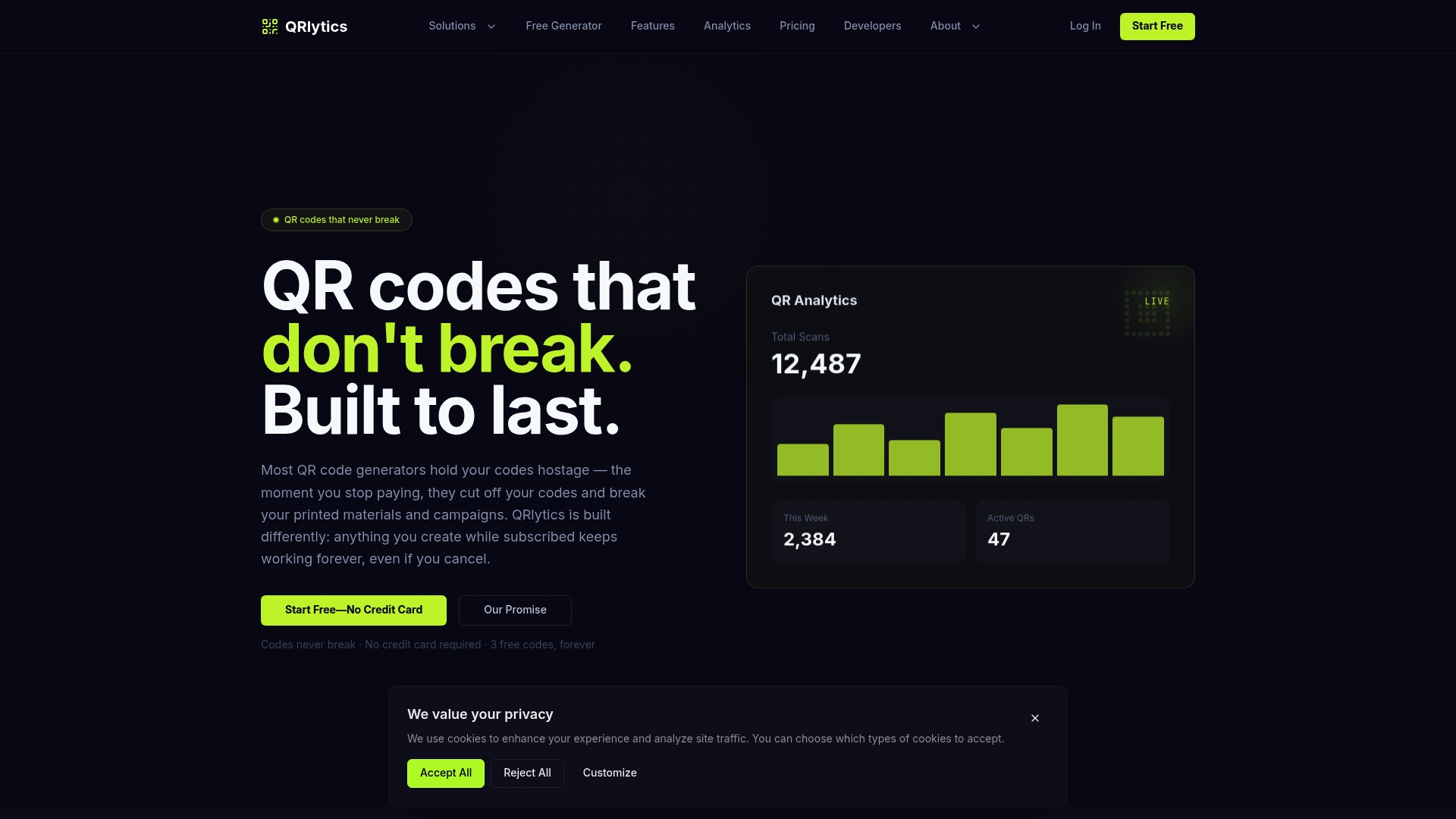
The platform supports bulk QR code creation, dynamic URL updates, GDPR-compliant scan analytics, and role-based access controls. You can start with the free QR code generator to test bulk creation, or move directly to dynamic QR codes for campaigns that need ongoing content updates and full scan tracking. No credit card is required to get started, making it accessible whether you are running a single event or managing codes across an entire retail network.
FAQ
What is high-volume QR management?
High-volume QR management is the centralised process of creating, organising, tracking, and governing large numbers of QR codes simultaneously. It typically involves bulk generation tools, dynamic codes, role-based access, and real-time analytics.
How many QR codes count as high volume?
There is no fixed threshold, but enterprise platforms are generally designed for campaigns involving thousands of codes. Platforms capable of processing 10,000+ codes in under three minutes represent the upper end of current capability.
Why do QR codes break in large campaigns?
QR codes most commonly break when a subscription lapses, a destination URL changes without a dynamic redirect in place, or a code is deleted from a platform without a redirect fallback. Governance policies and dynamic codes prevent most of these failures.
What is a dynamic QR code and why does it matter at scale?
A dynamic QR code stores a redirect URL rather than a fixed destination, so you can change the landing page after the code is printed. At scale, this eliminates costly reprints whenever campaign content changes.
What analytics should I track in a high-volume QR campaign?
The most useful metrics are scan volume by code, geographic distribution, device type, and time-of-day patterns. These four data points give you enough information to adjust placements, landing pages, and campaign timing while the campaign is still running.