What is QR link uniformity? a 2026 guide

TL;DR:
- QR link uniformity is the consistent use of branding, URL structure, and redirect reliability across all QR codes an organization deploys. It ensures reliable, predictable user experiences, maintains brand trust, and supports scalable management of QR code campaigns.
QR link uniformity is the consistent application of branding, URL structure, and redirect reliability across every QR code an organisation deploys. Without it, your printed packaging, campaign materials, and digital touchpoints each behave differently, eroding customer trust and making performance measurement almost impossible. For marketing professionals and brand managers, this is not a technical nicety. It is a foundational requirement for any QR code strategy that scales.
What is QR link uniformity in practice?
QR link uniformity, known more formally as QR code link standardisation, means every code in your portfolio points to a predictable, managed destination using a consistent technical structure. Three components define it.

URL structure and redirect reliability are the backbone. Dynamic QR codes encode a short redirect URL rather than a final destination, which means you can update the landing page without reprinting. Static codes embed the destination directly, offering no redirect layer and no analytics. For any campaign where the destination might change, or where you need attribution data, dynamic codes are the correct choice.
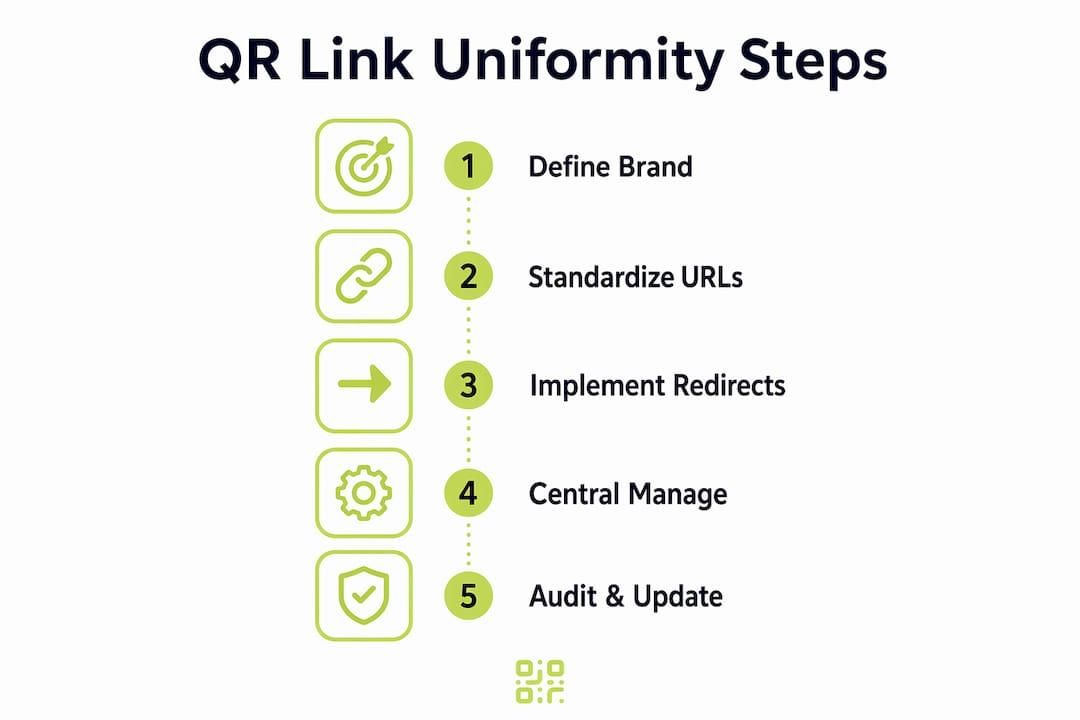
Branding consistency covers the visual design of the code itself: colour, logo placement, and module style. Customisation is legitimate, but it must stay within technical boundaries. Altering module shapes or reducing quiet zones breaks ISO/IEC 18004 standards, the international specification governing QR code grid patterns. When those standards are violated, error correction capacity is consumed by visual distortions rather than data recovery, and scan failure becomes intermittent and hard to diagnose.
Encoding standards complete the picture. The GS1 Digital Link standard, now formalised as ISO/IEC 18975, encodes supply chain identifiers directly into the URL. A single GS1 Digital Link QR code can serve a point-of-sale scanner, a consumer information page, and a logistics system simultaneously. That multi-purpose capability is only reliable when the URI syntax is precise and consistently applied across your entire code set.
- Consistent URL structures prevent broken redirects across campaigns
- Dynamic codes allow destination updates without reprinting materials
- ISO/IEC 18004 compliance preserves scan reliability under real-world conditions
- GS1 Digital Link syntax enables one code to serve multiple audiences
Pro Tip: Keep a brand style guide specifically for QR code design. Define permitted colour contrast ratios, minimum quiet zone sizes, and approved logo placement rules. Share it with every agency or supplier producing codes on your behalf.
Why does QR link uniformity matter for brand trust?
Inconsistent QR links create a trust deficit that is difficult to recover from. When one code on your packaging leads to a product page, another leads to a PDF, and a third leads to an unverified third-party site, customers cannot distinguish legitimate brand engagement from a security risk.
“Users find it nearly impossible to distinguish legitimate brand engagement from security risks without uniformity. Inconsistent link destinations undermine confidence in the entire QR code ecosystem a brand has built.” — Qualification Check
The practical consequences are measurable. Customers who scan a code and land somewhere unexpected do not scan again. That lost scan is a lost conversion, a lost data point, and a lost opportunity to reinforce your brand message. Uniform QR codes reduce customer confusion and improve the trustworthiness of every digital touchpoint you own.
The security dimension is equally serious. Rogue QR codes, those created outside your central management system by individual team members or external suppliers, can redirect to outdated pages, competitor sites, or in worst cases, phishing destinations. Without uniformity, you have no reliable way to audit what your codes are doing in the field.
Brand managers who treat QR codes as permanent infrastructure, comparable to legal documentation or manufacturing records, build a more accountable and trustworthy customer experience. The Delhi Public Works Department recognised this when it mandated standardised QR codes on all road signage, requiring manufacturer information and warranty data to be encoded reliably. Public infrastructure and consumer brands face the same underlying challenge: the code must always do what it promises.
How does centralised management enable QR code consistency?
Centralised QR code management is the operational mechanism that makes link uniformity achievable at scale. Without a central system, codes proliferate across departments, agencies, and suppliers, each created with different tools, different URL conventions, and no shared governance.
A centralised platform integrates with your packaging and marketing systems to govern every code from creation to retirement. Here is how the process works in practice:
- Create codes centrally. All QR codes are generated through one platform, applying consistent URL structures, redirect logic, and design standards automatically.
- Synchronise destinations automatically. When a product page URL changes, the redirect updates across every affected code without reprinting. This prevents the broken link problem that ruins printed materials.
- Monitor performance in real time. Scan analytics covering timestamp, device OS, and geolocation give your team attribution data for every campaign touchpoint.
- Audit and retire codes systematically. A central registry lets you identify inactive or misdirected codes before they reach customers.
- Maintain compliance records. Centralised logs support GDPR compliance and provide an audit trail for regulatory purposes.
Centralised QR management reduces invalid destinations by 100% compared to manual methods. That figure reflects a straightforward operational reality: when every code is created and updated through one system, there is no mechanism by which a code can point to an invalid destination unless the destination itself is removed.
Platforms like Qrlytics are built specifically for this model. Qrlytics guarantees that codes created during an active subscription remain functional regardless of billing status, which addresses one of the most common failure modes in QR code management: codes deactivating when a subscription lapses.
Pro Tip: Before migrating to a centralised platform, audit your existing QR code inventory. Catalogue every code currently in circulation, its destination URL, and the printed material it appears on. This baseline makes the migration process far cleaner and prevents legacy codes from being overlooked.
What technical pitfalls break QR link consistency?
Several technical mistakes consistently undermine QR link uniformity, even when the intent to maintain consistency is present.
| Pitfall | Technical Cause | Impact on Uniformity |
|---|---|---|
| Warped module shapes | Violates ISO/IEC 18004 grid standards | Consumes error correction capacity; intermittent scan failure |
| Insufficient quiet zones | Reduces scanner’s ability to locate the code boundary | Codes fail in busy visual environments |
| Oversized logo placement | Exceeds error correction tolerance | Permanent scan failure in low-light or low-resolution conditions |
| Long or complex URLs | Increases QR code version size and density | More error-prone; harder to scan at small print sizes |
| Stale GS1 Digital Link qualifiers | Outdated URI syntax returns incorrect data | Users receive wrong product or destination information |
Long URLs increase QR code complexity, making scanning more error-prone. Removing unnecessary tracking parameters and using uppercase-only domains where possible reduces the QR code version size and improves reliability. URL shorteners serve the same purpose when full URLs are unavoidable.
Visual customisation is the most misunderstood pitfall. Marketers frequently request heavily styled codes with custom shapes and gradient colours. These can work, but only when the design stays within the error correction budget defined by ISO/IEC 18004. Grid pattern warping and insufficient quiet zones directly reduce error correction functionality, causing scan failures that are difficult to reproduce and diagnose in the field.
GS1 Digital Link URI syntax requires particular care. Stale qualifiers or incorrectly formatted application identifiers cause codes to return outdated information, which is a uniformity failure even when the code itself scans successfully. The GS1 Digital Link URI syntax must be validated at the point of creation, not assumed to be correct.
Best practices for QR link uniformity in marketing campaigns
Achieving consistent QR link behaviour across a marketing programme requires both technical governance and team-level discipline. The following practices apply whether you manage ten codes or ten thousand.
- Use dynamic QR codes for all campaign materials. Dynamic codes allow destination updates without reprinting, which is the single most effective way to prevent broken links on printed assets.
- Adopt a single generation platform. Fragmented tooling is the primary cause of inconsistent URL structures. One platform means one set of standards applied to every code.
- Define and enforce design standards. Document permitted customisations, minimum quiet zone dimensions, and approved logo sizes. Apply these standards in your supplier briefs and agency contracts.
- Schedule regular link audits. Redirect destinations change as websites are restructured. A quarterly audit of all active codes catches broken or misdirected links before they affect customers.
- Train your team on ISO and GS1 compliance. Marketing teams do not need to memorise technical specifications, but they do need to understand why certain design requests are rejected and why URL formatting conventions matter.
- Use scan analytics to monitor performance. Tracking timestamp, device OS, and geolocation data reveals which codes are underperforming and where in the customer journey uniformity is breaking down.
Brand consistency supports business growth across every channel, and QR codes are no exception. A code that behaves exactly as expected, every time, in every context, is a brand asset. A code that sometimes works, sometimes redirects to the wrong page, and sometimes fails to scan is a liability.
Key takeaways
QR link uniformity requires centralised management, technical compliance with ISO/IEC 18004 and GS1 Digital Link standards, and consistent redirect governance to protect brand trust and campaign performance.
| Point | Details |
|---|---|
| Centralised management is non-negotiable | Centralised QR platforms eliminate invalid destinations and prevent rogue codes from reaching customers. |
| Dynamic codes prevent broken links | Dynamic QR codes allow destination updates without reprinting, protecting printed materials from becoming obsolete. |
| ISO/IEC 18004 compliance protects scan reliability | Visual customisations must stay within error correction tolerances or intermittent scan failures will follow. |
| GS1 Digital Link enables multi-purpose codes | Correctly formatted GS1 Digital Link URIs allow one code to serve retail, logistics, and consumer audiences simultaneously. |
| Regular audits close the governance loop | Quarterly link audits catch broken or misdirected redirects before they erode customer trust. |
QR link uniformity is more strategic than most teams realise
Having worked across marketing programmes where QR codes were treated as an afterthought, I have seen the same failure pattern repeat itself. A campaign launches with well-designed codes. Six months later, a website migration breaks half the redirects. Nobody notices until a customer complains or a campaign report shows a sudden drop in scan conversions.
The uncomfortable truth is that most organisations do not have a QR code governance problem. They have a QR code visibility problem. Nobody knows how many codes are live, where they point, or who created them. Uniformity is impossible to maintain when the inventory itself is unknown.
The shift I expect to see accelerate through 2026 is the treatment of QR codes as permanent infrastructure rather than disposable campaign assets. GS1 Digital Link adoption is growing in retail and packaging, and the organisations adopting it early are building a QR code estate that serves multiple functions from a single, well-governed code set. That is a significant competitive advantage.
My practical advice: start with the audit. Before you invest in any platform or redesign any codes, catalogue what you have. The results are almost always surprising, and they make every subsequent decision about uniformity far easier to justify internally.
— The
Manage your QR codes with Qrlytics
If you are ready to bring genuine consistency to your QR code programme, Qrlytics gives you the tools to do it without complexity.
Qrlytics offers a free QR code generator alongside a full dynamic QR code platform with real-time scan analytics, GDPR-compliant tracking, and redirect management built in. Unlike free tools that deactivate codes when a subscription lapses, Qrlytics guarantees your codes remain functional regardless of billing status. For brand managers who need reliable, auditable QR code governance across campaigns and packaging, it is a practical starting point with no credit card required.
FAQ
What is QR link uniformity?
QR link uniformity is the consistent application of URL structure, redirect behaviour, and branding across all QR codes in an organisation’s portfolio. It ensures every code delivers a predictable, reliable experience to the end user.
Why do QR codes break or redirect incorrectly?
QR codes break when the destination URL changes and the code has no dynamic redirect layer, or when the code was created outside a centralised management system. Centralised management eliminates invalid destinations by synchronising redirects automatically.
What is the difference between dynamic and static QR codes?
Dynamic QR codes encode a short redirect URL that can be updated after printing, while static codes embed the final destination directly. Dynamic codes are preferred for marketing because they support destination changes and provide scan analytics.
How does iso/iec 18004 affect QR code design?
ISO/IEC 18004 defines the technical standards for QR code grid patterns, quiet zones, and error correction. Designs that violate these standards, such as warped modules or undersized quiet zones, reduce scan reliability and consume error correction capacity unnecessarily.
What is gs1 digital link and why does it matter?
GS1 Digital Link is an ISO/IEC 18975 standard that encodes supply chain identifiers into a URL, allowing one QR code to serve multiple purposes across retail, logistics, and consumer information systems. Correct URI formatting is required for the standard to function reliably.