Why choose advanced QR platforms for your campaigns
TL;DR:
- Advanced QR platforms combine dynamic code management, real-time analytics, and security certifications to provide measurable marketing insights. They enable updates, detailed scan tracking, and seamless integration with CRM and GA4 systems, improving attribution and campaign performance. Choosing a compliant, reliable platform ensures codes remain active and campaign data stays secure, especially in regulated industries.
Advanced QR platforms are defined as systems that combine dynamic code management, real-time scan analytics, and compliance-grade data security into a single managed service. Basic QR code generators produce a static image and nothing more. Advanced platforms, by contrast, let you update destinations after printing, track every scan by location and device type, and connect offline interactions to your digital marketing stack. For marketing professionals, business owners, and campaign managers who need measurable results from printed and physical media, understanding why choose advanced QR platforms is the difference between guesswork and evidence-based decisions.
What features distinguish advanced QR platforms from basic generators?
Dynamic QR codes allow you to change the destination URL after a code has been printed. Static codes cannot be updated, which means a misprint or a campaign change renders them permanently broken. Dynamic codes also tend to be smaller and more scannable because they store a short redirect URL rather than the full destination address.
The feature gap between basic and advanced platforms is significant. Here is what separates them:
- Dynamic URL editing: Update destinations without reprinting any physical material.
- Scan analytics: Track total scans, unique scans, scan location, device type, and time of scan.
- Bulk generation: Create thousands of codes via CSV upload, which is essential for product labelling and event management at scale.
- Team management: Centralised dashboards with role-based access controls for marketing teams.
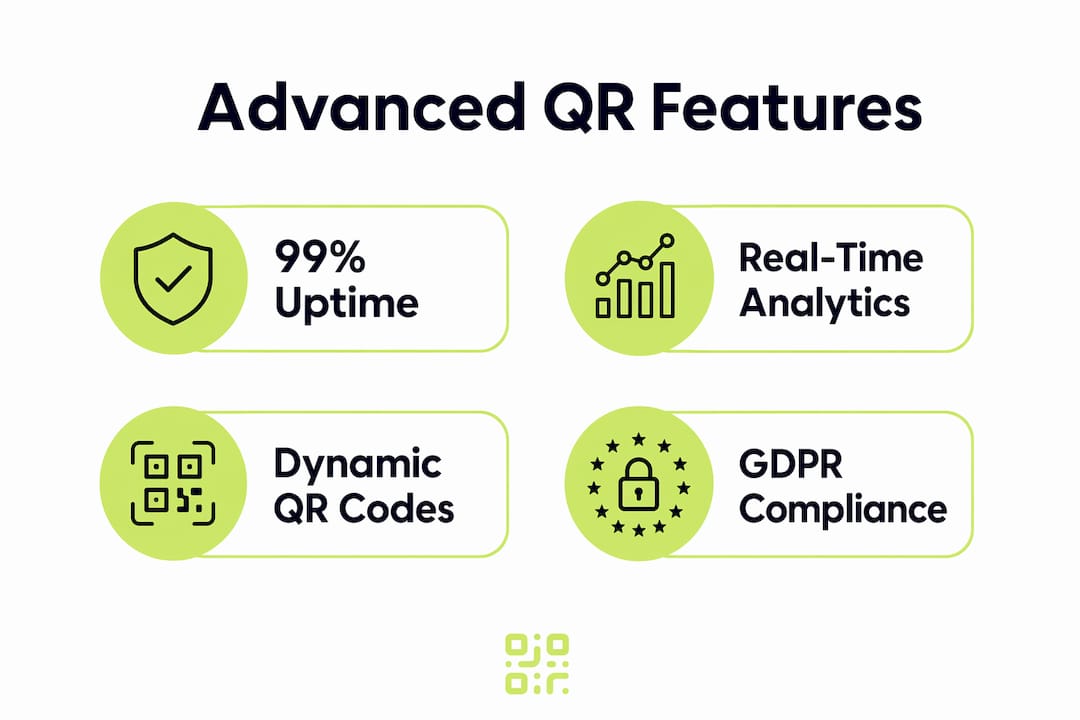
- Compliance certifications: Enterprise platforms carry certifications such as ISO 27001, SOC 2 Type 2, HIPAA, and GDPR to meet governance requirements.
- Integrations: Native connections to CRM systems, GA4, and retargeting pixels.
Pro Tip: When evaluating platforms, ask specifically whether analytics data is retained after a subscription lapses. Some platforms delete historical scan data on cancellation, which destroys your campaign records.
The integrations point deserves particular attention. CRM and GA4 connections eliminate the manual reconciliation of offline scan data with online conversion records. That gap has historically made QR campaigns difficult to attribute, and closing it changes how you report campaign ROI.
How do advanced QR platforms enhance campaign tracking and engagement?
Real-time scan analytics give marketers total scans, unique scans, trends over time, user location, and device type in a single dashboard. That data enables optimisation decisions that would otherwise require a separate research project. The insight is immediate and tied directly to physical campaign assets.
Advanced platforms take tracking further with GPS-level location data and retargeting pixels. Here is how a well-structured tracking workflow looks in practice:
- Deploy dynamic QR codes across printed materials, packaging, or outdoor advertising.
- Capture scan data including precise location, device type, and timestamp for every interaction.
- Fire retargeting pixels so that scanners who do not convert immediately can be reached again via paid social or display advertising.
- Map the user journey from the physical scan point through to the digital conversion event.
- A/B test destinations by routing different audience segments to different landing pages and comparing conversion rates.
GPS-level tracking and GA4 pixels eliminate the gap between offline scan activity and online conversion measurement. That is the core reason advanced platforms justify their cost over basic generators. You can read more about putting this into practice in this practical guide for marketers on QR code tracking.
The A/B testing capability is underused by most campaign managers. Routing 50% of scans to version A and 50% to version B of a landing page, then measuring which drives more conversions, turns a printed poster into a controlled experiment. No other offline channel offers that level of measurability.

Why is compliance and security critical in choosing a QR platform?
Platforms lacking compliance certifications fail to meet governance requirements for managing large volumes of scan data and sensitive user information. For organisations in healthcare, finance, or public sector, this is not a preference. It is a procurement requirement.
The relevant standards to check for are:
- ISO 27001: International standard for information security management systems.
- SOC 2 Type 2: Audited confirmation that a platform’s security controls operate effectively over time.
- GDPR: Mandatory for any platform collecting scan data from users in the United Kingdom or European Union.
- HIPAA: Required for healthcare sector deployments in the United States.
Non-compliant platforms create real risks. Scan data collected without proper consent mechanisms or encryption exposes your organisation to regulatory fines and reputational damage. A platform that cannot produce an audit trail of data access is also a liability during procurement reviews. You can find a detailed breakdown of what to look for in this QR data privacy guide for marketing campaigns.
Security features to verify include end-to-end encryption of redirect data, role-based access controls, and audit logs that record who changed a destination URL and when. These are not advanced features. They are baseline requirements for any platform handling campaign data at scale.
What are the cost considerations and pricing models for advanced QR platforms?
Monthly subscription tools typically cost between £4 and £12 per month, while one-time purchase applications generally break even against subscription costs within 2–3 months. The right model depends entirely on what you need the platform to do.
| Use case | Recommended model | Reason |
|---|---|---|
| Single campaign, no analytics needed | One-time purchase | Lower total cost, no ongoing obligation |
| Ongoing campaigns with tracking | Subscription | Real-time analytics and dynamic editing require live infrastructure |
| Enterprise with team management | Subscription | Centralised controls and compliance features require maintained infrastructure |
| Regulated industry deployment | Subscription with compliance certs | ISO 27001 and SOC 2 Type 2 require continuous auditing |
Subscription tools create a perpetual financial obligation for features that do not fundamentally change over time, since the QR standard itself is stable. That is a fair criticism of the model. The counter-argument is that centralised team management, real-time attribution tracking, and compliance maintenance genuinely require live infrastructure and ongoing investment from the vendor.
Pro Tip: Before committing to a subscription, confirm in writing that QR codes created during an active subscription remain functional if you cancel. Some platforms deactivate codes on cancellation, which destroys any printed materials that carry them.
The permanence question is the most overlooked cost consideration. A platform that deactivates your codes on cancellation creates a hidden switching cost. Every printed item carrying those codes becomes worthless the moment you stop paying.
How can marketing professionals apply advanced QR platforms effectively?
Effective QR campaigns depend on both platform capability and execution discipline. The analytics are only as useful as the campaign design that generates the data.
- Maintain the Quiet Zone: A 4-module white border around every QR code is required for reliable scanning. Removing it to fit a design is the most common cause of scan failures in printed materials.
- Use Level H error correction when adding a logo or overlay to a QR code. This setting allows up to 30% of the code to be obscured without losing scannability.
- Place codes at eye level on physical materials. Codes placed below knee height or above head height are scanned far less frequently.
- Link integrations early: Connect your QR platform to your CRM and GA4 before launch, not after. Retroactive data reconciliation is time-consuming and often incomplete.
- Rotate destinations for seasonal campaigns using dynamic URL editing rather than reprinting. This keeps costs down and maintains scan history continuity.
Pro Tip: Use scan volume trends to identify peak engagement windows. If 70% of scans happen within the first 48 hours of a campaign going live, you know where to concentrate your paid amplification budget.
CRM integrations with marketing automation allow scan events to trigger follow-up sequences automatically. A customer who scans a QR code on product packaging can receive a personalised email within minutes, without any manual intervention. That kind of automation is only possible when your QR platform connects to your broader marketing stack.
The pitfall most campaign managers encounter at scale is inconsistent code management. When different team members create codes in different accounts or tools, you lose centralised visibility and your analytics fragment across multiple dashboards. A single platform with team-level access controls solves this directly.
Key takeaways
Advanced QR platforms deliver measurable campaign value through dynamic code management, real-time analytics, compliance-grade security, and direct integration with CRM and GA4 systems.
| Point | Details |
|---|---|
| Dynamic codes are non-negotiable | Static QR codes cannot be updated after printing; dynamic codes protect your printed investment. |
| Analytics drive ROI proof | Real-time scan data including location, device, and time enables direct campaign attribution. |
| Compliance is a procurement requirement | ISO 27001, SOC 2 Type 2, and GDPR certifications are mandatory for regulated sector deployments. |
| Code permanence affects total cost | Platforms that deactivate codes on cancellation create hidden costs for any printed materials. |
| Integrations close the attribution gap | CRM and GA4 connections link offline scan events to online conversions without manual reconciliation. |
The compliance shift that most marketers are not ready for
The conversation around QR platforms has shifted considerably over the past two years. When I started working with QR-based campaigns, the primary question was always “does it scan reliably?” That question is now table stakes. The question that actually determines platform selection in 2026 is “can this platform pass our procurement team’s security review?”
Compliance requirements have moved from a niche concern for healthcare and finance into mainstream marketing procurement. I have seen campaigns delayed by weeks because the chosen QR platform could not produce a SOC 2 Type 2 report or demonstrate GDPR-compliant data handling. The analytics capability was excellent. The platform failed on governance, and the campaign suffered for it.
The integration challenge is equally underestimated. Connecting a QR platform to GA4 sounds straightforward, but retargeting pixel implementation requires careful coordination with your paid media team. When it works, the results are genuinely impressive. Offline scan events feeding directly into audience lists for paid social is a capability that most marketers have not yet fully used.
My honest advice: choose a platform that your procurement team can approve, your marketing team can use without training, and that guarantees your codes remain active regardless of billing status. Those three criteria eliminate most of the risk in QR platform selection.
— The
Qrlytics: advanced QR code management built for marketers
Qrlytics is built for marketing professionals who need QR codes that work reliably, track accurately, and never break. Every code created during an active subscription remains functional permanently, regardless of billing status. That guarantee protects every printed asset you produce.
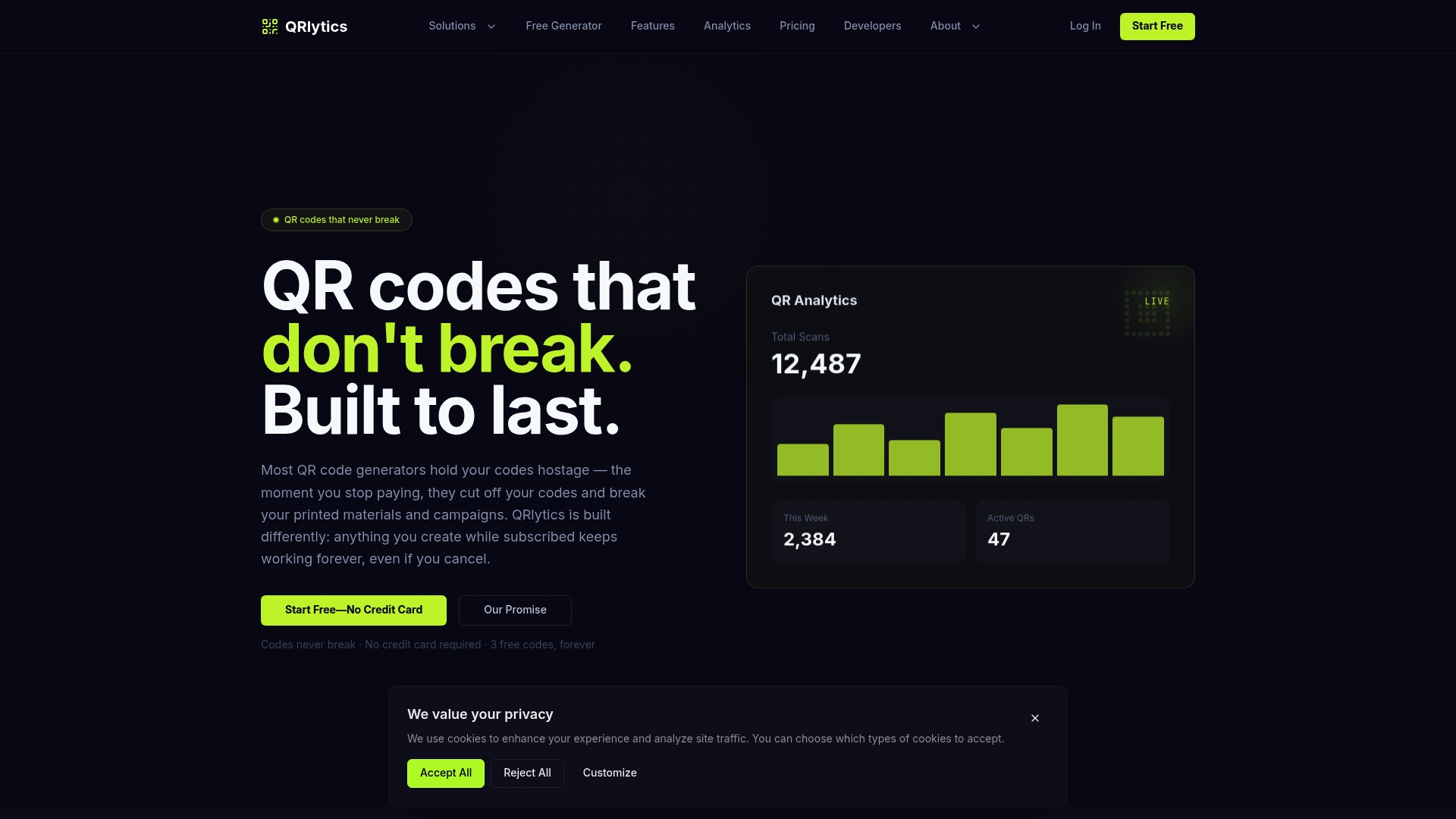
The platform provides real-time scan analytics, GDPR-compliant tracking, dynamic URL editing, and high-quality branded code generation. You can generate your first QR code free without a credit card to test the platform before committing. For teams managing campaigns at scale, Qrlytics offers centralised management, bulk generation, and the compliance documentation that enterprise procurement requires.
FAQ
What is an advanced QR platform?
An advanced QR platform is a managed service that provides dynamic QR code generation, real-time scan analytics, team management, and compliance-grade data security. It goes beyond basic code creation by enabling destination updates after printing and connecting scan data to marketing tools such as CRM systems and GA4.
Why use dynamic QR codes instead of static ones?
Dynamic QR codes allow you to change the destination URL after printing, provide scan analytics including location and device type, and support A/B testing of destinations. Static codes are fixed at creation and provide no tracking data.
What compliance certifications should a QR platform hold?
Enterprise QR platforms should hold ISO 27001, SOC 2 Type 2, and GDPR certifications as a minimum. Healthcare sector deployments additionally require HIPAA compliance. Platforms without these certifications fail standard procurement reviews in regulated industries.
How much do advanced QR platforms typically cost?
Monthly subscription plans typically cost between £4 and £12 per month. One-time purchase tools break even against subscription costs within 2–3 months but lack real-time analytics and dynamic editing capabilities.
What happens to QR codes if I cancel my subscription?
This varies by platform and is the most important question to ask before committing. Some platforms deactivate all codes on cancellation, which renders any printed materials carrying those codes permanently broken. Qrlytics guarantees that codes created during an active subscription remain functional regardless of future billing status.