Examples of branded code landing pages for marketers
TL;DR:
- Branded QR landing pages are mobile-friendly, styled pages linked to QR codes that include interactive demos or campaign assets. They must be GDPR-compliant, accessible, and managed via dynamic links to allow updates without reprinting. Using proven templates and testing across devices ensures effective, measurable campaigns that foster trust and conversion.
A branded code landing page is a mobile-first, brand-styled destination page that a QR code points to, often embedding live code previews, interactive demos, or campaign assets alongside your logo, colours, and calls to action. The highest-impact examples for QR campaigns fall into eight types: technical demo or live playground, SDK/API integration time estimator, coupon or gated offer, product micro-site, event check-in hub, installer or CLI hero, personalised journey, and downloadable asset hub.
Every example in this article is built around three non-negotiables: GDPR-compliant data handling for UK campaigns, WCAG-aligned accessibility, and dynamic QR links managed through a platform like Qrlytics so your destination URL can be updated without reprinting a single code.
- Technical demo / live playground — proves product value before asking for a sign-up
- SDK/API estimator — quantifies integration time to create immediate ROI clarity
- Coupon / gated offer — single-field email gate with UTM-tagged coupon reveal
- Product micro-site — feature tiles, benchmarks, and a sticky CTA
- Event check-in hub — QR-initiated check-in with real-time attendance counter
- Installer / CLI hero — centred terminal card with copy-to-clipboard install command
- Personalised journey — dynamic URL parameters prefill name or offer
- Downloadable asset hub — gated downloads with file metadata and integrity checks
Table of Contents
- Eight branded QR landing page templates you can adapt today
- What does a well-branded QR landing page look like on mobile?
- Developer-ready code patterns for branded QR destinations
- How do you measure QR campaign performance accurately?
- UK GDPR and accessibility: what your QR landing page must cover
- Key takeaways
- Qrlytics makes permanent, trackable QR campaigns straightforward
- FAQ
Eight branded QR landing page templates you can adapt today
These templates map directly to common QR campaign objectives. Each one includes a primary objective, three must-have elements, a suggested metric, and a one-line microcopy sample. For deeper conversion-focused examples, the Qrlytics blog covers real campaign builds in detail.
| Template | Primary objective | Three must-have elements | Metric to track | Microcopy sample |
|---|---|---|---|---|
| Technical demo / live playground | Prove product value before sign-up | Dark hero with auto-typing prompt, blurred output gate after a few lines, inline sign-up | Playground interactions (micro-conversions) | “Run the demo. Sign up to copy.” |
| SDK/API estimator | Quantify integration time | Input selectors, animated results panel, copy install buttons | Estimator completions | “See how long your integration actually takes.” |
| Coupon / gated offer | Capture email and drive redemption | One-field email gate, single-step coupon reveal, UTM tagging | Coupon reveals and redemptions | “One step. Your discount is waiting.” |
| Product micro-site | Communicate value and convert | Feature tiles, quick comparison data tile, sticky CTA | Scroll depth and CTA clicks | “Everything you need to decide. Right here.” |
| Event check-in hub | Streamline attendance | QR-initiated check-in flow, ticket QR pairing, real-time counter | Check-ins per minute | “Scan your ticket. You’re in.” |
| Installer / CLI hero | Reduce setup friction | Centred terminal card, copy-to-clipboard command, one-click run instructions | Install command copies | “One command. You’re running.” |
| Personalised journey | Increase relevance and conversion | Dynamic URL params prefilling name or offer, progressive disclosure, fallback for unknown users | Personalised vs generic conversion rate | “Hi [Name]. Your offer is ready.” |
| Downloadable asset hub | Gate and deliver resources | Gated downloads, file metadata display, API usage examples | Download completions | “Your files. Verified and ready to use.” |
The Compile template from Rocket demonstrates the live playground pattern well: a dark full-bleed hero auto-types a monospaced prompt, then reveals cascading code blocks inside a bento grid containing language benchmarks and latency graphs, with the playground itself blurred until sign-up. The Invoke template shows how an above-the-fold estimator anchors the primary CTA inside the results panel, so the conversion moment arrives exactly when the visitor sees their ROI number.

For coupon and gated offer pages, the Qrlytics blog’s coupon code generator guide covers copy patterns and redemption flows in detail. Personalised journey pages work best when paired with QR personalisation strategies that explain how dynamic parameters map to real conversion uplifts.
What does a well-branded QR landing page look like on mobile?
Mobile-first layout is not optional when your traffic arrives via QR scan. Every visitor is on a phone, often in a noisy physical environment with limited attention.
Layout and hierarchy:
- Single-column layout with the headline and primary CTA above the fold
- Large tappable CTAs (minimum 44×44px touch target per WCAG 2.1)
- Progressive disclosure for technical content: show the headline value first, reveal code blocks on scroll
Brand continuity:
- Use a compact logo variant sized for small screens, not the full horizontal lockup
- Apply your primary and secondary colour tokens consistently, including to syntax highlighting in code blocks
- Keep font choices consistent between marketing copy and code snippets — a mismatched monospace font signals carelessness to technical visitors
Microcopy:
- CTAs use single action verbs: “Copy”, “Download”, “Scan”, “Redeem”
- Add friction-reducing affordances such as “Copy install command” rather than just “Copy”
- Include a short privacy notice with a link to your cookie or consent page near any data-capture field
Accessibility essentials:
- Colour contrast ratio of at least 4.5:1 for body text (WCAG AA)
- Skip links and clear focus styles for keyboard and screen-reader users
- Descriptive alt text on all images, including QR code images themselves
Pro Tip: Consistent syntax highlighting colour tokens — amber, emerald, and blue are a common developer-familiar palette — signal professionalism at first glance and reassure technical visitors before they read a word of copy. See the shadcn dark code-window hero for a reference implementation.
Good web design principles reinforce that brand systems applied consistently across every touchpoint, including landing pages, build the trust that converts a scan into a sign-up.
Developer-ready code patterns for branded QR destinations
Essential meta tags
Every branded QR landing page needs these at the top of the <head>:
<meta name="viewport" content="width=device-width, initial-scale=1">
<meta property="og:title" content="Your Campaign Name">
<meta property="og:description" content="Short campaign description">
<meta property="og:image" content="https://yourdomain.com/og-image.png">
<link rel="canonical" href="https://yourdomain.com/campaign-slug">
The canonical tag preserves analytics accuracy when UTM parameters are appended to the URL.
Copy-to-clipboard install command
<div class="hero-install">
  <code id="install-cmd">npm install your-sdk</code>
  <button onclick="copyInstall()">Copy</button>
</div>

<script>
function copyInstall() {
  navigator.clipboard.writeText(
    document.getElementById('install-cmd').innerText
  ).then(() => {
    document.querySelector('button').innerText = 'Copied ✓';
  });
}
</script>
Dynamic QR redirect (Node/Express)
app.get('/qr/:campaignId', async (req, res) => {
  const destination = await db.getCampaignUrl(req.params.campaignId);
  const utmDest = destination + '?utm_source=qr&utm_campaign='
    + req.params.campaignId;
  res.redirect(302, utmDest);
});
This pattern lets you update the destination URL server-side without changing the printed QR code.
Blur-gate progressive reveal
.gated-output { filter: blur(4px); transition: filter 0.3s; }
.gated-output.unlocked { filter: none; }
document.getElementById('signup-form').addEventListener('submit', () => {
  document.querySelector('.gated-output').classList.add('unlocked');
});
| Snippet | File | Complexity |
|---|---|---|
| Meta tags block | head-meta.html |
Low |
| Copy-to-clipboard hero | install-hero.html + copy.js |
Low |
| Dynamic QR redirect | qr-redirect.js |
Medium |
| Blur-gate reveal | gate.css + gate.js |
Low |
| UTM appending helper | utm-helper.js |
Low |
Pro Tip: For dynamic QR destinations, always use a 302 (temporary) redirect rather than a 301 (permanent) one. A 302 keeps the redirect logic server-side and editable; a 301 gets cached by browsers and breaks your ability to update the destination. Read more about dynamic vs static QR links and why the distinction matters for printed campaigns.
How do you measure QR campaign performance accurately?
Scan analytics and web analytics are two separate data streams. Connecting them is where most campaigns fall short.
Primary metrics to track:
- Scans: total QR code scans recorded by your QR platform
- Unique scanners: distinct devices scanning the code, filtered by Qrlytics per-scan metadata
- Scan-to-conversion rate: scans divided by completed goal events (sign-ups, downloads, redemptions)
- Time-to-conversion: median time from first scan to goal completion
- Scan geography and device distribution: available via Qrlytics heat maps and per-scan metadata
Attribution approach:
Append UTM parameters at the QR destination, not in the QR code URL itself, so the parameters survive dynamic destination updates. Use short-lived campaign tokens where you need to join scan IDs to downstream conversion events server-side.
Micro-conversions matter. Track copy button clicks, playground interactions, and estimator completions as early engagement signals. These tell you whether your creative is working before the conversion funnel even begins. Heat maps for mobile tap analysis reveal which CTAs are being reached and which are being missed on small screens.
Qrlytics provides dynamic links, per-scan metadata, and CSV exports so you can pull scan data into your own analytics stack or BI tool for campaign-level reporting.
UK GDPR and accessibility: what your QR landing page must cover
UK GDPR requires a lawful basis for every piece of personal data you collect. For most QR campaign landing pages, that means either a clear consent mechanism before data capture or a documented legitimate interests assessment. Minimal data collection is not just good practice — it is a legal requirement under the UK GDPR, enforced by the Information Commissioner’s Office (ICO).
Privacy checklist:
- State your lawful basis clearly near any data-capture field
- Link to your full privacy notice from the landing page
- Include data subject rights contact details (email or web form)
- Use a lightweight consent banner for non-essential trackers such as analytics pixels
- Where possible, capture scan events server-side and minimise IP address storage
Accessibility checklist:
- WCAG 2.1 AA colour contrast (4.5:1 for body text, 3:1 for large text)
- All interactive elements keyboard-operable with visible focus styles
- Readable font sizes (minimum 16px for body copy on mobile)
- Descriptive alt text for all images, including QR code images
- Meaningful fallback page for devices that cannot render interactive elements — all CTAs should degrade to simple links
The ICO’s guidance on cookies and the UK WCAG standard (published by the Cabinet Office) are the primary references for UK-based campaigns.
Pre-print and launch tests to run before deploying QR codes
- Scan across at least three devices and two camera apps — confirm the QR code resolves correctly on iOS native camera, Android native camera, and a third-party scanner.
- Test dynamic destination updates — change the destination URL in your QR platform and rescan to confirm the new page loads without any caching delay.
- Validate UTM parameters — check that UTM tags appear correctly in your analytics platform after a live scan.
- Print and distance check — print the QR code at the intended size and test scanning at typical viewing distances (30cm, 60cm, and 1m) under normal lighting.
- Slow network test — throttle your connection to 3G in browser developer tools and confirm the page loads within three seconds and all CTAs remain visible.
- Offline and error fallback — disconnect entirely and confirm the error state shows a meaningful message rather than a blank page.
- Set up scan-drop alerting — configure an alert in Qrlytics or your analytics platform for an abnormal drop in scans, so you can catch a broken destination before it affects a live campaign.
Use Qrlytics’s free QR generator to create a test code for each new landing page before committing to print.
Key takeaways
Branded QR landing pages convert best when they combine mobile-first design, dynamic links, GDPR-compliant data capture, and scan-level analytics from the first day of a campaign.
| Point | Details |
|---|---|
| Choose a template first | Match the template type to your campaign goal before writing a single line of copy or code. |
| Use dynamic QR links | Dynamic links let you update the destination URL without reprinting, protecting your printed materials investment. |
| Instrument analytics from day one | Append UTM parameters at the destination and capture per-scan metadata to connect scans to conversions. |
| Confirm GDPR and WCAG basics | Every UK QR landing page needs a lawful basis for data collection and WCAG 2.1 AA accessibility compliance. |
| Qrlytics for permanence and measurement | Qrlytics provides permanent dynamic links, per-scan metadata, heat maps, and CSV export for full campaign visibility. |
Why working code converts better than marketing copy
Technical audiences are sceptical by default. A headline that says “the fastest SDK on the market” is easy to ignore; a live playground that returns a result in under 200ms is not. The most persuasive branded code landing pages lead with proof: a runnable snippet, an estimator that shows a real number, or a copy-to-clipboard install command that removes the first barrier to trying the product.
The practical balance is this: show the value first, gate only the final copy action. Blur the output after a few lines, not before the visitor has seen anything worth having. That pattern, used well in templates like Compile and Invoke, keeps bounce rates low because the visitor already has a reason to stay before the sign-up prompt appears.
Where most campaigns go wrong is treating the QR landing page as a miniature homepage. It is not. It is a single-purpose page with one job: convert the person who just scanned your code. Every element that does not serve that job should be removed.
Qrlytics makes permanent, trackable QR campaigns straightforward
Printed materials are a long-term commitment. A QR code on a brochure, poster, or product label needs to work in six months, not just today. Qrlytics guarantees that codes created during an active subscription remain functional permanently, regardless of billing changes — so your campaign investment is protected.
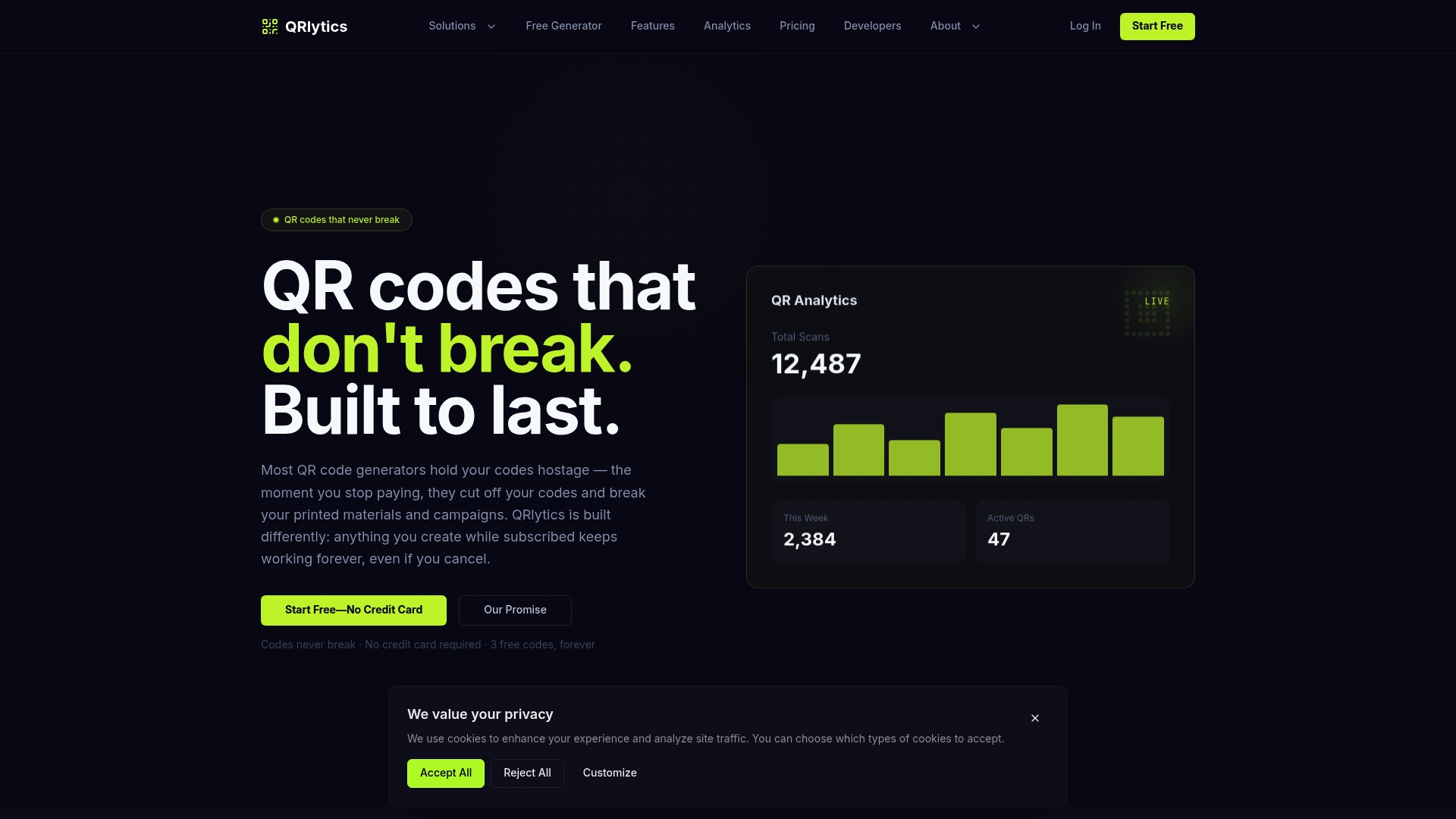
The platform’s dynamic QR code generator lets you update the destination URL at any time, while per-scan metadata, global heat maps, and CSV export give you the campaign data you need to optimise creative and prove ROI. The API access means you can automate redirect updates for personalised journey templates or event check-in flows without manual intervention. Custom branded QR generation keeps your visual identity consistent across every touchpoint.
Start with the free QR generator to create a test code for your first branded landing page, run the seven pre-launch checks above, and you will have a live, measurable QR campaign ready before the end of the week. No credit card required.
Key sources and further reading
Template and design resources:
- Compile velocity code landing page template — Rocket.new: live playground gating pattern and bento grid layout
- Invoke SDK landing page template — Rocket.new: integration time estimator and scroll-reveal pattern
- Hero with code preview block — Shadcn UI Blocks: two-column install command hero
- Dark code-window hero block — shadcn: terminal chrome and syntax highlighting tokens
- Live code playground showcase block — shadcn: PillTabs language selector with animated preview pane
Qrlytics platform pages:
- QR code landing page examples that convert — campaign build examples and conversion guidance
- Dynamic QR code generator — permanent dynamic links and destination management
- QR codes with analytics — per-scan metadata, heat maps, and CSV export
FAQ
What is a branded code landing page?
A branded code landing page is a mobile-first web page, styled with your brand’s visual identity, that serves as the destination for a QR code scan. It typically includes a hero section, a single clear CTA, and often a live code preview or interactive demo.
Why should QR codes use dynamic links rather than static ones?
Dynamic links let you update the destination URL after the QR code has been printed or distributed, so you can fix errors, run A/B tests, or redirect to a new campaign page without reprinting materials. Qrlytics’s dynamic QR codes remain functional permanently, protecting your printed investment.
What UTM parameters should I use for QR campaigns?
Use at minimum utm_source=qr, utm_medium=print (or offline), and utm_campaign=[campaign-name]. Append these at the destination URL in your redirect logic rather than encoding them into the QR code itself, so they survive dynamic destination updates.
What GDPR requirements apply to QR landing pages in the UK?
Under UK GDPR, you need a lawful basis for any personal data collected, a clear privacy notice linked from the page, and a consent mechanism for non-essential tracking cookies. The ICO provides authoritative guidance at ico.org.uk.
How do I test a QR code before printing?
Scan the code across at least three devices and two camera apps, validate UTM parameters in your analytics platform, and print a test copy to check scannability at typical viewing distances. Qrlytics’s free QR generator lets you create and test a code before committing to a full print run.