Explaining QR redirected links for marketers
TL;DR:
- QR redirected links utilize a redirect server within a short URL embedded in a QR code, enabling destination updates and real-time scan tracking. Unlike static codes, dynamic QR codes rely on this server layer, which must be reliable and owned to ensure long-term functionality and data collection. Proper implementation, branded domains, and platform choice are critical to maximizing campaign flexibility and trustworthiness.
A QR redirected link is a short URL encoded inside a QR code that routes the scanner to a final destination via a redirect server, giving you the ability to change that destination after printing and track every scan in real time. This is the core mechanism behind dynamic QR codes, as distinct from static QR codes that embed a fixed URL directly. Platforms such as Qrlytics and Bitly use this redirect architecture to give businesses full control over their printed materials long after they leave the printer. Understanding QR redirected links is the foundation of any serious QR-based marketing campaign.
How do QR redirected links work technically?
A dynamic QR code encodes a short URL rather than the final destination URL. When someone scans the code, their phone sends an HTTP request to the redirect server that owns that short URL.
The server then performs the following steps in a fraction of a second:
- Logs the scan event with metadata including timestamp, IP address, device type, operating system, and user agent string
- Reads any UTM parameters appended to the redirect destination to support Google Analytics attribution
- Returns an HTTP 302 response that sends the user’s browser to the final destination URL
- Stores the event as a durable data record for campaign reporting
The choice of HTTP 302 over 301 is deliberate and significant. A 301 redirect is permanent, which means browsers and operating systems cache it aggressively. If you later update the destination URL, some users will still be sent to the old page until their cache expires. A 302 tells the browser the redirect is temporary, so it always checks back with the server. This is what makes real-time destination changes possible.
Static QR codes skip the server entirely. The URL is baked into the pixel pattern, so there is no server hop, no logging, and no way to change the destination. The fundamental difference between static and dynamic codes is precisely this redirect layer, which is what enables analytics and remote edits.

Pro Tip: Test your redirect speed before printing at scale. A redirect that takes more than 300 milliseconds will noticeably affect the user experience on slower mobile connections, and users may abandon the scan before the page loads.
Why do persistent and consistent QR links matter for campaigns?
The marketing case for persistent QR redirects is straightforward: printed materials are expensive and slow to update, but campaigns are not. A poster printed in January may still be on a wall in September. Without a redirect layer, you are locked into whatever URL you printed. With one, you control the destination indefinitely.
Here are the four most practical advantages of persistent, consistent QR link redirects for campaign management:
- Post-print destination updates. You can redirect a QR code on a product label from a launch page to a review page to a seasonal promotion, all without reprinting. This alone justifies the cost of a dynamic QR platform for any business running multi-phase campaigns.
- Durable scan analytics. Scan analytics depend on the redirect server logging each event. Every scan becomes a data point with timestamp, location, and device type, giving you a persistent record that static codes simply cannot produce.
- Granular placement tracking. Assigning a unique redirect per placement, one for a poster, one for a flyer, one for a product insert, lets you identify which channel drives the most scans. This is how QR campaign tracking moves from guesswork to evidence.
- UTM parameter integration. Adding UTM parameters within the redirect destination connects QR scan data directly to Google Analytics, so you can attribute conversions to specific codes and placements without manual reconciliation.
“The redirect server is not just a technical middleman. It is the measurement layer that turns a printed square into a measurable marketing channel.”
Branded short URLs add a further layer of value. Branded short links increase user trust and click-through rates by approximately 2.3 times compared to generic short links. When a user sees a recognisable domain in their browser bar during the redirect, they are far less likely to abandon the journey. Consistency in your redirect domain is not just a technical preference. It is a trust signal.
What are the key nuances in implementing QR redirects?
Not all redirect implementations carry the same risk profile. Understanding the practical considerations below will help you avoid the most common and costly mistakes.
| Factor | Static QR code | Dynamic QR redirect |
|---|---|---|
| Destination editable after print | No | Yes |
| Scan analytics available | No | Yes |
| Dependent on third-party server | No | Yes |
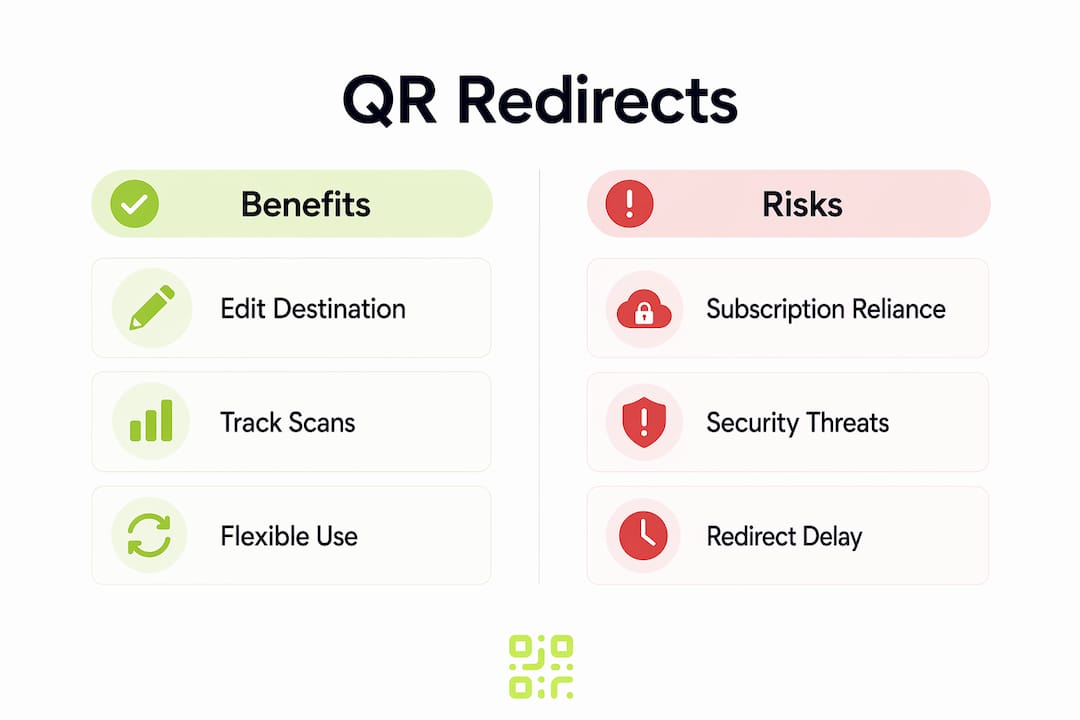
| Risk of expiry | None | High if subscription lapses |
| Supports geo or device routing | No | Yes |
| Branded URL possible | No | Yes |
The most underappreciated risk in dynamic QR deployments is subscription dependency. Dynamic QR codes stop working if the provider’s subscription lapses or the redirect server becomes unavailable. A static code never expires because there is no server in the chain. This is a critical distinction for any printed material with a long shelf life, such as product packaging, signage, or event branding. Qrlytics addresses this directly by guaranteeing that codes created during an active subscription remain functional permanently, regardless of future billing status.
Security is a second consideration. QR code phishing, sometimes called quishing, exploits the fact that users cannot read a QR code before scanning it. Redirect chains through unrecognised domains increase this risk. Using a branded custom domain for your redirect server significantly reduces user hesitation and the risk of your codes being mistaken for malicious links.
Edge routing is a more advanced capability worth knowing about. The redirect server can inspect the incoming request and route users to different destinations based on their country, language setting, or device type, all from a single printed QR code. A UK user scanning a restaurant menu might see a sterling price list while a US user sees a dollar version, without any change to the printed code.
Pro Tip: Always use a custom domain for your redirect server rather than a shared platform subdomain. If the platform changes its domain or shuts down, your printed codes become dead links overnight. Owning the domain gives you a fallback option.
How can businesses use QR redirects effectively for marketing?
Effective use of QR redirected links in marketing comes down to three disciplines: precise tracking setup, smart routing, and reliable platform selection.
On tracking setup, the single most impactful change most businesses can make is to assign unique codes per placement. One code for the window display, one for the till receipt, one for the email footer. This granularity reveals which touchpoints actually drive scans and which are invisible to your audience. Combined with real-time scan data, you can make mid-campaign adjustments rather than waiting for a post-mortem.
On routing, consider these practical applications:
- A/B split redirects send 50% of scans to version A of a landing page and 50% to version B, giving you statistically valid conversion data from a single printed code
- Geo-routing directs users to localised pages based on their country or region, which is particularly useful for brands operating across multiple markets
- Device routing sends iOS users to the App Store and Android users to Google Play from the same code, removing friction from app download campaigns
On platform selection, redirect server reliability directly determines your scan success rate. A platform with poor uptime means failed scans, and failed scans on printed materials cannot be recovered. Prioritise providers that publish uptime records, support custom domains, and offer GDPR-compliant data handling. For businesses that rely on advanced scan tracking, the platform’s analytics depth matters as much as its reliability.
Key takeaways
QR redirected links are only as reliable and measurable as the redirect server behind them, making platform choice and implementation discipline the deciding factors in campaign success.
| Point | Details |
|---|---|
| Redirect layer is the difference | Dynamic QR codes use a short URL and server hop; static codes do not, making analytics impossible. |
| Use HTTP 302, not 301 | A 302 redirect prevents browser caching, so destination updates take effect immediately after printing. |
| Persistent links protect printed assets | Choosing a platform that guarantees code longevity prevents dead links on long-life printed materials. |
| Unique codes per placement | Assigning one code per channel gives granular data on which placements drive the most engagement. |
| Branded domains build trust | Recognisable redirect domains increase click-through rates and reduce the risk of quishing attacks. |
Why I think most businesses underestimate the redirect layer
Most marketers treat the QR code as the product and the redirect as a technical detail. In practice, it is the other way around. The redirect server is where your campaign data lives, where your destination flexibility comes from, and where your brand trust is either built or eroded.
The most common mistake I see is businesses choosing a free or low-cost QR platform without considering what happens to their codes if they cancel or the provider shuts down. Printed materials have a lifespan. A product label might be on a shelf for two years. If your redirect server goes dark six months in, every scan after that is a dead end. That is not a technical inconvenience. It is a direct loss of customer engagement.
The second pitfall is broken conversion tracking. Conversion measurement fails when the server-side postback that connects an anonymous scan event to a later identified conversion is never implemented. Most teams set up scan counting and assume that is sufficient. It is not. Without end-to-end attribution, you know how many people scanned but not how many converted, which makes ROI measurement impossible.
My honest recommendation is to treat your redirect domain as a business asset, not a platform feature. Own it, monitor it, and choose a provider that gives you permanence by design rather than as a paid add-on.
— The
Start managing your QR redirects with Qrlytics
If the concepts above have made one thing clear, it is that the platform behind your QR codes matters as much as the codes themselves. Qrlytics is built specifically to address the reliability and analytics gaps that plague generic QR generators. Every code you create with Qrlytics during an active subscription remains functional permanently, so your printed materials never become dead links. You get dynamic QR codes with editable destinations, real-time scan analytics, GDPR-compliant tracking, custom domain support, and global heat maps. No credit card is required to get started. Whether you are running a single event or managing codes across dozens of campaigns, Qrlytics gives you the control and data you need. Create your first QR code free today and see the redirect layer working in your favour.
FAQ
What is a QR redirected link?
A QR redirected link is a short URL embedded in a QR code that routes the scanner through a redirect server to the final destination. This server hop enables destination changes after printing and logs scan data for analytics.
Why do dynamic QR codes stop working?
Dynamic QR codes expire when the redirect server becomes unavailable, typically because a subscription has lapsed or the provider has shut down. Static QR codes do not expire because they contain no server dependency.
What is the difference between HTTP 301 and 302 for QR redirects?
A 302 redirect is temporary and prevents browsers from caching the destination, which means updates take effect immediately. A 301 is permanent and can cause browsers to serve the old destination from cache even after you have changed it.
How do I track QR code scans in Google Analytics?
Append UTM parameters to your redirect destination URL, using values such as "utm_medium=qrandutm_source` set to the placement name. The redirect server passes these parameters to the landing page, where Google Analytics records them as standard campaign traffic.
Can one QR code send different users to different pages?
Yes. Edge routing at the redirect server level allows geo-targeting and device-based routing from a single printed code, sending users to different destinations based on their country, language, or device type without any change to the physical code.