Coupon code generator: the marketer’s 2026 guide

TL;DR:
- A coupon code generator creates unique, secure promotional codes for marketing campaigns. Using cryptographically secure methods and removing ambiguous characters improves campaign integrity and redemption rates. Effective management requires real-time validation, proper integration, and scalable batch capacity.
A coupon code generator is a tool that creates unique, random, or custom promotional codes for businesses to drive sales and measure marketing effectiveness. The industry term for the underlying process is promotional code generation, and it covers everything from a simple random code generator free to use in a browser, to enterprise-grade discount code maker platforms that produce hundreds of thousands of codes per batch. Getting the fundamentals right matters: predictable pseudorandom generators risk fraud through code guessing, which makes cryptographic security a baseline requirement for any code holding monetary value. This guide covers the features that matter, how to generate and customise codes step by step, and how to manage them inside live campaigns.
What features matter in a coupon code generator?
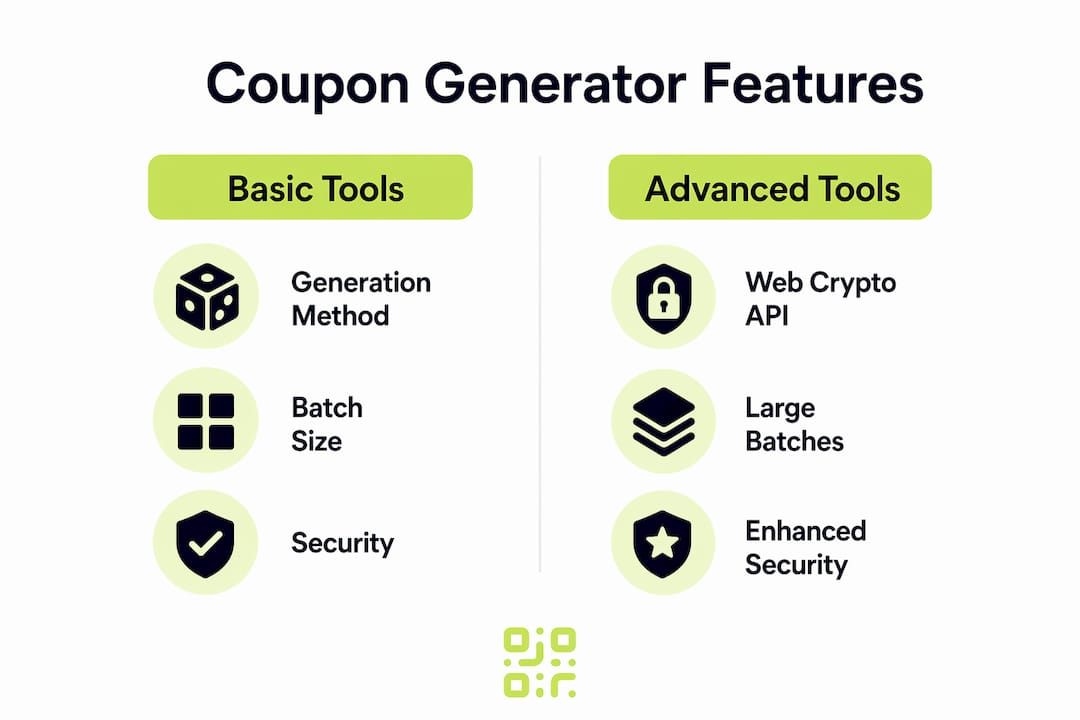
The most important feature in any promo code generator is the method it uses to produce codes. Cryptographically secure generation via the Web Crypto API produces true unpredictability, making codes suitable for high-value vouchers and exclusive promotions. Tools that rely on Math.random() instead produce predictable sequences. That predictability is a direct fraud risk.
Beyond security, the following features separate capable tools from basic ones:
- Batch size. Advanced generators support up to 250,000 codes per batch, which is the scale needed for loyalty programmes and large promotional events. A tool capped at a few hundred codes will not serve an enterprise campaign.
- Uniqueness enforcement. Duplicate checking at generation guarantees no two codes in a batch are identical, protecting campaign integrity.
- Customisation options. Prefixes and suffixes of up to 10 characters let you mark codes by campaign, channel, or user segment. Common examples include “VIP” as a prefix or “2026” as a suffix.
- Ambiguity exclusion. Removing visually similar characters such as “0” and “O” or “1” and “l” reduces entry errors and improves redemption rates.
- Export formats. CSV, JSON, and plain text export options allow flexible integration with e-commerce platforms, CRM systems, and email marketing tools.
| Feature | Basic tools | Advanced tools |
|---|---|---|
| Generation method | Math.random() |
Web Crypto API |
| Batch size | Up to 500 codes | Up to 250,000 codes |
| Uniqueness check | Manual or absent | Automated at generation |
| Ambiguity exclusion | Rarely included | Standard option |
| Export formats | Plain text only | CSV, JSON, plain text |
Pro Tip: Always confirm a tool uses the Web Crypto API before generating codes for high-value discounts. The documentation or settings panel will usually state the generation method explicitly.
How to generate and customise coupon codes step by step
Generating codes well requires more than pressing a button. Each parameter you set affects security, usability, and campaign tracking. Follow these steps to produce codes that work reliably at scale.
-
Set your code length. Codes of 8–12 characters balance security with ease of entry. Shorter codes are easier to type but easier to guess. Longer codes are more secure but increase entry errors at checkout.
-
Choose your character set. Alphanumeric sets (A–Z, 0–9) are the standard for coupon codes. Restrict to uppercase letters and numbers to avoid case-sensitivity confusion on mobile keyboards.
-
Apply ambiguity exclusion. Remove “0”, “O”, “1”, “I”, and “l” from the character set. This single step directly increases redemption conversion rates by reducing customer frustration at entry.
-
Add a prefix or suffix. Use a prefix to identify the campaign, such as “SUMMER26” or “VIP”. Use a suffix to mark the year or channel, such as “EMAIL” or “2026”. Campaign indicators like these make post-campaign analysis far simpler.
-
Choose a separator. A dash or underscore between character groups (for example, “SAVE-XKQT-2026”) improves readability. No separator works for shorter codes used in digital-only campaigns.
-
Set your batch size. Decide how many codes you need before you generate. Generating in a single batch with uniqueness enforcement is cleaner than combining multiple smaller batches, where duplicate risk increases.
-
Generate in the browser. Browser-based generation keeps your code logic on the client side, preventing your promotional algorithm from being exposed to third-party servers.
-
Export and store securely. Download your codes in CSV or JSON format immediately. Store them in a secure location before importing into your platform.
Pro Tip: For very large campaigns, generate codes in a single batch rather than combining several smaller ones. Uniqueness is guaranteed within a batch, not across batches, so merging multiple exports requires a separate deduplication step.
How to integrate and manage coupon codes in campaigns
Generating codes is only half the work. The codes must connect to a system that validates, tracks, and controls them in real time. A standalone random code generator free of any integration capability is useful for producing codes, but it cannot manage them once they are live.

Real-time validation at checkout prevents duplicate redemption. Without it, the same code can be used multiple times, which undermines the campaign’s budget and integrity. Platforms such as WooCommerce Smart Coupons support batch import and status tracking, connecting generated codes directly to your store’s database.
Key practices for managing codes in live campaigns:
- Set expiry dates. Time-limited codes create urgency and prevent long-term budget exposure. Set expiry at the campaign level, not per code, for easier management.
- Apply usage limits. Restrict each code to a single use per customer, or to a fixed total number of redemptions across all customers.
- Segment codes by channel. Use different prefixes for email, social media, and printed materials. This tells you which channel drove the most redemptions without needing separate tracking pixels.
- Track redemption status. Your platform should log whether each code is unused, redeemed, or expired. This data feeds directly into ROI calculations.
- Distinguish internal from customer-facing codes. Internal test codes should never enter the live validation pool. Label them clearly and keep them in a separate list.
Effective campaign management requires status tracking and CRM integration, not just a list of generated strings. The distinction between a coupon code creator and a full coupon management platform is the difference between producing codes and controlling them.
Pro Tip: Before importing codes into your live platform, run a deduplication check on your CSV file using a spreadsheet tool. Even with uniqueness enforcement at generation, a manual check takes under a minute and prevents costly errors.
How to troubleshoot and improve coupon code campaigns
Most coupon campaign failures trace back to three causes: fraud from predictable codes, customer errors at entry, and poor redemption tracking. Each has a direct fix.
Fraud from predictable codes is the most serious risk. Security experts recommend cryptographically secure methods for any code holding monetary value. If your current tool uses Math.random(), replace it before your next high-value campaign.
Customer entry errors are the most common cause of low redemption rates. Ambiguity exclusion addresses this directly. Removing visually similar characters from your code set reduces the frustration that causes customers to abandon checkout.
“Ambiguity exclusion and security features, while often overlooked, significantly impact both user satisfaction and fraud prevention. Treating them as optional extras rather than baseline requirements is one of the most common and costly mistakes in coupon campaign design.”
Additional steps to improve campaign performance:
- Monitor redemption rates in real time. A rate significantly below your historical average signals a technical issue, such as a validation error or an expired batch.
- Balance code length against convenience. Eight characters is the practical minimum for security. Codes longer than 12 characters see measurably higher abandonment at manual entry.
- Plan for throughput at scale. Batch generation up to 250,000 codes is necessary for enterprise loyalty events. Confirm your tool’s limit before campaign planning, not during it.
- Review channel performance after each campaign. Segmented prefixes make this straightforward. Compare redemption rates by channel and reallocate budget accordingly for the next campaign.
Key takeaways
A coupon code generator produces secure, unique promotional codes, but campaign success depends equally on cryptographic security, ambiguity exclusion, and real-time platform integration.
| Point | Details |
|---|---|
| Use cryptographic security | The Web Crypto API produces unpredictable codes; Math.random() creates fraud risk for high-value promotions. |
| Enforce uniqueness at generation | Duplicate checking within a batch protects campaign integrity and prevents redemption conflicts. |
| Apply ambiguity exclusion | Removing visually similar characters reduces entry errors and improves redemption rates. |
| Integrate with your platform | Real-time validation and status tracking require CRM or e-commerce integration, not just a code list. |
| Segment codes by channel | Prefixes and suffixes tied to channels make post-campaign ROI analysis fast and accurate. |
What I have learned from years of coupon campaign work
The most consistent mistake I see marketers make is treating code generation as a commodity task. They reach for the first free coupon generator they find, generate a batch, and import it without checking the generation method or the character set. Then they wonder why redemption rates are low or why their budget overruns.
The security question is not academic. I have seen campaigns where predictable code sequences allowed a small number of users to guess valid codes and redeem them repeatedly before the fraud was caught. The fix was straightforward: switch to a tool using the Web Crypto API. The cost of not doing so was significant.
Ambiguity exclusion is the other feature that consistently surprises marketers when they see its impact. Removing six characters from the set feels trivial. The improvement in redemption rates at checkout does not feel trivial at all. Customers who cannot read a code correctly abandon the purchase. That is a lost sale that never appears in your analytics as a failure.
The scalability point matters more than most marketers expect. A campaign that performs well at 1,000 codes often needs to scale to 50,000 or more for a seasonal event. Choosing a text code generator that supports large batches from the start avoids a painful tool switch mid-campaign. Plan for the scale you might need, not just the scale you currently expect.
— The
How Qrlytics complements your coupon code campaigns
Coupon codes drive redemptions. QR codes drive traffic to the point of redemption. Combining both gives you a measurable, end-to-end promotional channel.
Qrlytics offers dynamic, trackable QR codes that connect printed and digital materials directly to your coupon landing pages. Every scan is logged with real-time analytics, including location, device type, and time of day. You can update the destination URL without reprinting, which means a single QR code can serve multiple campaign phases. Qrlytics codes created during an active subscription remain functional permanently, so your printed materials never become dead ends. Start with the free QR code generator to see how scan tracking pairs with your existing coupon strategy.
FAQ
What is a coupon code generator?
A coupon code generator is a tool that produces unique, random, or custom promotional codes for use in marketing campaigns. Professional tools use the Web Crypto API to ensure codes are cryptographically secure and unpredictable.
What is the difference between a random code generator and a coupon management platform?
A random code generator produces codes but does not track or validate them. A coupon management platform integrates with your e-commerce or CRM system to provide real-time validation and redemption status tracking.
How many codes can a professional discount code maker generate?
Advanced batch generators support up to 250,000 unique codes per batch, which covers enterprise-scale loyalty programmes and large seasonal promotions.
Why should I exclude ambiguous characters from coupon codes?
Removing characters like “0”, “O”, “1”, and “l” prevents customers from misreading codes at entry. This directly reduces checkout abandonment and improves redemption rates.
Is browser-based code generation more secure?
Yes. Browser-based generation keeps your code logic on the client side, preventing your promotional algorithm from being transmitted to or stored on third-party servers.