Offline-to-online attribution: a practical guide for marketers

TL;DR:
- Offline-to-online attribution connects offline customer actions back to digital campaigns that influenced them, improving ROI measurement. It requires capturing matchable identifiers at the point of offline conversion, mapping integrations, and running small pilot tests within weeks. Clear frontline processes and validation ensure accurate, GDPR-compliant results.
Offline-to-online attribution is the process of connecting offline conversions — store purchases, phone orders, event sign-ups — back to the digital touchpoints that influenced them, answering the question: “Which online campaign actually drove that sale?” If you are a marketing professional or business owner in the UK, the most useful thing you can do right now is audit the identifiers your business currently captures at the point of offline conversion, map which systems need to connect, and pick one small pilot to run in the next four to six weeks.
Three immediate actions to get started:
- Audit your identifiers. Check whether your POS, CRM, call-tracking system, or event registration tool captures a matchable field (email address, phone number, loyalty ID, or scanned QR code) at the moment of offline conversion.
- Map your integrations. List the systems that need to talk to each other: your ad platform, CRM, POS, and data warehouse. Gaps here are where attribution breaks down.
- Pick one pilot method. QR codes on printed materials or call-tracking on inbound campaigns are both low-friction starting points that produce deterministic data within weeks, not months.
Table of Contents
- Why does offline-to-online attribution matter for your ROI?
- How does customer identity matching connect clicks to purchases?
- What are the practical methods for capturing offline conversions?
- Where does offline-to-online attribution deliver the most impact?
- How do you build the offline attribution infrastructure?
- How do you turn offline attribution data into better campaign decisions?
- Why QR codes are one of the most practical capture methods for UK marketers
- What are realistic timelines and costs for a pilot?
- How do you choose the right attribution approach for your organisation?
- Key takeaways
- What marketers consistently get wrong about offline attribution
- Qrlytics makes QR-based offline attribution straightforward
- Useful sources and further reading
- FAQ
Why does offline-to-online attribution matter for your ROI?
Most marketing teams have a hidden revenue gap. A customer sees your outdoor advertisement on the London Underground, searches your brand name that evening, and buys in-store two days later. Your Google Analytics 4 dashboard records zero conversions from that campaign. Your media planner cuts the outdoor budget. The campaign that was actually working gets defunded.
That is misattribution in practice, and it happens constantly across retail promotions, TV spots, events, and call-centre campaigns. The result is not just a measurement inconvenience; it is a systematic bias that pushes budget towards last-click digital channels and away from the offline activity that primed the customer to convert.
Analytics-driven marketing that covers offline impact has been associated with meaningfully better returns: analytics-driven marketing that covers offline impact has been associated with meaningfully better returns according to partner analyses. The mechanism is straightforward: when you can see the full picture, you stop cutting what works.
Stat to know: Measuring offline conversions alongside digital ones is not an advanced analytics luxury. For any business with a physical presence, a sales team, or an inbound phone line, it is the baseline required to make budget decisions with confidence.
Common scenarios where misattribution causes the most damage:
- Retail promotions: A leaflet drop or in-store event drives a spike in online orders, but the campaign is coded as “direct” traffic because no identifier was captured.
- TV and radio: Brand search volume rises after a broadcast campaign, but the lift is attributed to organic SEO rather than the media spend.
- Events and trade shows: Leads collected at a stand convert weeks later via a sales call, with no link back to the event spend.
- Click-to-call campaigns: A customer calls after seeing a paid search ad, converts over the phone, and the sale never reaches your conversion data.
Pro Tip: The single governance change that fixes the biggest measurement blind spot is aligning your sales and operations teams on identifier capture. If your till script, phone script, and event check-in process do not ask for a matchable field, no software can fix the gap retrospectively.
How does customer identity matching connect clicks to purchases?
The core technical challenge of cross-channel attribution is identity: you have a digital click tied to a cookie or a device ID, and an offline purchase tied to a receipt or a phone record. Connecting them requires a shared identifier.

Deterministic vs probabilistic matching
Deterministic matching uses an exact shared identifier — an email address captured at checkout that matches the one used to click an ad, a loyalty card number, or a phone number linked to a call-tracking record. The match is certain. Accuracy is high, but coverage depends entirely on how consistently your frontline systems capture that identifier.
Probabilistic matching uses statistical inference — device signals, IP addresses, behavioural patterns, and timing — to estimate that a given offline customer is likely the same person as a given online visitor. Coverage is broader, but accuracy is lower and the approach carries higher GDPR risk because it often involves processing inferred personal data without explicit consent.
For most UK businesses running their first pilot, deterministic matching is the right starting point. It is simpler to audit, easier to explain to stakeholders, and produces data you can act on with confidence.
Practical identifiers and where you capture them
| Identifier | Typical capture point | Match quality |
|---|---|---|
| Email address | Online checkout, loyalty sign-up, event registration, receipt opt-in | High (deterministic) |
| Phone number | Call-tracking platform, CRM, inbound enquiry form | High (deterministic) |
| Loyalty card / membership ID | POS, app, in-store sign-up | High (deterministic) |
| Scanned QR code with UTM parameters | Printed materials, packaging, event signage | High (deterministic) |
| Transaction ID | POS receipt matched to online order | High (deterministic) |
| IP address / device fingerprint | Web analytics, probabilistic matching tools | Medium (probabilistic) |
Common pitfalls and how to avoid them
- Inconsistent data formats: An email captured as “John@Example.com” will not match “john@example.com” without normalisation. Apply lowercase and trim-whitespace rules at the point of ingestion.
- Missing fields: Staff skip the email field at a busy till. Build it into the POS flow as a required step, or offer a loyalty scan as an alternative.
- Delayed CRM sync: Offline data sitting in a spreadsheet for a week means your attribution window closes before the match is made. Automate sync to run at least daily.
- Unstandardised phone numbers: UK numbers entered with or without the country code, with spaces or without, will fail to match. Normalise to E.164 format (+44XXXXXXXXXX) at capture.
Pro Tip: Bake identifier capture into frontline standard operating procedures. A till script that says “Can I take your email for your receipt?” and an event check-in form that requires a loyalty ID or email address will do more for your match rate than any software upgrade. Frontline capture is the critical bottleneck — if the identifier is not collected at the moment of conversion, no downstream system can reconstruct the link.
What are the practical methods for capturing offline conversions?
The right capture method depends on your business model, the volume of offline conversions, and the identifiers you can realistically collect. Here is a comparison of the main options.

Capture method comparison
| Method | Accuracy | Implementation complexity | Data required | GDPR risk | Best fit | Typical cost |
|---|---|---|---|---|---|---|
| QR codes (dynamic, with UTM) | High (deterministic) | Low | Landing page capture, CRM sync | Low with consent | Events, OOH, retail, print | Low |
| Unique promo codes | High (deterministic) | Low | Code redemption log, CRM | Low | Retail, direct mail, TV | Low |
| Call tracking (e.g. ResponseTap) | High (deterministic) | Medium | Phone number match, CRM | Medium | B2B, call centres, local services | Medium |
| POS/CRM integration | High (deterministic) | Medium–High | Email/loyalty ID at POS, CRM sync | Low with consent | Retail chains, franchise | Medium |
| Receipt matching | Medium (deterministic) | Medium | Receipt upload, transaction ID | Low | Retail, grocery | Medium |
| Loyalty programme linkage | High (deterministic) | Medium | Loyalty ID, purchase history | Low | Retail, hospitality | Low–Medium |
| Offline conversion APIs (e.g. Google Ads Enhanced Conversions) | High (deterministic) | Medium–High | Hashed email/phone, CRM | Medium | Ecommerce with offline sales | Low (platform cost) |
| Onsite surveys | Low (self-reported) | Low | Survey response, session data | Low | Any channel, brand tracking | Low |
| Probabilistic / device matching | Medium | High | IP, device signals, behavioural data | High | Large-scale OOH, TV | High |
ResponseTap is a UK-based call-tracking platform that assigns unique phone numbers to specific campaigns or ad groups, enabling deterministic matching of inbound calls to the digital touchpoints that generated them. It integrates with Google Analytics 4, HubSpot, and Salesforce, making it a practical choice for businesses with significant inbound call volume.
Google Ads Enhanced Conversions for Leads allows you to upload hashed customer data (email addresses, phone numbers) from your CRM to match offline conversions back to ad clicks. It works alongside standard offline conversion import and is available to UK advertisers through Google Ads.
HubSpot and Salesforce both support offline conversion tracking through their CRM platforms, enabling you to log offline deals and sync them with ad platform conversion data via API or CSV upload.
When to combine methods
Combining methods improves both coverage and validation. A QR code on a direct mail piece captures the digital click; a loyalty ID captured at the till confirms the purchase; a CRM sync links both to the original ad impression. The redundancy lets you cross-check match rates and catch gaps in any single method.
GDPR and lawful basis for UK usage
Under UK GDPR, you need a lawful basis for processing personal data used in matching. Consent is the most straightforward basis for email and phone matching in a marketing context. Legitimate interests may apply in some B2B scenarios, but requires a documented balancing test. Key obligations:
- Collect only the data you need for the specific matching purpose (data minimisation).
- State clearly on landing pages and at the point of capture how the data will be used (purpose limitation).
- Record consent at the point of capture, not retrospectively.
- Do not retain raw personal identifiers beyond the attribution window without a separate lawful basis.
Practical next step: Pick one low-friction method — QR codes or unique promo codes are the easiest starting points — and run a four to six week pilot. Measure the incremental lift in attributed conversions compared to your baseline, not just the absolute number of matches.
Where does offline-to-online attribution deliver the most impact?
Not every business needs a full attribution infrastructure from day one. The highest-value scenarios share a common characteristic: a meaningful volume of offline conversions that are currently invisible to your digital reporting.
- Retail chains with POS-influenced ecommerce: A customer browses in-store, scans a QR code on a product display, and completes the purchase online. Without QR tracking and CRM sync, that conversion appears as direct traffic. With it, you can attribute the sale to the in-store touchpoint and the campaign that drove the footfall.
- Event marketing: Conference leads, trade show contacts, and experiential marketing participants convert days or weeks after the event. Capturing email or loyalty ID at check-in and syncing with your CRM closes the loop between event spend and pipeline.
- TV, radio, and outdoor advertising: These channels drive brand search volume and direct traffic spikes that are measurable through omnichannel attribution approaches. Unique promo codes broadcast in TV spots or displayed on billboards provide a deterministic signal without requiring any personal data matching.
- Click-to-call campaigns: Paid search ads with call extensions generate inbound calls that convert at high rates. Call-tracking platforms like ResponseTap assign unique numbers per campaign, enabling direct attribution of phone conversions to ad spend.
- Field sales and B2B appointment conversions: A sales rep meets a prospect at a networking event, logs the contact in Salesforce, and closes the deal three months later. Linking the original digital touchpoint (a LinkedIn ad, a webinar registration) to the CRM record closes the attribution gap in long B2B sales cycles.
- Franchise networks: Individual franchise locations running local campaigns need attribution that rolls up to a central reporting view. QR codes with location-specific UTM parameters and a shared CRM structure make this tractable.
On scale: A small pilot (one campaign, one capture method, four to six weeks) is sufficient to validate the approach and estimate match rates before committing to organisation-wide infrastructure. Reserve the larger investment for scenarios where the volume of unattributed offline conversions is demonstrably significant — typically when offline sales represent a significant portion of total revenue.
How do you build the offline attribution infrastructure?
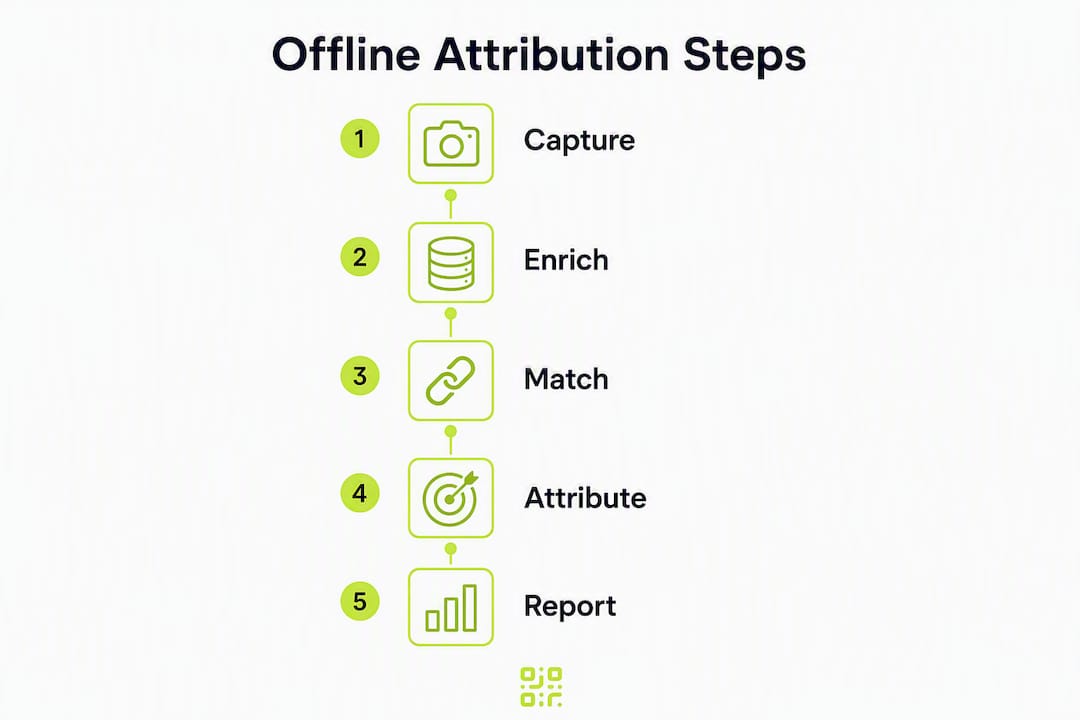
The data flow for offline attribution follows four stages: capture → enrich → match → attribute → report. Each stage has specific integration requirements and operational considerations.
Integration checklist
| System | What to connect | Key fields required |
|---|---|---|
| POS system | Offline transaction data | Customer identifier, transaction ID, date/time, location, product SKU |
| CRM (HubSpot / Salesforce) | Customer records and deal history | Email, phone, loyalty ID, lead source, deal stage, close date |
| Call-tracking platform (ResponseTap) | Inbound call records | Unique tracking number, caller ID, call duration, campaign source |
| Ad platforms (Google Ads, Meta) | Conversion import or Enhanced Conversions API | Hashed email/phone, click ID (GCLID/FBCLID), conversion value, conversion time |
| Email service provider | Campaign click and open data | Email address, campaign ID, click timestamp |
| Data warehouse (BigQuery / Snowflake) | Centralised storage for matching and reporting | All of the above, unified schema |
| Identity resolution service | Optional probabilistic layer | Device signals, IP, behavioural data |
| Consent management platform | Consent records | Consent timestamp, purpose, identifier |
Operational considerations
- Sync cadence: Daily automated sync is the minimum for most attribution use cases. Real-time sync via API is preferable for call-tracking and high-volume retail.
- ETL and data cleaning: Normalise identifiers (lowercase email, E.164 phone format) before matching. Apply deduplication rules to prevent the same conversion being counted twice across methods.
- Deduplication rules: Define a priority order for match methods (deterministic before probabilistic) and a time window for attribution (typically 7–30 days post-click, depending on your sales cycle).
- Retention policies: Under UK GDPR, raw personal identifiers used for matching should be deleted or anonymised once the attribution window closes. Aggregated match results can be retained for reporting.
- Consent records: Store consent timestamps and purposes alongside the matched data, not just in your consent management platform.
Implementation options
Three practical approaches exist for building the data pipeline:
- CSV upload: — Supported by Google Ads, Meta, and most CRM platforms. Lower technical overhead but introduces latency and manual process risk.
For a practical guide to coordinating data across offline and online touchpoints, the key principle is to define your unified schema before you build any integration. Agreeing on field names, formats, and identifier standards upfront prevents the most common cause of failed attribution projects: data that cannot be joined because it was captured differently in each system.
How do you turn offline attribution data into better campaign decisions?
Matched data is only useful if it changes what you do. The practical steps from match to decision are: deduplicate, apply attribution rules, validate with a holdout test, and then report.
From match to campaign credit
- Deduplicate first. A customer who clicked a Google ad, received an email, and then called your sales line should appear as one conversion, not three. Define your deduplication window (typically 24 hours) and your priority rule (last deterministic touch, or the touch closest to conversion).
- Choose your attribution model. Rule-based models — last click, first click, time decay — are easy to implement but systematically overvalue end-of-funnel channels. Last-touch models in particular tend to credit retargeting and branded search while undervaluing the awareness campaigns that primed the customer. Data-driven attribution distributes credit based on actual conversion patterns and outperforms rule-based approaches where sufficient data exists. For most UK businesses starting out, a position-based model (40% first touch, 40% last touch, 20% middle) is a reasonable interim choice.
- Set your attribution window. Match offline conversions to digital clicks within a defined window: 7 days for impulse retail, 30 days for considered purchases, 90 days for B2B sales cycles. Conversions outside the window are excluded from campaign credit.
Validation: do not skip this step
Matched conversions are not the same as incremental conversions. A customer who would have bought anyway, regardless of your campaign, should not be credited to your media spend. Validation methods:
- Holdout tests: Withhold a random sample of your audience from a campaign and compare their offline conversion rate to the exposed group. The difference is your incremental lift.
- Lift testing: Most major ad platforms (Google Ads, Meta) offer built-in lift studies that measure the causal impact of exposure on offline conversions.
- Bayesian causal inference: Causal modelling approaches are effective for estimating incremental sales driven by offline campaigns and for adjusting for confounders such as seasonality and concurrent promotions. Particularly useful when holdout tests are not feasible.
- Sample audits: Manually review a random sample of matched records to check that the identifier join is producing plausible results. A 5% sample audit each month catches systematic matching errors before they distort budget decisions.
Reporting cadence
Marketing needs to see attributed offline conversions by channel and campaign, with incremental lift highlighted. Sales needs to see which lead sources are producing closed deals, not just pipeline. Finance needs to see cost per offline conversion alongside cost per online conversion, to make a fair comparison. Build a single shared dashboard that serves all three views, rather than three separate reports that produce conflicting numbers.
Validation checklist before acting on results:
- Match rate is above a defined threshold (typically 20–30% for deterministic methods in a first pilot).
- Sample audit confirms matches are plausible (correct geography, timing, product category).
- Holdout or lift test confirms incremental conversions, not just attributed ones.
- Deduplication rules are applied consistently across all channels.
- Attribution window is appropriate for the sales cycle being measured.
Why QR codes are one of the most practical capture methods for UK marketers
QR codes offer something most other capture methods cannot: a low-friction, deterministic identifier that works across print, outdoor, packaging, and events without requiring any personal data at the point of scan. When a customer scans a dynamic QR code, you capture the scan event, the campaign source, the location, and the time — all without asking for an email address. The personal data collection happens on the landing page, where you have full control over the consent flow.
Dynamic QR codes with editable destinations take this further. If your landing page URL changes after print, you update the destination in your QR management platform rather than reprinting. If a campaign underperforms, you redirect the code to a different offer. The analytics continuity is preserved throughout.
QR pilot setup checklist
- Dynamic URL: — Create the code in a QR management platform that supports editable destinations and UTM parameter injection. This is what makes the scan data attributable to a specific campaign.
A practical example: event-to-online conversion
An event organiser places unique QR codes on delegate lanyards at a trade show, each linking to a post-event resource page with a short sign-up form. Delegates scan the code, land on the page, and submit their email to access the content. The CRM records the submission with the event UTM parameters. Three weeks later, when those contacts convert via a follow-up email campaign, the original event source is visible in the CRM record. The event budget is credited with the pipeline it generated, not written off as “brand awareness.”
Pro Tip: Use dynamic QR codes with editable destinations for every printed campaign. If you discover a landing page error after materials have been distributed, you can fix the destination without reprinting a single sheet. Qrlytics’s QR code tracking platform preserves analytics continuity across destination changes, so your scan data is never lost.
GDPR note for QR pilots: Display a clear privacy notice on the landing page before the form. Collect only the identifier you need for matching (typically email). Record the consent timestamp and purpose in your CRM alongside the contact record. Do not use the scan event itself (which contains no personal data) as a basis for individual-level targeting without a separate consent step.
What are realistic timelines and costs for a pilot?
A minimum viable pilot for offline-to-online attribution takes four to eight weeks from setup to preliminary results. Here is what each phase delivers:
- Weeks 1–2 (setup): Define the capture method, configure the QR codes or call-tracking numbers, set up the landing page or CRM integration, and agree on the attribution window and deduplication rules. Cost: primarily people hours (typically 10–20 hours of marketing and technical resource).
- Weeks 3–6 (data collection): Run the campaign and collect scan, call, or redemption data. Monitor match rates weekly. Cost: campaign media spend plus any platform subscription fees.
- Week 7 (matching and validation): Join the offline conversion data to the digital click data. Run a sample audit. Compare attributed conversions to a holdout group if one was set up. Cost: analyst time (typically 4–8 hours).
- Week 8 (preliminary results and decision gate): Present results to stakeholders. Decide whether to scale, adjust the method, or decommission the pilot. Cost: reporting and presentation time.
Cost buckets
| Cost type | Low | Medium | High |
|---|---|---|---|
| Platform subscriptions | Free tier (QR, GA4) | — | — |
| Integration development | None (CSV upload) | 1–3 days developer time | — |
| Vendor / agency fees | None | — | — |
Pilot checklist
- Define success criteria before the pilot starts (target match rate, minimum incremental lift, cost per attributed conversion).
- Set a minimum sample size: a sufficient number of offline conversions in the pilot period to produce statistically meaningful results.
- Establish a control group (holdout) at the outset, not after the fact.
- Assign clear ownership: one person owns data collection, one owns validation, one signs off on budget changes based on results.
- Set a decision gate at week 8: scale if match rate exceeds your threshold and lift is positive; adjust the method if match rate is low; decommission if the operational overhead outweighs the insight.
How do you choose the right attribution approach for your organisation?
The right approach depends on four variables: the volume of offline conversions, the quality of your current identifier capture, the maturity of your CRM, and your budget. Use this checklist to assess your starting position.
Decision checklist
- Volume: If you have relatively low offline conversions, a simple promo code or QR pilot with manual matching is sufficient. For higher volumes, automated CRM sync and API-based conversion import become worthwhile.
- Identifier capture rate: What percentage of offline transactions currently include a matchable identifier (email, phone, loyalty ID)? Below 20%, fix the frontline capture process before investing in matching infrastructure.
- CRM maturity: Can your CRM store a lead source field and sync with your ad platforms? If not, that integration is the first investment to make.
- Regulatory constraints: Are you processing sensitive personal data (health, financial) in the matching process? If so, you need a documented legitimate interests assessment or explicit consent, and a data processing agreement with any third-party matching vendor.
- Budget: A QR code pilot with GA4 and a free-tier CRM costs almost nothing. An enterprise identity resolution platform with probabilistic matching costs significantly more and requires a longer procurement process.
Vendor evaluation questions
When assessing any platform or agency for offline attribution support, ask:
- What match accuracy do you achieve on deterministic vs probabilistic methods, and can you show a sample audit from a comparable client?
- How do you handle UK GDPR compliance, specifically data minimisation, retention controls, and consent records?
- What integration APIs do you support (Google Ads, Meta, HubSpot, Salesforce, Shopify)?
- Can you demonstrate a lift-testing methodology, not just attributed conversion counts?
- Who retains raw PII after the attribution window closes, and what contractual safeguards govern that retention?
Red flags
- No clear plan for identifier capture at the point of offline conversion.
- Vendor cannot explain or demonstrate their lift-testing methodology.
- Vendor asks to retain raw personal identifiers indefinitely without a clear contractual basis.
- Match rates are presented without a sample audit or validation methodology.
- The solution relies entirely on probabilistic matching with no deterministic fallback.
Practical next step: Run a two-option pilot simultaneously — one low-friction method (QR codes or promo codes) and one integrated method (CRM sync with offline conversion API). Compare the incremental lift and the operational overhead of each. The method that produces the better lift-to-effort ratio is the one to scale.
Key takeaways
Offline-to-online attribution works when you capture a matchable identifier at the point of offline conversion, connect it to your digital click data through a validated pipeline, and measure incremental lift rather than raw attributed conversions.
| Point | Details |
|---|---|
| Start with identifier capture | Audit your POS, CRM, and call-tracking systems for matchable fields before investing in matching infrastructure. |
| Deterministic beats probabilistic | Exact identifiers (email, phone, loyalty ID, QR scan) produce reliable matches; probabilistic methods carry higher GDPR risk and lower accuracy. |
| Validate with lift testing | Attributed conversions overstate impact without a holdout test or Bayesian causal model to confirm incrementality. |
| Pilot in 4–8 weeks | A minimum viable pilot requires one capture method, one campaign, and a defined success criterion — not a full data warehouse. |
| Qrlytics for QR pilots | Qrlytics provides dynamic QR codes with editable destinations, real-time scan analytics, and GDPR-compliant tracking — a practical starting point for deterministic capture in any UK pilot. |
What marketers consistently get wrong about offline attribution
The most common mistake is treating offline attribution as a technology procurement problem. Teams spend months evaluating identity resolution platforms, negotiating data processing agreements, and building ETL pipelines — and then discover that their match rate is 8% because the till staff are not collecting email addresses.
The technology is the easy part. The hard part is changing frontline behaviour: getting a retail assistant to ask for an email at checkout, training a call handler to log the campaign source in the CRM, or designing an event check-in flow that captures a loyalty ID rather than just a name badge. These process changes are unglamorous, they require cross-functional buy-in, and they are almost always the bottleneck.
The second mistake is demanding perfect match rates before acting on the data. A 25% deterministic match rate on a well-run pilot is enough to estimate the contribution of an offline channel with reasonable confidence, particularly when combined with a holdout test. Incrementality measurement — measuring the lift in conversions caused by a campaign, rather than counting every matched conversion as incremental — is the more honest and more useful metric. Teams that wait for 80% match rates before making any budget decisions are waiting for a standard that does not exist in practice.
The organisational fix that produces the biggest improvement is a simple governance change: assign one person in marketing operations to own the identifier capture rate as a KPI, and give them the authority to change till scripts, phone scripts, and event check-in flows. That single accountability change, more than any software investment, is what separates teams that make offline attribution work from those that abandon it after a failed pilot.
Qrlytics makes QR-based offline attribution straightforward
For UK marketers who want a deterministic capture method that is ready to use in days rather than weeks, Qrlytics provides the QR code infrastructure that pilots and scaled campaigns both need. The core advantage over generic QR generators is permanence and control: codes created during an active subscription remain functional regardless of billing status, so a QR code printed on 10,000 leaflets will not break if your subscription renews late.
The features that matter most for offline attribution pilots map directly to the implementation checklist above:
- UTM parameter support: — Append campaign parameters automatically so every scan flows into GA4 with the correct source and medium.
A practical starting point: create a dynamic QR code for one active campaign, point it to a landing page with a short sign-up form, and sync the form submissions to your CRM. You will have your first deterministic offline-to-online match data within the first week of the campaign. No credit card is required to get started — the free tier at Qrlytics lets you generate and test codes before committing to a paid plan.
Useful sources and further reading
The following resources support the guidance in this article, covering implementation, attribution modelling, GDPR compliance, and QR-based capture methods.
Implementation and attribution modelling:
- Offline To Online Attribution: Complete Guide — Cometly — Foundational guide covering identity matching, CRM integration, and frontline capture.
- Offline-to-online attribution with AI — Pedowitz Group — Practical guidance on incrementality measurement and Bayesian causal methods.
- Offline Attribution: definition, examples and best practices — Causality Engine — Prerequisites for causal offline measurement and ecommerce integration.
- Offline To Online Attribution: Bridging the Data Gap — Causality Engine — Bayesian causal inference for estimating incremental offline sales.
- Understanding Different Attribution Models — Quantum Metric — Clear explanation of rule-based and data-driven attribution models.
- Attribution models explained — Attriqs — Why last-touch models misallocate spend and how mature teams are moving to causal methods.
- About offline conversion imports — Google Ads Help — Official Google Ads documentation for importing offline conversions and Enhanced Conversions for Leads.
- Offline conversion tracking — Shopify — Practical overview of offline conversion tracking for ecommerce businesses.
GDPR and privacy:
- UK GDPR guidance — ICO — The Information Commissioner’s Office is the primary UK authority on data protection obligations relevant to identity matching and consent.
QR code capture and analytics:
- QR code tracking: a practical guide for marketers — Qrlytics Blog — Step-by-step implementation guidance for QR-based capture and analytics export.
- Lead generation with QR codes: 2026 guide — Qrlytics Blog — Guidance for using QR codes to capture leads at events and in-store.
- QR codes for marketing and advertising — Qrlytics — How QR codes support campaign measurement and attribution in UK marketing contexts.
FAQ
What is offline-to-online attribution?
Offline-to-online attribution is the process of connecting offline customer actions — such as in-store purchases, phone orders, or event sign-ups — back to the digital campaigns that influenced them. It answers the question of which online touchpoints drove conversions that happened away from a website.
What does “online to offline” mean in a marketing context?
“Online to offline” (O2O) describes the reverse journey: a digital campaign (a paid search ad, an email, a social post) drives a customer to take an action in the physical world, such as visiting a store, calling a sales line, or attending an event. Attribution in this context means measuring how much of that offline activity was caused by the online campaign.
How do you track offline marketing effectiveness?
The most reliable methods use deterministic identifiers: unique promo codes, dynamic QR codes with UTM parameters, call-tracking numbers (such as those provided by ResponseTap), or email addresses captured at the point of offline conversion and matched back to CRM records. Validation with a holdout test or lift study confirms that the attributed conversions are genuinely incremental.
What is the difference between online and offline advertising attribution?
Online attribution tracks conversions that happen on a website or app, where cookies and click IDs create a direct link between an ad and a purchase. Offline attribution requires an additional matching step — connecting a physical conversion event to a digital touchpoint using a shared identifier — which is why identifier capture at the point of sale or enquiry is the critical bottleneck.
How does GDPR affect offline-to-online attribution in the UK?
Under UK GDPR, you need a lawful basis (typically consent or documented legitimate interests) for processing personal data used in identity matching. Data minimisation applies: collect only the identifier needed for the specific matching purpose, retain it only for the duration of the attribution window, and record consent at the point of capture. The Information Commissioner’s Office (ICO) publishes detailed guidance on lawful bases and data minimisation obligations.