Secure QR solutions checklist for business teams

TL;DR:
- A secure QR solutions checklist ensures every QR code is safe, traceable, and manageable throughout its campaign. It covers platform controls, physical inspection, digital verification, audit readiness, and ongoing monitoring to prevent attacks and operational errors. Implementing these controls helps organizations mitigate risks associated with QR code deployment and maintenance.
A secure QR solutions checklist is a structured set of controls that verifies every QR code your organisation deploys is safe, traceable, and manageable throughout its full campaign lifecycle. Without one, you expose customers and colleagues to phishing attacks, malicious redirects, and brand damage that printed materials make permanent. The industry term for this practice is QR code security governance, and it covers everything from platform configuration to physical inspection. This guide gives you a practical QR code security checklist built for business professionals who need reliable, long-term control over their campaigns.
1. What does a secure QR solutions checklist cover?
A QR code security checklist covers six distinct control areas: platform configuration, URL validation, physical inspection, digital verification, audit readiness, and ongoing monitoring. Each area addresses a different attack surface. Skipping even one leaves a gap that attackers or simple operational errors will eventually exploit.

The checklist format matters because QR codes are permanent once printed. A flaw in a destination URL or redirect chain becomes locked into packaging, signage, or event materials the moment they leave the printer. Treating security as a pre-launch gate rather than an afterthought is the single most cost-effective decision you can make.
2. Platform-level security controls
Platform-level controls are the foundation of any credible QR code security programme. End-user vigilance is necessary but insufficient without them. Your platform must enforce the following before any code goes live.
URL validation against multiple threat feeds
Validate every destination URL against real-time threat intelligence sources including Google Safe Browsing, URLhaus, and PhishTank. Single-source validation misses threats that one feed has not yet catalogued. Cross-referencing multiple feeds closes that gap.
Full redirect chain auditing
Most organisations fail to audit full redirect chains. Attackers exploit this by inserting a malicious destination several hops into a chain, well past the point where basic URL scanning stops. Your platform must follow every redirect hop and flag any suspicious intermediate destination.
HTTPS enforcement and SSL validation
Every QR code destination must use HTTPS with a valid, unexpired SSL certificate. Any code pointing to an HTTP destination should be blocked before deployment. This is a non-negotiable baseline, not an optional enhancement.
Role-based access controls and domain allowlists
Restrict who can create, edit, or redirect QR codes within your organisation. Pair that with a domain allowlist so codes can only resolve to pre-approved destinations. This prevents internal misuse and limits the blast radius of a compromised account.
Tamper-evident audit logs
Standard activity logs are insufficient for compliance. Your platform needs append-only or cryptographically signed logs that no application layer can alter. This is the standard required by ISO 27001 and SOC 2 frameworks.
Rate limiting and scan anomaly monitoring
Anomaly monitoring is a high-value control that most QR platforms omit entirely. Set rate limits per code and alert on unusual scan volumes, geographic clusters, or repeated failed redirects. These patterns often signal active abuse or a phishing campaign in progress.
Pro Tip: Configure your platform to send automated alerts when a single code exceeds its average daily scan rate by more than double. This catches both abuse and viral sharing events before they escalate.
3. Physical QR code inspection
Physical attacks are the most underestimated threat in any QR code security checklist. The most common tactic, known as quishing, involves placing fake sticker codes over legitimate ones on menus, posters, or payment terminals. Customers scan without suspicion because the physical context looks authoritative.
Your physical inspection process should follow these steps before any printed material goes live:
- Inspect for overlays. Run a finger across the code surface. A sticker placed over an existing code will have a raised edge. Reject any material where the code surface is not flush with the surrounding print.
- Verify branding consistency. Check that fonts, logos, and colour schemes on the surrounding material match your brand guidelines exactly. Attackers rarely replicate full brand context accurately.
- Confirm authorised placement. Cross-reference the physical location against your approved deployment list. A QR code appearing in an unapproved location is a red flag regardless of what it scans to.
- Test scan before distribution. Scan every code yourself on a secured device before materials leave your premises. Confirm the destination URL matches the intended landing page exactly.
- Document placement with photos. Photograph each deployed code in situ and log the date, location, and responsible team member. This creates a reference baseline for future inspections.
Pro Tip: Integrate physical inspection into your print sign-off workflow rather than treating it as a separate security task. When the person approving print quality also verifies the QR destination, you eliminate the handover gap where errors hide.
4. Digital verification before and after deployment
Digital verification covers the checks you run on a code’s destination URL both before launch and on a recurring basis throughout the campaign. Security scanners that check URLs against 90 or more vendors complete these analyses in under 60 seconds by tracking every redirect hop. That speed removes any excuse for skipping pre-launch checks.
- Preview the URL without tapping. Most modern phone cameras display the destination URL before you open it. Check for suspicious domains, unusual subdomains, or URL shorteners masking the true destination. A legitimate campaign URL is always transparent.
- Run a reputation scan. Use a URL reputation engine to verify the destination against multiple threat databases. URL previews alone do not guarantee safety; reputation scanning is the essential second layer.
- Reject HTTP destinations. Any QR code pointing to an HTTP page is unsafe for deployment. Customers who follow it may encounter browser warnings or, worse, a man-in-the-middle attack on an unencrypted connection.
- Schedule recurring destination checks. Campaign URLs can be hijacked or expire after launch. Set a calendar reminder to re-verify every active code’s destination at least once per month. Dynamic QR codes allow you to update the destination immediately if a problem is detected, without reprinting materials.
- Monitor scan patterns for anomalies. Review your scan analytics weekly. A sudden spike in scans from an unexpected geography, or a sharp drop to zero, both warrant investigation. Either pattern can indicate abuse or a broken redirect.
5. Audit readiness and compliance controls
Audit readiness is where most QR code programmes fall short. Organisations assume their platform logs activity automatically and that those logs will satisfy an auditor. They rarely do.
Tamper-evident audit logs must be append-only or cryptographically signed. Standard logs that an administrator can edit or delete are worthless for ISO 27001 or SOC 2 compliance. The log must be structured so that no application layer can alter the records after the fact.
Your audit readiness checklist should confirm the following:
- Logs capture every code creation, edit, redirect change, and deletion with a timestamp and user identity.
- Log storage is isolated from the application layer, preventing modification by the same accounts that manage QR codes.
- Structured audit reports can be exported on demand in a format your compliance team or external auditor can read without specialist tools.
- Access control reviews are scheduled quarterly to remove permissions from lapsed accounts.
- Redirect chain records are retained for a minimum period aligned with your data retention policy.
| Audit control | Compliance relevance |
|---|---|
| Append-only or signed logs | ISO 27001, SOC 2 requirement |
| Isolated log storage | Prevents false compliance reporting |
| Exportable structured reports | Supports external audit processes |
| Quarterly access reviews | Reduces insider threat exposure |
| Redirect chain retention | Supports incident investigation |
6. Situational recommendations by organisation size
Security controls should match your risk profile and operational capacity. A sole trader running a single campaign has different needs from an enterprise managing hundreds of active codes across multiple markets.
Small businesses and starter campaigns
Start with QR code consistency checks and a free URL reputation scanner. Use a platform that enforces HTTPS by default and gives you a simple dashboard to verify destinations. Avoid free QR generators that deactivate codes when a subscription lapses. A broken code on printed packaging is expensive to fix.
Mid-sized organisations
Adopt dynamic QR codes so you can update destinations without reprinting. Add scan analytics to your workflow so you can spot anomalies early. Implement role-based access so only authorised team members can edit live codes.
Enterprise teams
Require full redirect chain auditing, domain allowlists, and tamper-evident logs as non-negotiable platform features. Integrate QR code audit exports into your existing compliance reporting cycle. Monitoring scan anomalies at scale requires automated alerting, not manual review.
Pro Tip: Even small businesses benefit from scan analytics. A sudden drop in scans on a high-traffic code often means the code has been physically damaged or covered. Analytics surfaces this problem before customers start complaining.
Key takeaways
A secure QR code programme requires platform-level controls, physical inspection, digital verification, and tamper-evident audit logs working together. No single measure is sufficient on its own.
| Point | Details |
|---|---|
| Platform controls are non-negotiable | Enforce URL validation, HTTPS, role-based access, and redirect chain auditing before any code goes live. |
| Physical inspection prevents quishing | Inspect every printed code for overlays, verify branding consistency, and document placement with photos. |
| Digital verification must be ongoing | Re-verify destinations monthly and monitor scan patterns weekly to detect hijacking or abuse. |
| Audit logs must be tamper-evident | Append-only or cryptographically signed logs are required for ISO 27001 and SOC 2 compliance. |
| Dynamic codes reduce campaign risk | Use dynamic QR codes so you can update or expire unsafe destinations without reprinting materials. |
Why platform responsibility matters more than user caution
The security conversation around QR codes has focused too heavily on educating end users. “Don’t scan codes you don’t recognise” is reasonable advice, but it places the entire burden of defence on the person least equipped to act on it. A customer standing at a restaurant table or a trade show booth has no way to audit a redirect chain or verify a domain allowlist.
The organisations deploying those codes carry the real responsibility. When a platform fails to validate destinations against live threat feeds, or allows redirect chains to pass unchecked, the resulting harm lands on customers who trusted the brand. I have seen campaigns where a single compromised redirect went undetected for weeks because the platform had no anomaly monitoring and the team assumed “no complaints” meant “no problem.”
The checklist in this article is not a bureaucratic exercise. Each control exists because a specific attack vector exploits its absence. Redirect chain auditing exists because multi-hop redirects bypass simple URL validation. Tamper-evident logs exist because standard logs can be altered to hide incidents. Physical inspection exists because sticker attacks are cheap, fast, and devastatingly effective.
My advice to any organisation managing QR campaigns: audit your platform first, your processes second, and your user education third. The order matters.
— The
Qrlytics: built for secure, long-term QR campaigns
Organisations that take QR code security seriously need a platform that matches that commitment.
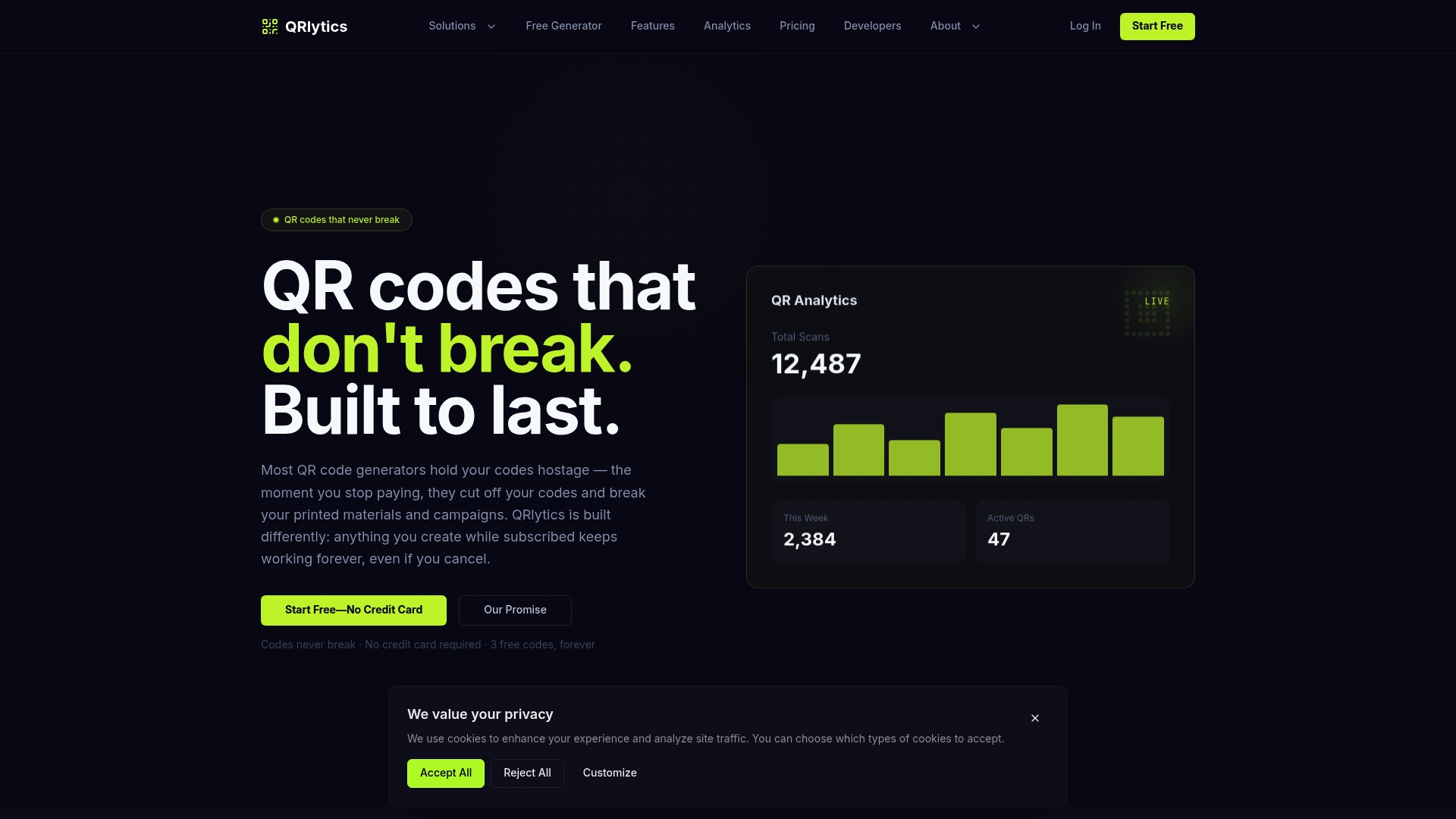
Qrlytics provides dynamic QR codes that let you update destinations instantly, expire unsafe links, and monitor every scan through real-time analytics. The platform includes GDPR-compliant tracking, consistent link redirection, and global scan heat maps so you can spot anomalies before they become incidents. Codes created during an active subscription remain functional permanently, removing the risk of broken links on printed materials. You can generate your first QR code without a credit card and explore the full feature set at no cost. For teams that need long-term control over their QR campaigns, Qrlytics is the dependable starting point.
FAQ
What is a QR code security checklist?
A QR code security checklist is a structured set of controls covering URL validation, redirect chain auditing, physical inspection, and audit log requirements. It verifies that every deployed QR code is safe and traceable throughout its campaign lifecycle.
How do I verify a QR code is safe before scanning?
Preview the destination URL on your camera screen before opening it, then run it through a reputation scanner that checks against multiple threat databases. URL previews alone do not confirm safety; reputation scanning is the essential second step.
What are tamper-evident audit logs and why do they matter?
Tamper-evident audit logs are append-only or cryptographically signed records that no application layer can alter after creation. They are required for ISO 27001 and SOC 2 compliance and prevent false reporting during security audits.
What is a quishing attack?
Quishing is a phishing attack that uses a physical QR code, typically a fake sticker placed over a legitimate code, to redirect users to a malicious site. Inspecting codes for overlays and verifying branding consistency are the primary defences.
Why should businesses use dynamic QR codes for security?
Dynamic QR codes allow you to update or expire a destination URL after the code has been printed. This means you can respond immediately to a compromised or broken link without reprinting any materials.