Business QR code governance: a guide for decision-makers
TL;DR:
- Business QR code governance is a centralized system that manages, secures, and monitors QR codes across all departments. It prevents code sprawl, ensures compliance, and turns QR codes into measurable marketing and operational assets.
Business QR code governance is defined as the centralised system of policies, processes, and tools that organisations use to manage, secure, and monitor QR codes across every department and channel. Without it, businesses face QR code sprawl, where uncontrolled code creation leads to broken links, inconsistent branding, and serious compliance gaps. Effective governance enforces standardised templates, role-based access controls, audit trails, and branded dynamic domains. The result is a QR programme that is accountable, measurable, and built to meet regulatory demands.
What is business QR code governance and what does it include?
Business QR code governance is the structured framework organisations use to control QR code creation, deployment, and monitoring at scale. The term is sometimes described informally, but the underlying discipline maps directly to established enterprise content governance principles. It addresses a specific operational risk: when any team member can generate a QR code using a free tool, the organisation loses visibility, consistency, and control overnight.
The core components of an effective governance system are well established:
- Centralised dashboard. A single platform where all QR codes are created, catalogued, and tracked. This replaces fragmented creation across departments.
- Role-based access controls. Permissions restrict who can create, edit, or retire codes. Only authorised users can make changes, which prevents uncontrolled code sprawl.
- Branded dynamic domains. Codes resolve through a company-owned domain rather than a generic short URL. This protects brand identity and reduces phishing risk.
- Audit trails and version control. Every change to a QR code is logged with a timestamp and user record. This supports accountability and compliance reviews.
- Real-time analytics. Scan data, geographic distribution, and device types feed into a live dashboard so teams can act on performance immediately.
The distinction between static and dynamic QR codes matters greatly in a governance context. Static codes encode a fixed URL that cannot be changed after printing. Dynamic QR codes allow the destination URL to be updated at any time, support analytics, and enable brand-consistent design. For any organisation managing codes across printed materials, packaging, or signage, dynamic codes are the only practical choice.
Pro Tip: Before deploying any QR code on printed materials, confirm it resolves through a branded domain you control. Generic short-link services can deactivate codes if your subscription lapses, leaving physical materials permanently broken.

How does QR code governance support compliance and risk management?
QR code compliance in business is not optional in regulated sectors. Several major regulatory frameworks now directly implicate how QR codes are created, displayed, and tracked.
ZATCA Phase 2 mandates specific QR code requirements for e-invoices in Saudi Arabia. Penalties reach SAR 50,000 per non-compliant invoice, with criminal charges possible for repeated violations. Compliant codes must use Tag-Length-Value encoding, include nine data fields such as digital signatures and cryptographic hashes, and meet a minimum printed size of 2x2 cm. That level of technical specificity makes ad-hoc QR code creation genuinely dangerous.
GDPR and CCPA/CPRA apply whenever a QR code scan triggers data collection. Explicit, documented consent is required before collecting personal data, and businesses must honour the right to be forgotten and data minimisation obligations. A “Notice at Collection” is mandatory under CCPA/CPRA. Without a governed system that logs consent and tracks data flows, proving compliance in an audit is extremely difficult.
PCI DSS becomes relevant when QR codes carry cardholder or payment data. QR codes in payment contexts fall within the cardholder data environment, requiring the same security controls applied to any payment-processing system.
The risks of non-compliance extend beyond fines. Reputational damage from a QR-linked data breach or a broken invoice code can erode customer trust far faster than any regulatory penalty. Governance systems that maintain audit trails and historic code versions give compliance teams the evidence they need when regulators ask questions.
What practical steps build an effective QR code governance programme?
Implementing a business QR code strategy with proper governance follows a clear sequence. Skipping steps creates the same fragmentation the framework is designed to prevent.
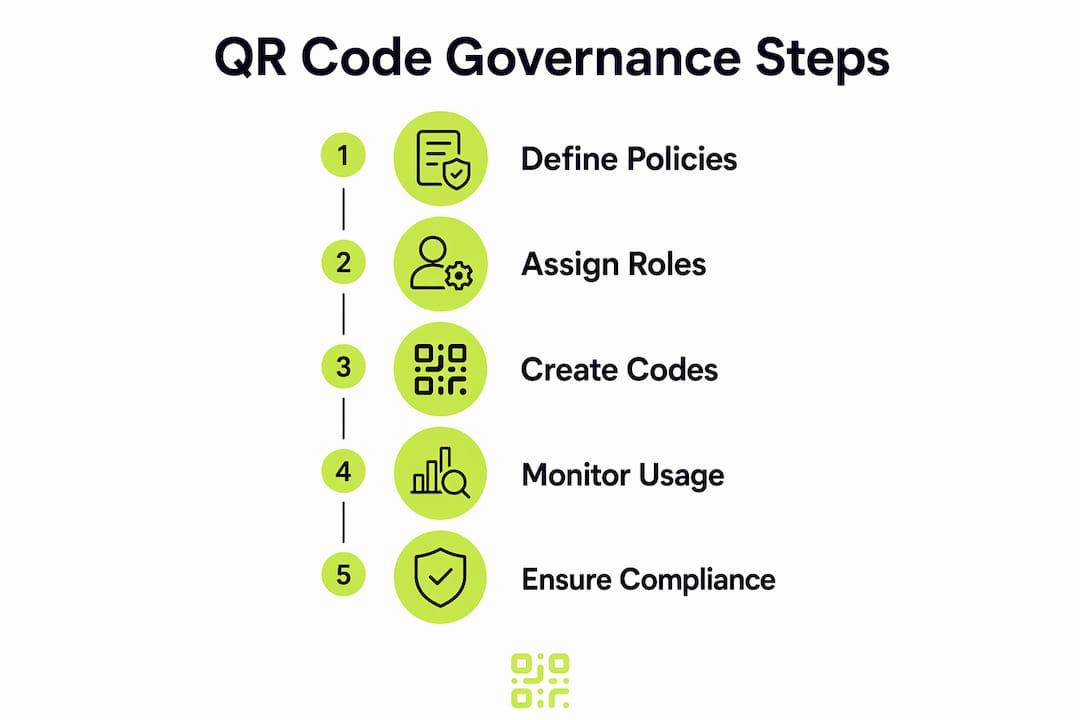
- Define a centralised management policy. Document who owns QR code creation, what tools are approved, and what naming conventions apply. A written policy is the foundation everything else rests on.
- Set up role-based access. Assign creation rights only to trained team members. Editors can update destination URLs; viewers can access analytics. No one outside the approved list generates a live code.
- Adopt branded dynamic domains. Replace generic short-link services with a domain your organisation controls. This protects brand consistency and means you can update destination URLs without reprinting. Platforms like Qrlytics support branded dynamic QR codes as a core feature.
- Build standardised templates. Create approved QR code designs that include your logo, brand colours, and call-to-action text. Consistent design builds consumer trust and makes codes easier to scan.
- Connect analytics to your reporting stack. Real-time QR data feeds into campaign decisions. Integrate scan analytics with your existing business intelligence tools so marketing and operations teams can act on the same numbers.
- Schedule regular audits. Review active codes quarterly. Retire codes that are no longer in use, update destination URLs where content has changed, and confirm that all active codes meet current compliance requirements.
Pro Tip: The most common governance failure is not a technical one. It is the absence of a written policy. Teams revert to free tools the moment no one is watching. A documented, enforced policy is what separates a governed programme from a collection of random codes.
Integrating QR governance with existing marketing and operational systems also matters. QR code tracking that feeds directly into campaign dashboards removes the manual reporting step and gives decision-makers faster access to performance data.
What are the business benefits of investing in QR code governance?
The benefits of QR code policies extend well beyond avoiding fines. Governance turns QR codes from passive print elements into a measurable engagement channel.
- Proved marketing ROI. Centralised analytics track scan volumes, geographic spread, device types, and conversion paths. Marketing teams can attribute campaign performance to specific codes and adjust spend accordingly.
- Stronger security posture. Managed permissions reduce the risk of unauthorised or malicious codes appearing under your brand. Phishing attacks increasingly use QR codes to bypass email filters. A governed system makes it far harder for bad actors to exploit your brand identity.
- Supply chain transparency. GS1 Digital Link standards enable QR codes to serve multiple functions simultaneously: consumer engagement, regulatory compliance, and supply chain traceability. A single code on a product can surface ingredient data for consumers, batch information for auditors, and logistics data for distributors.
- Operational agility. Dynamic codes allow destination URL updates without reprinting physical materials. A product recall, a pricing change, or a campaign pivot can be reflected instantly across all deployed codes.
- Future-readiness. GS1 Digital Link and the Sunrise 2027 initiative are reshaping how barcodes and QR codes function in retail and regulated sectors. Organisations with governed, dynamic QR programmes are already positioned to meet these standards.
“Modern QR code governance transforms every scan into a measurable digital brand experience that increases customer engagement and loyalty.”
The strategic value compounds over time. Each governed scan produces data. That data informs better campaigns, tighter compliance, and stronger customer relationships. Ungoverned codes produce none of that.
Key takeaways
Effective QR code governance is the single most important step a business can take to protect its brand, meet regulatory obligations, and turn QR codes into a measurable asset.
| Point | Details |
|---|---|
| Governance prevents code sprawl | Centralised policies and role-based access stop uncontrolled QR code creation across departments. |
| Compliance is non-negotiable | ZATCA, GDPR, CCPA/CPRA, and PCI DSS all impose specific obligations on how QR codes are created and tracked. |
| Dynamic codes are the governance standard | Dynamic QR codes allow URL updates, support analytics, and maintain brand consistency without reprinting. |
| Audit trails protect the business | Logged version histories and user records give compliance teams the evidence they need during regulatory reviews. |
| Governance delivers measurable ROI | Centralised analytics turn scan data into campaign insights, proving marketing performance and informing future spend. |
The governance gap most businesses ignore
The conversation around QR codes in business tends to focus on design and placement. Governance rarely comes up until something breaks. A code on 50,000 printed brochures stops working because the free tool that generated it deactivated the link. A marketing team in one region creates codes that look nothing like the approved brand. A compliance audit reveals no record of what data was collected from a campaign QR code six months ago.
These are not edge cases. They are the predictable result of treating QR codes as a tactical tool rather than a managed asset. The shift from ad-hoc to governed approaches is happening fastest in enterprises with large physical footprints: retail, logistics, pharmaceuticals, and financial services. But the same risks apply to any organisation deploying codes at scale.
The arrival of GS1 Digital Link and Sunrise 2027 will accelerate this shift. When a single QR code must simultaneously satisfy a consumer, a regulator, and a logistics system, the idea of generating codes informally becomes untenable. Governance is not a compliance overhead. It is the infrastructure that makes QR codes worth deploying in the first place.
— The
How Qrlytics supports your QR code governance needs
Qrlytics is built for organisations that need reliable, governed QR code management without the complexity of enterprise procurement.
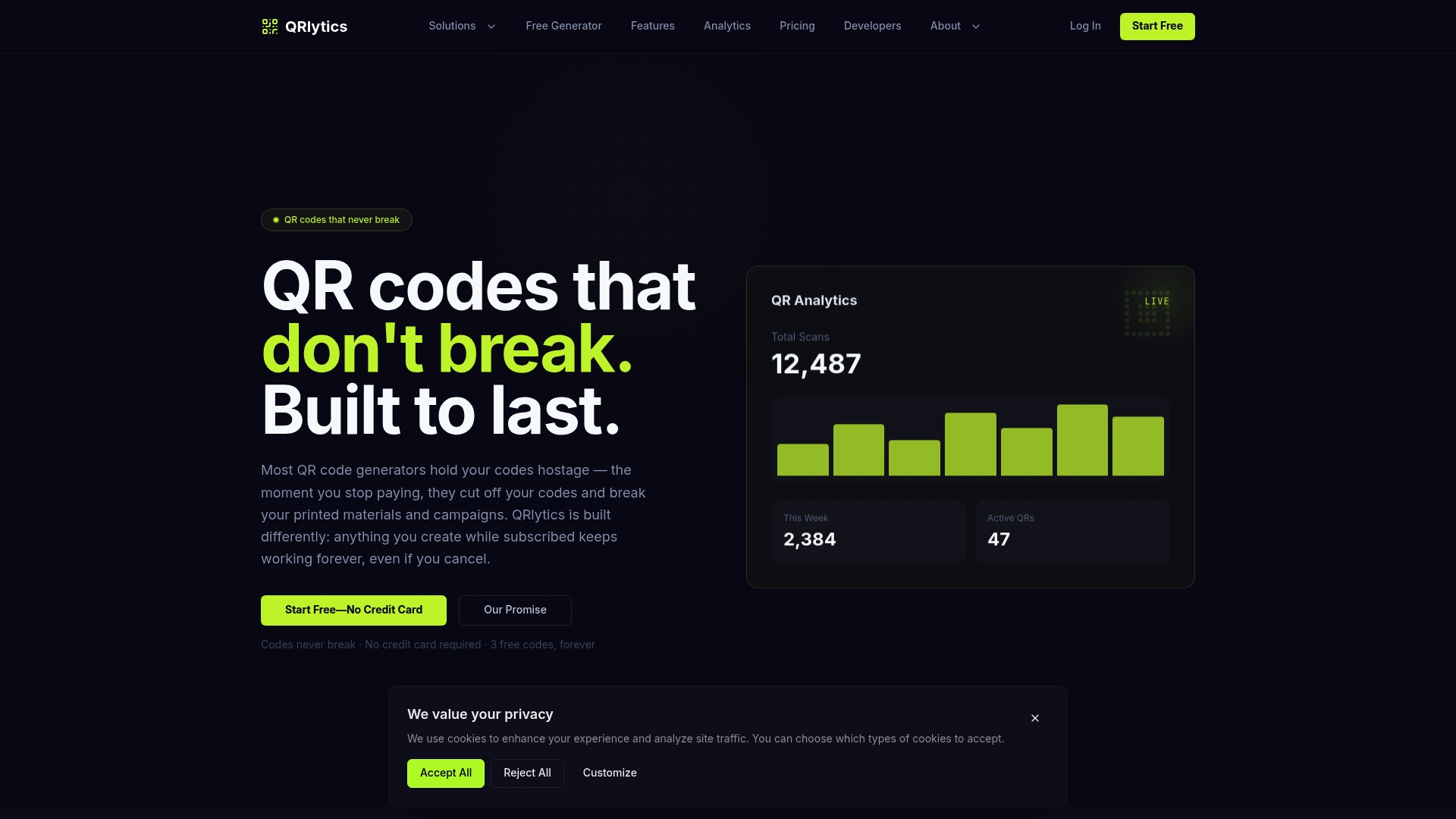
The platform provides a centralised dashboard for creating, tracking, and managing dynamic QR codes with branded domains and real-time analytics. Role-based permissions mean only authorised team members can create or edit codes. Every scan feeds into a live analytics view, giving you the data you need to prove campaign ROI and satisfy compliance reviews. Crucially, Qrlytics guarantees that codes created during an active subscription remain functional permanently, regardless of billing status. Start with the free QR code generator or move directly to trackable dynamic codes with full analytics. No credit card required.
FAQ
What is business QR code governance?
Business QR code governance is the centralised system of policies and tools organisations use to manage QR code creation, deployment, and monitoring across all departments. It addresses risks like code sprawl, compliance failures, and inconsistent branding.
Why does QR code compliance matter in regulated industries?
Regulations such as ZATCA Phase 2, GDPR, and PCI DSS impose specific technical and data-handling requirements on QR codes. Non-compliance can result in fines, legal consequences, and reputational damage.
What is the difference between static and dynamic QR codes in governance?
Static QR codes encode a fixed URL that cannot be changed after printing. Dynamic QR codes allow destination URL updates at any time, support analytics, and are the standard choice in any governed QR programme.
How do audit trails support QR code governance?
Audit trails log every change to a QR code, including who made the change and when. This record supports regulatory transparency requirements and gives compliance teams verifiable evidence during audits.
What is GS1 Digital Link and why does it matter for businesses?
GS1 Digital Link is an international standard that enables a single QR code to serve multiple functions, including consumer engagement, supply chain traceability, and regulatory compliance. The Sunrise 2027 initiative will make GS1 Digital Link-compliant codes the retail standard.