Secure QR code forwarding: how it works in 2026
TL;DR:
- Secure QR code forwarding routes scans through server validation to prevent phishing and malicious redirects. It uses HTTPS, signed tokens, and real-time auditing, giving ongoing control and security. This approach enhances user trust, supports anti-counterfeiting, and provides valuable analytics, making QR campaigns safer and more effective.
Secure QR code forwarding is the process of routing every QR code scan through a validated, server-side redirect that authenticates the destination before the user reaches it. Rather than sending a phone directly to a URL embedded in a static image, the system intercepts the scan, checks the redirect chain, and confirms the destination is safe. This is the industry practice now referred to as a “secure QR journey,” and it sits at the intersection of HTTPS enforcement, cryptographically signed tokens, and real-time audit logging. For businesses running QR-based marketing campaigns, understanding this process is the difference between a trusted scan and a phishing incident.
What is secure QR code forwarding and how does it work?
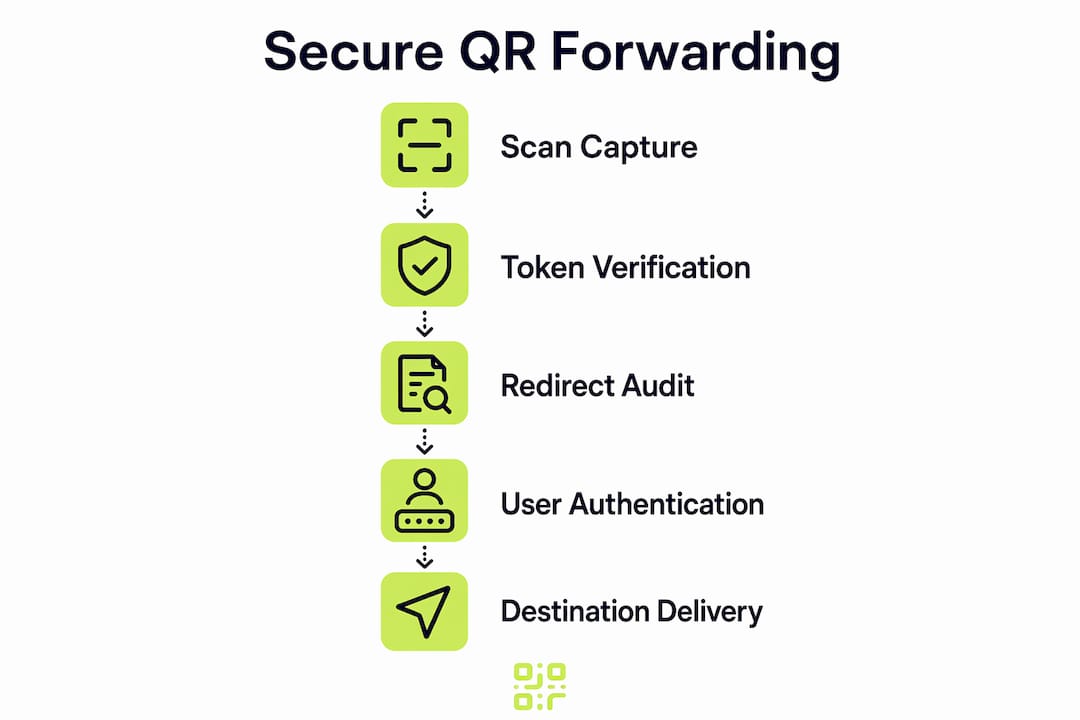
Secure QR code forwarding works by placing a server between the scanned code and the final destination URL. When a user scans a code, the request goes to a backend system first. That system inspects the full redirect chain, validates a signed token, and only then forwards the user to the intended page.
The technical architecture relies on several controls working together:
-
HTTPS enforcement with X.509 certificates. Professional platforms enforce HTTPS with valid certificates and audit every intermediate hop in the redirect chain. This prevents a technique called domain laundering, where attackers route users through a legitimate-looking domain before landing them on a malicious page.
-
Cryptographically signed tokens. Signed tokens using HMAC or JWT bind each scan session to a specific time window, device class, and geo-location. A token generated for a scan in London at 10:00am cannot be replayed by an attacker in a different location an hour later.
-
Server-side redirect validation. Client-side redirects create security blind spots because the user’s device has no way to inspect intermediate hops. Server-side validation catches malicious redirects before they ever reach the browser.
-
Dynamic QR code management. Dynamic QR codes allow continuous audit and control over destinations. You can rotate, update, or revoke a code’s destination without reprinting anything.
-
Transparent confirmation screens. Before the final redirect completes, well-designed systems show users a brief confirmation screen. This gives the user a moment to verify the destination and reduces blind-redirect risk.
Pro Tip: Always check whether your QR platform validates the full redirect chain, not just the first hop. A URL that starts with HTTPS can still route through an unsecured intermediate domain.
The key distinction here is between a QR code as a simple image and a QR code as a controlled data pipeline. Most free generators treat it as the former. Secure systems treat every scan as a handshake that must be authenticated before access is granted.
What threats does secure QR forwarding protect against?
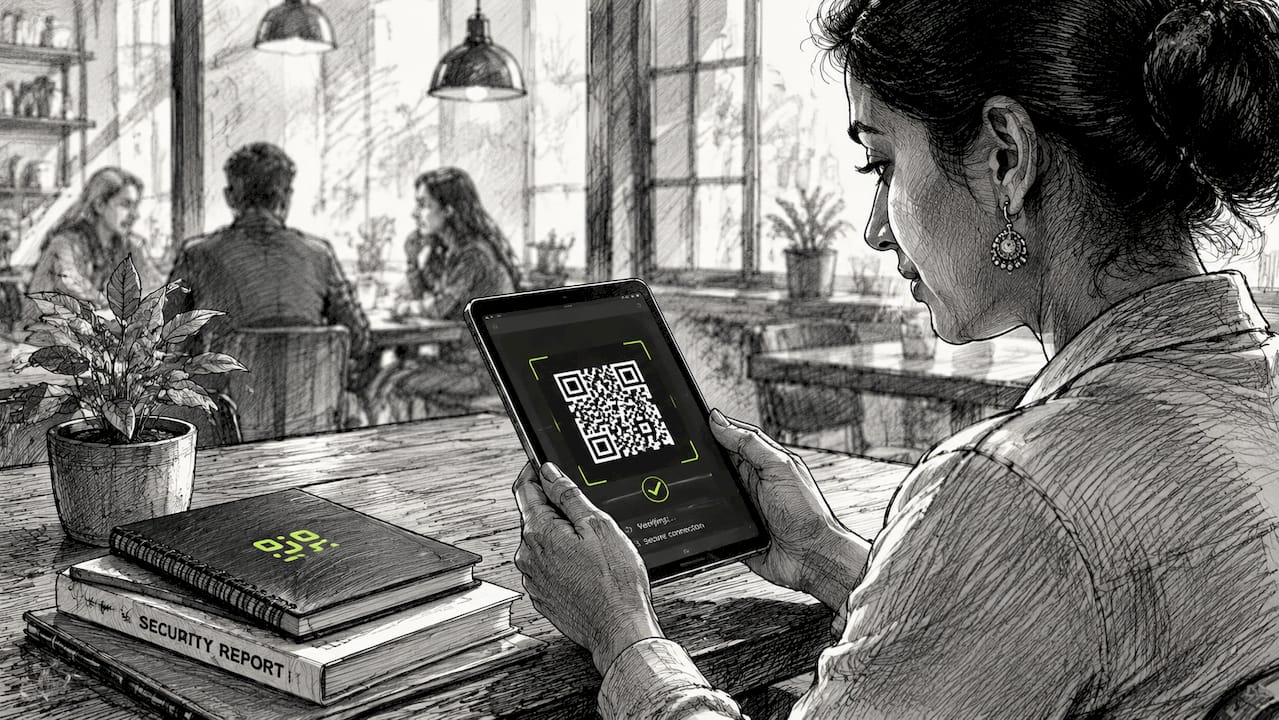
QR code phishing surged significantly after 2025, with attackers exploiting the fact that most users cannot read a QR code before scanning it. Attackers exploit unsecured QR codes across authentication flows, payment pages, and API access points. The threat is not theoretical. It is active and growing.
The main attack types are:
- Malicious redirects and domain laundering. A QR code appears to link to a trusted brand but routes through a chain of domains before landing on a phishing page. Without full redirect chain auditing, neither the user nor the platform detects the switch.
- Replay attacks. An attacker captures a valid scan token and reuses it to gain access. Static QR codes are especially vulnerable because their embedded URL never changes.
- QR code cloning. A physical QR code in a public space is replaced with a near-identical one pointing to a malicious URL. Dynamic codes with signed tokens make cloning ineffective because the token is time-bound and device-specific.
- Unencrypted payloads. Some platforms pass sensitive parameters in plain text within the redirect URL. Encrypted payloads prevent interception during transit.
“Strong architecture transforms each scan into a controlled handshake instead of a blind redirect, reducing phishing risk.” — QR journeys for security
Audit logs play a critical role here. Every scan event, including the originating IP, device class, timestamp, and redirect outcome, should be recorded. This gives security teams the evidence they need to detect anomalies and respond quickly. User-facing confirmation screens add a final layer of transparency, letting the person scanning see exactly where they are going before they arrive.
Benefits of secure QR code forwarding for marketing and authentication
Secure QR forwarding is not only a security measure. It is a marketing asset. When users trust that a QR scan will not expose them to risk, they scan more readily. That trust directly improves conversion rates on printed materials, packaging, and event signage.
Dynamic campaigns with real-time control
Dynamic QR codes let you update the destination URL after the code has been printed. A campaign that launched pointing to a product page can be redirected to a limited-time offer without reprinting a single poster. Combined with QR code tracking, you get a full picture of which placements drive scans and which do not.
Anti-counterfeiting and product authentication
Secure QR codes act as digital passports that verify product authenticity along supply chains. A consumer scanning a code on a luxury item or pharmaceutical product receives cryptographic confirmation that the product is genuine. This application is growing rapidly in regulated industries where provenance matters.
Comparison of QR code forwarding approaches
| Feature | Basic redirect (static code) | Secure QR forwarding (dynamic, signed) |
|---|---|---|
| Redirect chain auditing | No | Yes, full chain inspected server-side |
| Token-based scan validation | No | Yes, HMAC or JWT with time binding |
| URL updatable after print | No | Yes, without reprinting |
| Phishing protection | None | Active, with backend verification |
| Scan analytics | Limited or none | Real-time, GDPR-compliant tracking |
| Anti-counterfeiting support | No | Yes, digital passport capability |
Pro Tip: If your QR codes appear on physical packaging or printed materials, use dynamic codes from the start. Reprinting is expensive. Updating a destination URL costs nothing.
The analytics dimension is equally significant. Secure platforms capture scan data including location, device type, and time of day. This turns a printed QR code into a measurable marketing channel, giving you the same depth of insight you would expect from a digital ad campaign.
How to use QR code forwarding securely: best practices
Adopting secure QR forwarding does not require a security engineering team. The right platform handles the hard parts. Your job is to choose correctly and configure thoughtfully.
-
Choose a platform that enforces HTTPS and audits redirect chains. Not all QR generators do this. Look for platforms that explicitly state they validate intermediate hops, not just the final destination.
-
Use signed, time-limited tokens for sensitive use cases. For payment flows, access control, or product authentication, HMAC signature verification adds minimal latency (under 10ms) while dramatically hardening the scan session against replay attacks.
-
Rotate and revoke codes regularly. Dynamic codes give you the ability to change or disable a destination at any time. Build a rotation schedule into campaigns that run for more than a few weeks.
-
Integrate with analytics from day one. Understanding QR redirected links and their performance is only possible if your platform captures scan data at the point of redirect. Set up tracking before you launch, not after.
-
Design confirmation screens for high-risk scans. For codes used in financial or authentication contexts, a brief confirmation screen showing the destination domain builds user confidence and catches any last-minute redirect anomalies.
-
Audit your logs on a regular schedule. Scan logs reveal unusual patterns such as a spike in scans from a single IP or unexpected geo-locations. These patterns often indicate cloning or replay attempts before they escalate.
Platforms like Qrlytics are built around these principles. The platform provides dynamic QR code generation with real-time analytics, GDPR-compliant tracking, and guaranteed code permanence. Codes created during an active subscription remain functional regardless of billing status, which removes one of the most common failure points in QR-based campaigns.
Key takeaways
Secure QR code forwarding is the most reliable way to protect users and brand reputation from phishing, cloning, and malicious redirects in any QR-based campaign.
| Point | Details |
|---|---|
| Server-side validation is non-negotiable | Client-side redirects cannot inspect intermediate hops; only backend validation catches domain laundering. |
| Signed tokens block replay attacks | HMAC or JWT tokens bound to time, device, and location make captured scan sessions useless to attackers. |
| Dynamic codes give ongoing control | Updating or revoking a destination after print prevents long-term vulnerabilities without reprinting materials. |
| Analytics require secure infrastructure | Reliable scan data depends on server-side interception, which secure forwarding provides by design. |
| Anti-counterfeiting is a real use case | Secure QR codes function as digital passports, verifying product authenticity across supply chains. |
The shift I think most marketers are still missing
Most marketers treat QR codes as a print-to-digital shortcut. Scan, land, done. The security layer is someone else’s problem, usually IT’s, usually after something goes wrong.
That thinking is now genuinely costly. The post-2025 surge in QR phishing has moved this from a niche security concern to a mainstream brand risk. A customer who scans your code and lands on a phishing page does not blame the attacker. They blame your brand. The reputational damage is immediate and hard to reverse.
What I find most interesting is how little friction the right architecture actually adds. Adding HMAC signature verification introduces under 10ms of latency. Users do not notice. But the protection it provides is substantial. The gap between a basic redirect and a fully signed, audited QR journey is enormous in security terms and negligible in user experience terms.
The next frontier is post-quantum cryptography. Current HMAC and JWT implementations rely on classical algorithms that quantum computing will eventually challenge. Forward-thinking platforms are already evaluating post-quantum signature schemes. For most businesses, this is not an immediate concern, but it is worth choosing a platform that has a clear security roadmap rather than one that treats the current standard as permanent.
My advice to early adopters is straightforward. Do not wait for a phishing incident to prompt the upgrade. The cost of switching to a secure, dynamic QR platform is low. The cost of a compromised campaign is not.
— The
Qrlytics makes secure QR forwarding practical for every campaign
Secure QR forwarding is only useful if you can actually implement it without a development team. Qrlytics is built for exactly that.
The platform gives you dynamic QR codes with built-in tracking and real-time analytics, all without requiring a credit card to get started. You can update destination URLs after print, monitor scan performance through GDPR-compliant dashboards, and rely on codes that stay active regardless of your billing status. For businesses that need a dependable QR infrastructure without the technical overhead, Qrlytics provides a free QR code generator as the starting point, with full analytics and scan performance tracking available as you scale.
FAQ
What is secure QR code forwarding?
Secure QR code forwarding is the practice of routing QR code scans through a server-side system that validates the redirect chain, checks signed tokens, and confirms the destination is safe before the user arrives. It prevents phishing, replay attacks, and malicious redirects.
How does a signed token protect a QR code scan?
A signed token, generated using HMAC or JWT, binds the scan session to a specific time window, device, and location. This means a captured token cannot be reused by an attacker in a different context.
What is the difference between a static and a dynamic QR code for security?
Static QR codes embed a fixed URL that cannot be changed or revoked, making them permanently vulnerable to cloning. Dynamic QR codes allow you to update or revoke the destination at any time, giving you ongoing control over where each scan leads.
Does adding security to QR forwarding slow down the scan?
No. HMAC signature verification and redirect chain auditing add under 10ms of latency, which is imperceptible to users. The security gain is substantial with no meaningful impact on scan speed.
Can secure QR codes be used for product authentication?
Yes. Secure QR codes function as digital passports, providing cryptographic verification of product authenticity along supply chains. This application is widely used in pharmaceuticals, luxury goods, and regulated manufacturing.