Marketers: Scale QR Code Campaigns, Track 4 Metrics, Avoid Reprints

Scaling QR code campaigns comes down to four levers working together: dynamic codes that let you swap destinations without reprinting, measurement systems that attribute scans to real conversions, creative and placement optimisation that improve scan rates, and automation that keeps hundreds or thousands of codes reliable. Platforms like QRlytics and governance frameworks responding to Microsoft’s quishing data both point to the same lesson: scale without discipline, just multiplies your failure points.
TL;DR:
- Test two or three placement types with clear scan targets, comparing plain codes against branded calls to action before expanding investment.
- Track total scans, unique scanners, scan to conversion rate, and landing page engagement; consistent UTM tags and CRM fields connect placements to eventual sales.
- Microsoft reported quishing incidents rising from 7.6 million to 18.7 million in one quarter, so restrict destination edits and retain an audit trail.
- Use static codes for fixed assets, but confirm dynamic code redirects remain active after billing lapses before printing materials at scale.
Table of Contents
- High-impact campaign strategies to increase scans and engagement
- How to measure and attribute QR code campaigns when scaling
- Operational setups and tooling to run many codes reliably
- Typical integrations and end-to-end workflows for scaled campaigns
- Publisher expertise: evidence and practice from the author and platform
- Prioritising investments when scaling QR campaigns
- Try QRlytics for your next QR campaign
- FAQ
- Sources
High-impact campaign strategies to increase scans and engagement
Dynamic QR codes are the foundation of any scaled campaign. They let you change the destination URL after printing, which means a single poster, product label or flyer can be redirected to a new landing page, promotion or event without a reprint. Static codes lock you into whatever you pointed them at on day one, which works for a one-off business card but falls apart across hundreds of placements.
Beyond the code itself, scan rates come down to three practical factors: a clear incentive, a fast-loading mobile landing page built for a single action, and smart placement. A code tucked into dense packaging copy performs worse than one with breathing room, strong contrast and a short instruction like “Scan for 20% off”. Branding the code’s corner markers or adding a short line of microcopy near it can lift scans without changing the underlying technology.
Treat placements as experiments rather than guesses:
- Test two creative variants (plain code versus branded code with a CTA) across similar locations before committing budget.
- Set a scan target per placement type, such as a minimum scan rate for shelf tags versus print adverts, so underperformers get flagged early.
- Rotate incentives seasonally rather than running the same offer indefinitely.
Retail shelf-edge tags, packaging inserts, event signage and direct mail inserts all behave differently: a retail tag gets a glance of two or three seconds, while a direct mail piece can hold attention longer, so the CTA and landing page need to match that context.
Pro Tip: Put the code where a hand is already reaching, such as next to a price tag or a till receipt, rather than where eyes merely pass.

How to measure and attribute QR code campaigns when scaling
A scaled QR programme is only as useful as its measurement layer. At minimum, track total scans, unique scanners, scan-to-conversion rate and engagement once someone lands on the destination page. These four numbers tell you whether a campaign is reaching people, whether it’s reaching the same people repeatedly, and whether the landing experience actually converts.
Attribution gets harder once a scan leaves a tracked environment, which is why UTM parameters matter. Applying consistent UTM conventions to every dynamic code and passing that data into hidden CRM fields lets a sales team see which physical placement generated a lead that eventually closed, turning a printed flyer into a line item your finance team can actually evaluate.
- Build real-time dashboards that show scan volume by location, time of day and device type.
- Run cohort analysis to see whether repeat scanners behave differently from first-time ones.
- Use scan heat maps to identify which placements justify further investment and which should be retired.
- Apply role-based access so only authorised team members can edit destinations or export data, with an audit trail of every change.
Governance isn’t optional once volume grows. Quishing incidents reported by Microsoft rose sharply from 7.6 million to 18.7 million in a single quarter, which means the same infrastructure that tracks your scans should also control who can change where they point.
Operational setups and tooling to run many codes reliably
The jump from a handful of QR codes to hundreds forces a different set of decisions. Static codes still make sense for a fixed asset that never needs updating, such as a one-time competition entry. Dynamic codes earn their cost everywhere else, because they allow destination swaps, retargeting between campaign phases, and reuse of the same printed asset across multiple promotions.
- Standardise naming conventions before bulk generation, so a code created for a Q1 retail push is identifiable six months later without guesswork.
- Use bulk generation and API access to create and tag large batches of codes in one pass rather than one at a time.
- Schedule lifecycle changes in advance, such as a code that redirects to a holiday landing page in December and reverts automatically in January.
- Confirm the platform guarantees permanent redirection, since a code that stops resolving after a billing issue turns a printed campaign into wasted materials.
- Monitor redirect speed, because a slow handoff between scan and landing page costs conversions before the page even loads.
Governance matters as much as the technology. Assign clear ownership for each campaign’s codes, keep a change log of every destination update, and limit edit permissions to the people actually running that campaign. Our practical guide to high-volume QR management covers the naming and scheduling patterns that keep a large portfolio from becoming unmanageable.
Typical integrations and end-to-end workflows for scaled campaigns
A scan is only the first step. The workflows that make QR campaigns measurable at scale connect that first step to everything downstream.
- Route UTM-tagged scans to mobile-first landing pages that capture a lead, then sync that lead into your CRM through hidden fields that preserve the original placement data.
- Forward conversion events server-side to ad platforms, so offline scan data can inform bidding and budget allocation the same way online conversions do.
- At large events, pair QR codes with NFC check-in for faster entry. Hybrid NFC/QR check-in workflows reduce queue friction when thousands of attendees need to check in within a short window.
- Use webhook or API flows to update destinations in bulk, export scan reports on a schedule, and trigger lifecycle changes without manual intervention.
These patterns matter most once a programme crosses from a single campaign into a recurring operation with multiple teams touching the same codes.
Publisher expertise: evidence and practice from the author and platform
Our platform solves operational problems common in QR code campaigns, including codes that stop working after a subscription lapses, destinations that can’t be updated once printed, and limited analytics. Codes generated during an active subscription keep working, dynamic codes allow destination updates without reprinting, and tracking provides scan-level detail while respecting privacy.
The gap between a QR campaign that scales cleanly and one that generates support tickets usually comes down to whether the underlying redirect infrastructure was built for permanence or treated as an afterthought.
That’s the proof point we design around: reliability first, measurement second, creativity third.
Prioritising investments when scaling QR campaigns
Measurement and reliability come before reach. A campaign that scans beautifully but can’t tell you which placement drove a sale, or breaks when a billing cycle hiccups, isn’t actually scaling, it’s just getting louder. Pick two or three high-impact placements, prove the pattern with real numbers, then automate it with proper governance. Treat code management as a security function, not an afterthought, because a broken or hijacked code damages trust faster than a slow campaign ever will.
— The
Try QRlytics for your next QR campaign
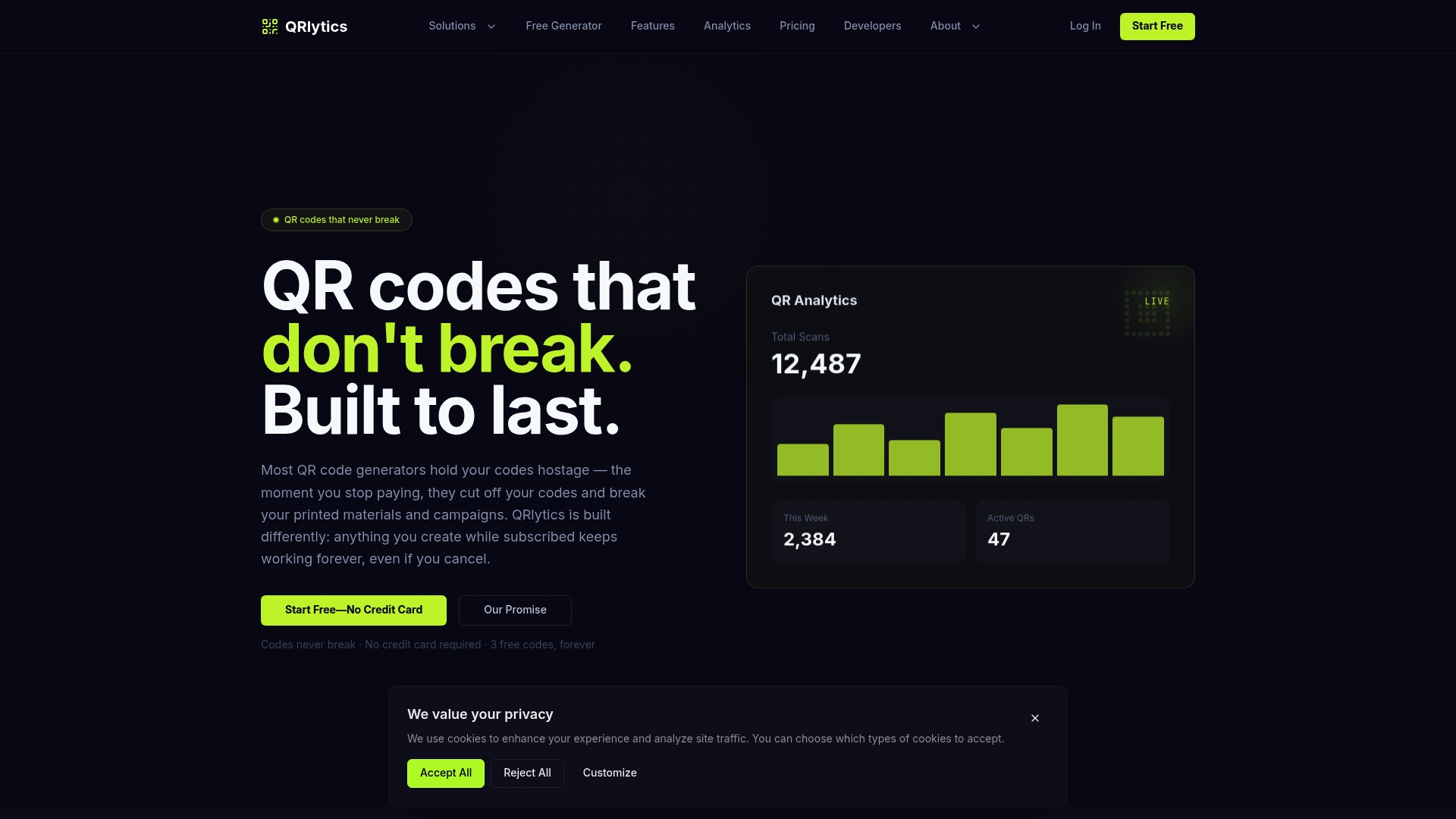
Everything in this guide maps to what we’ve built: permanent codes that never expire mid-campaign, dynamic destinations you can update without reprinting, and real-time analytics that show exactly which placement is earning its keep.
- Start free with no credit card required and test dynamic codes on our free QR code generator.
- Compare plans, including our Free tier and Pro tier, on the QRlytics pricing page.
- Generate QR codes and monitor scan data in real time.
FAQ
What’s the difference between dynamic and static QR codes?
A static QR code points to one fixed destination forever, while a dynamic QR code lets you change the destination URL after the code is printed. Dynamic codes are the practical choice for any campaign running across multiple placements or phases.
How do I track QR code scans back to actual sales?
Apply consistent UTM parameters to each code and pass that data into hidden fields in your CRM, so a lead generated from a scan carries its original placement data through to the point of sale. Pairing this with scan-to-conversion reporting lets you compare placements on actual revenue rather than scan count alone.
Why do some QR codes stop working after a while?
Many free QR services deactivate codes if a subscription lapses or a payment fails, which leaves printed materials pointing at a dead link. QRlytics guarantees that any code created during an active subscription keeps redirecting permanently, regardless of later billing status.
What are the security risks of scaling a QR campaign?
Quishing incidents, where QR codes are used to phish users, rose sharply in early 2026 according to Microsoft, which makes role-based access and audit trails essential once you manage many codes. Treat QR code governance as part of your broader security posture rather than a separate marketing concern.
How many QR placements should I test before scaling up?
There’s no universal number, but a small set of two or three placement types tested with clear scan targets gives you enough signal to decide what to scale. Running a structured competitor and campaign analysis beforehand helps you prioritise which formats and messages are worth testing first.
Sources
- QR Code Governance: How Businesses Can Manage The Risks Of Quishing
- How to conduct competitor analysis