QR redirection stability: the marketer’s 2026 guide

TL;DR:
- QR redirection stability is vital for reliable QR code campaigns, as it affects user experience and data accuracy. High latency, server outages, or insecure redirect chains can lead to errors, abandoned scans, and security vulnerabilities. Using edge-distributed architectures, HTTPS 302 redirects, and continuous monitoring ensures consistent performance and security throughout campaigns.
QR redirection stability refers to the reliability and performance of the server infrastructure that directs users from a scanned QR code to its intended destination URL. The role of QR redirection stability in campaign success is not a secondary concern. It is the foundation on which every printed poster, product label, and event badge either delivers results or fails silently. When that infrastructure falters, scans produce error pages, users abandon the experience, and your campaign data becomes unreliable. Qrlytics is built around the principle that this infrastructure must never be the weak link in a marketing campaign.
How does QR redirection stability affect QR code performance?
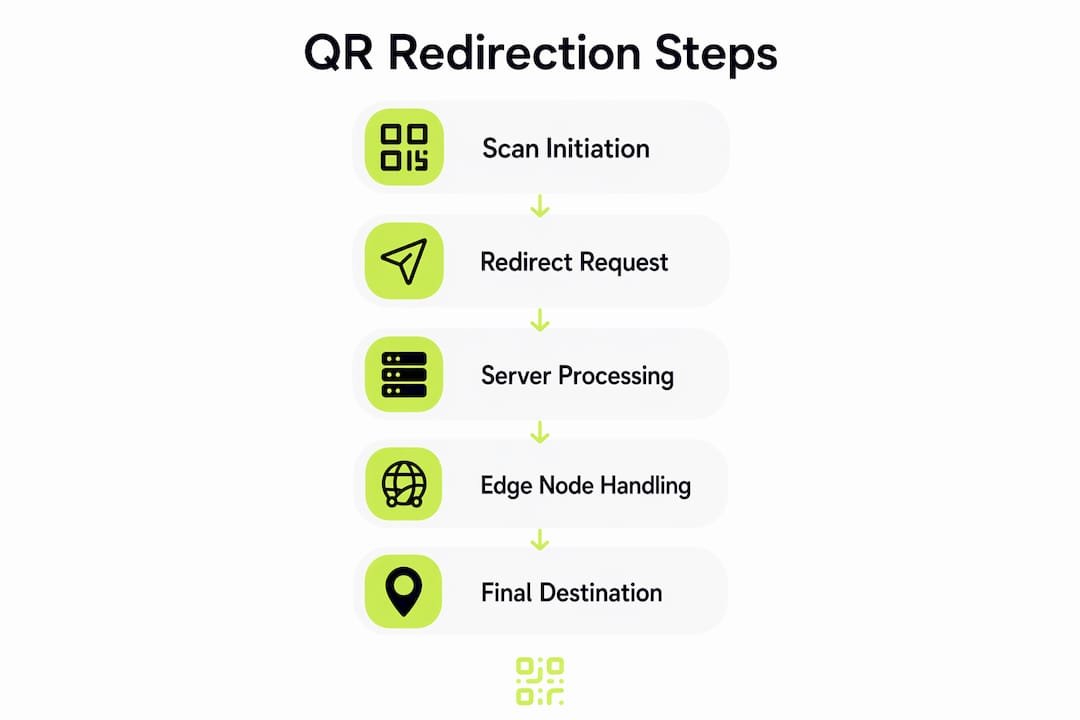
Redirection stability directly determines whether a scan succeeds or fails. A QR code itself is simply a pattern encoding a short URL. Everything that happens after the scan, including the speed and reliability of reaching the final destination, depends entirely on the redirect server. QR code stability depends on redirect server infrastructure, and latency or outages cause failure at the point of scan.

The numbers make the impact concrete. A user in Sydney scanning a code whose redirect server sits in Virginia faces a 180ms round-trip latency before the page even begins to load. That delay is enough to increase abandonment, particularly on mobile where users expect near-instant responses.
The consequences of poor QR code performance extend beyond a single frustrated scan:
- Scan failures produce error pages that damage brand credibility immediately.
- High latency increases the likelihood that users close the browser before the destination loads.
- Inconsistent uptime means campaign analytics miss scans entirely, distorting your data.
- Broken redirects on printed materials cannot be fixed without reprinting, which carries real cost.
Brand trust is the hardest thing to rebuild after a public-facing failure. A QR code on a billboard or retail shelf that returns an error is not a minor technical glitch. It is a visible signal to your audience that your business is unreliable.
Pro Tip: Test your QR codes from multiple geographic locations before any campaign goes live. A redirect that performs well in London may behave very differently for users in Singapore or São Paulo.
What technical architectures ensure high QR redirection stability?
The architecture behind your redirect infrastructure is the single biggest factor in QR code usability at scale. Two broad models exist: single-origin and edge-distributed.
Single-origin vs edge-distributed redirects
A single-origin setup routes every scan through one central server. This is simple to manage but creates a geographic bottleneck. Single-origin servers produce time-to-first-byte figures of 150–250ms for distant users, compared to 5–20ms for edge-distributed alternatives. That is a tenfold difference in responsiveness.
Edge-distributed architectures place redirect logic at nodes close to the end user. Platforms using Cloudflare Workers, for example, replicate data globally within approximately 60 seconds, achieving single-digit millisecond reads. Moving redirect logic to edge nodes reduces average redirect times from approximately 750ms to approximately 40ms. For a marketer running a global campaign, that difference is the gap between a completed scan and a lost lead.
| Architecture | Typical latency | Key trade-off |
|---|---|---|
| Single-origin server | 150–250ms for distant users | Simple setup, high geographic risk |
| Edge-distributed (global nodes) | 5–20ms | Higher reliability, lower latency worldwide |
Caching strategies that protect uptime
Caching is the second line of defence when a redirect server experiences pressure. The stale-while-revalidate and stale-on-error techniques serve a slightly older redirect target rather than an error page during an outage. This means users still reach a valid destination even if the backend is temporarily unavailable. A stale redirect is far preferable to a broken one, particularly for printed materials that cannot be updated.
Why HTTP 302 matters more than you think
The choice of redirect type has a direct impact on campaign flexibility. HTTP 301 redirects are aggressively cached by browsers and mobile operating systems, making destination changes invisible to returning users. If you update a campaign URL but the browser has cached the old 301, users continue landing on the previous page. HTTP 302 redirects, which signal a temporary redirect, prevent this caching behaviour and preserve the dynamic nature of your QR codes.
Pro Tip: Always confirm with your QR code platform that it issues HTTP 302 redirects, not 301s. This single setting determines whether your destination updates actually reach users.
What security challenges arise from QR redirect instability?
Redirect instability does not only affect performance. It creates security vulnerabilities that can harm your users and expose your brand to serious reputational risk.
Redirect laundering and why it is hard to detect
Redirect laundering is the practice of inserting a malicious destination into a redirect chain after a code has been deployed. 23% of malicious QR codes use at least one redirect hop that crosses to a different root domain than the one encoded in the QR code. This means a code that appeared safe at launch can silently route users to a phishing page weeks later.
The danger is that most platforms only audit the initial URL at the point of generation. They do not monitor the full redirect chain throughout the campaign lifecycle. Full redirect chain inspection and rate-limiting scan resolution are the controls that prevent real-time redirect manipulation attacks.
Effective security controls for QR redirect platforms include:
- Continuous redirect chain auditing throughout the campaign, not just at launch.
- Domain allowlists that restrict which destinations a redirect can resolve to.
- Rate limiting on scan resolution to prevent automated abuse.
- Tamper-evident audit logs that record every destination change with a timestamp.
- HTTPS enforcement on all redirect destinations, with threat feed validation before any URL goes live.
Security best practices require platforms to enforce redirect chain auditing, threat feed lookups, HTTPS enforcement, and anomaly detection both before generation and throughout the campaign’s active life. Platforms that skip post-launch monitoring leave a window open for destination manipulation that users and marketers may never detect until the damage is done.
Understanding secure QR code forwarding is not a developer concern alone. Marketers who own campaigns must understand what controls their platform applies, because the liability for a compromised redirect sits with the brand, not the infrastructure provider.
Pro Tip: Ask your QR platform provider directly: “Do you audit the full redirect chain after launch, or only at the point of code generation?” The answer tells you everything about their security posture.
How can marketers audit and maintain QR redirection stability throughout campaigns?
Maintaining stability across a live campaign requires a structured approach. A QR code deployed on packaging or signage cannot be recalled easily, so the work of ensuring reliability must happen before launch and continue throughout the campaign’s life.
- Audit all live redirect destinations before launch. Scan every code in your campaign and confirm the destination URL, redirect type, and HTTPS status. Document the results in a shared register.
- Monitor latency and error rates continuously. Set up alerts for redirect failures and response time spikes. A sudden increase in error rates often signals a server issue or a destination that has gone offline.
- Maintain a standardised naming scheme for all redirect URLs. Consistent naming makes it easier to identify which codes belong to which campaign and to archive assets when a campaign ends.
- Use scan analytics to detect anomalies. A sharp drop in scan volume from a previously active location can indicate a broken redirect rather than a change in user behaviour. Qrlytics provides real-time scan analytics that surface these patterns as they emerge.
- Own your redirect domain. Using a custom domain such as go.yourcompany.com means you can switch redirect infrastructure providers without reprinting a single QR code. The printed URL never changes; only the backend does.
- Archive campaign assets and redirect configurations. When a campaign ends, document the final state of every redirect. This protects you if a destination is later reused or if a compliance audit requires historical records.
A content audit approach applied to your QR redirect inventory works well here. Treat each active redirect as a live digital asset that requires periodic review, not a set-and-forget configuration.
Pro Tip: Avoid synchronous database writes in your redirect processing path. Asynchronous event logging records scan data without adding delay to the user’s redirect experience. Confirm your platform handles analytics logging this way.
Understanding QR redirected links at a technical level gives you the confidence to ask the right questions of your platform provider and to spot problems before they affect your audience.
Key takeaways
Stable QR redirection infrastructure is the single most controllable factor in whether a printed or digital QR code campaign delivers consistent results or fails at the point of scan.
| Point | Details |
|---|---|
| Latency kills conversions | A 180ms round-trip to a distant server is enough to increase scan abandonment on mobile. |
| Edge architecture cuts redirect times | Moving redirect logic to edge nodes reduces average times from ~750ms to ~40ms globally. |
| Use HTTP 302, not 301 | HTTP 301 caching breaks dynamic destination updates; always confirm your platform uses 302. |
| Audit the full redirect chain | 23% of malicious QR codes use cross-domain redirect hops that bypass initial URL checks. |
| Own your redirect domain | A custom domain lets you change infrastructure providers without reprinting any materials. |
Why redirect stability is the campaign risk most marketers ignore
I have reviewed a significant number of QR code campaigns over the years, and the pattern is consistent. Marketers spend weeks on creative, copy, and targeting, then hand the technical infrastructure to whichever free tool is easiest to set up. The redirect layer gets almost no scrutiny until something breaks publicly.
The shift towards edge-first infrastructure is the most important development in QR reliability right now. Platforms that still route every scan through a single application server are operating with a structural weakness that no amount of campaign planning can compensate for. When that server goes down, every printed code in your campaign becomes useless simultaneously.
Owning your redirect domain is the single most underrated decision a marketing team can make. It costs almost nothing to set up, and it gives you the ability to change providers, update infrastructure, or recover from a supplier failure without touching a single printed asset. The brands I have seen handle QR campaigns most confidently are the ones that treat the redirect domain as a core owned asset, not a platform dependency.
The forecast is clear: QR code adoption continues to grow, and with it, the consequences of instability grow proportionally. A broken redirect on a campaign reaching ten thousand people is a manageable problem. The same failure on a campaign reaching ten million is a reputational event. Building QR code consistency into your infrastructure now is not cautious. It is the only professional standard that makes sense.
— The
Qrlytics: dynamic QR codes built for reliable redirection
Qrlytics gives marketers direct control over the redirect infrastructure behind every QR code they create. The dynamic QR code generator lets you update destination URLs at any time without reprinting materials, while real-time scan analytics surface performance issues the moment they appear.
Every code created on Qrlytics during an active subscription remains functional permanently, regardless of billing changes. GDPR-compliant tracking, global heat maps, and built-in security controls mean you are not trading reliability for features. No credit card is required to get started, making it straightforward to test the platform against your current setup before committing. If redirect stability matters to your campaigns, Qrlytics is built to meet that standard.
FAQ
What is QR redirection stability?
QR redirection stability is the consistent ability of a redirect server to route users from a scanned QR code to the correct destination URL without failure or significant delay. It depends on server uptime, geographic latency, and redirect architecture.
Why does redirect latency matter for QR code campaigns?
High latency increases scan abandonment, particularly on mobile. A round-trip of 180ms to a distant server degrades the user experience enough to reduce engagement and distort campaign analytics.
What is the difference between HTTP 301 and 302 redirects for QR codes?
HTTP 301 redirects are cached by browsers, which means destination updates may not reach returning users. HTTP 302 redirects prevent caching and preserve the dynamic nature of QR codes, making them the correct choice for all campaign use.
What is redirect laundering and how does it affect QR campaigns?
Redirect laundering occurs when a malicious destination replaces a legitimate URL within a redirect chain after a code has been deployed. Research shows 23% of malicious QR codes use at least one cross-domain redirect hop, making post-launch chain auditing a necessary security control.
How do I maintain QR redirection stability throughout a long campaign?
Own your redirect domain, monitor latency and error rates continuously, and audit the full redirect chain at regular intervals. Using a platform like Qrlytics with built-in scan analytics makes anomaly detection straightforward without requiring developer support.