Keep Vehicle QR Codes Updatable and Trackable for Fleet Marketing

Yes: QR codes on vehicles work well for advertising, lead capture, registration and inspection, and day-to-day fleet reporting. The key is choosing dynamic codes for anything tied to a campaign or workflow, since they let you update the destination and track every scan. One safety note before you start: unsolicited QR codes are a known phishing vector, so keep destinations managed and verified.
TL;DR:
- Dynamic QR codes are recommended for campaigns because they allow destination updates and provide valuable scan data for measuring engagement.
- Proper placement, size, contrast, and testing are crucial to ensure scan reliability on moving or parked vehicles and avoid failed reads.
- Materials like UV-resistant vinyl with proper lamination extend the durability of vehicle QR codes, which should be checked quarterly for damage or fading.
- Tracking metrics such as total scans, conversions, and location data enable accurate ROI measurement for vehicle QR code campaigns.
- Implementing security best practices, including verifying landings and enforcing HTTPS, protects against malicious QR code tampering and phishing risks.
Table of Contents
- Practical use cases and campaign examples for vehicle QR codes
- Choosing the right QR code type and destination
- Design and placement best practices for scan reliability on vehicles
- Materials, printing and durability for vehicle-mounted codes
- Tracking and measurement: proving ROI from vehicle QR codes
- Security and legal considerations for public-facing vehicle codes
- Step-by-step implementation checklist and rollout plan
- What we have learned running vehicle QR programmes
- How QRlytics supports a vehicle QR programme
- Sources
- FAQ
Practical use cases and campaign examples for vehicle QR codes
A QR code on a van door or bus wrap turns idle parking time into an advertising channel. Passers-by scan the code, land on a microsite, and see a current offer or a booking form. Because the vehicle is stationary or slow-moving for long stretches, the scan window is longer than a billboard glimpse, which tends to lift engagement compared with fast-moving roadside media.

For transport, delivery and rideshare businesses, a QR code near the door or on a partition can drive lead capture directly. A mobile-first form, pre-filled where possible, converts far better than a code that dumps the visitor on a generic homepage. Keeping the path from scan to submission to two or three taps matters more than the creative on the decal itself.
Operationally, QR codes are doing quiet, useful work beyond marketing. Fleet platforms already print VIN-linked QR codes that surface vehicle details, service history and inspection records on demand, as shown in Hera’s documentation on vehicle QR codes. A code on the dashboard or door frame can also route a driver straight into an incident-reporting form after a knock or near-miss.
Common jobs for vehicle QR codes include:
- Out-of-home advertising: driving scans to a seasonal offer or event microsite.
- Lead capture: mobile forms for quotes, bookings or callback requests.
- Registration and inspection: linking a vehicle to its VIN record, service history or compliance documents.
- Incident and maintenance reporting: giving drivers a fast route to log issues without paperwork.
- Contactless information: menus, safety notices or rental instructions for shared or leased vehicles.
Choosing the right QR code type and destination
Static codes encode the destination permanently. Once printed, the link cannot change, which is fine for something you will never touch again but risky for anything tied to a campaign, price or season. Dynamic codes point to a short redirect URL that you can repoint at any time, and they generate scan data such as timestamps, device type and location.
For campaigns, retargeting and anything that might need a new landing page next quarter, dynamic is the sensible default. For a permanent identifier, such as a VIN plate, a static code works, though many fleets now choose a dynamic code anyway so the underlying record can be updated without a reprint.
Where the code sends people matters as much as the code itself:
- Landing page or microsite for campaigns and offers.
- Deep link into an app for existing customers or loyalty programmes.
- Wallet pass for loyalty cards or event tickets tied to a vehicle-based promotion.
- PDF or record page for maintenance history, inspection status or warranty details.
Plan the destination as something you will edit, not something you will reprint. A decal that survives two years on a van door should not be locked to a URL that expires with a single campaign.
Design and placement best practices for scan reliability on vehicles
A code that looks fine on a screen can fail completely on a moving vehicle. Size, contrast and placement decide whether a passer-by actually gets a scan or gives up after one failed attempt.
- Size for the viewing distance. A code meant to be scanned from a car park at close range can be smaller than one aimed at street traffic passing at speed; err larger rather than smaller when in doubt.
- Keep the quiet zone clear. Leave a plain border around the code roughly the width of one module; text or logos crowding the edge cause failed reads.
- Maximise contrast. Dark modules on a light background scan more reliably than colour-on-colour combinations, especially in bright sunlight or shade.
- Use higher error correction if adding a logo. A centred logo is fine with a higher error-correction level, but test it before mass production.
- Match placement to vehicle shape. Flat panels such as doors and rear panels scan better than curved bumpers or wheel arches, where distortion breaks the pattern.
- Account for motion and angle. Codes meant to be scanned while the vehicle is parked can sit lower or on the side; codes aimed at passing traffic need to be higher and angled towards the road.
Pro Tip: Before printing a full fleet run, test the artwork on one vehicle in real daylight and shade, from the distance your audience will actually stand.
Materials, printing and durability for vehicle-mounted codes
A vehicle QR code lives outdoors, through rain, sun and repeated washing, so the material choice decides whether it is still scannable in six months or peeling within six weeks.
- Cast vinyl with UV-resistant laminate holds up best on curved panels and in direct sun, generally outlasting cheaper calendared vinyl.
- Magnetic mounts suit vehicles that rotate branding or lease vehicles that need to revert to plain livery; adhesive vinyl suits permanent branding; window clings suit codes aimed at pedestrians rather than passing traffic.
- Ask suppliers for warranty terms, weather test data and minimum operating temperature ranges before committing to a print run.
- Set a maintenance cadence: a quarterly visual check and a scan test catches fading, peeling or damage before it costs you leads.
Tracking and measurement: proving ROI from vehicle QR codes
The value of a vehicle QR programme is only as good as the data behind it. Dynamic codes paired with proper measurement turn a printed decal into a channel you can actually report on, and industry guidance on dynamic QR use in out-of-home advertising points to exactly this shift from passive signage to trackable engagement.
Metrics worth tracking on every campaign:
- Total scans and unique devices, to separate reach from repeat interest.
- Conversions, meaning form submissions, bookings or app opens tied to the scan.
- Time and location data, showing when and where scans cluster.
- Session paths, showing whether visitors bounce or move through the funnel.
Tagging the redirect URL with UTM parameters lets you attribute scans in the same analytics stack as your other campaigns, and a practical guide to QR code tracking walks through setting this up without over-engineering it. Keep measurement privacy-compliant: anonymise device identifiers where possible, document what you collect, and make consent notices visible on the landing page rather than buried in a footer.
For reporting, a monthly export covering scans, conversions and a heatmap snapshot gives stakeholders a clear read on which vehicles, routes or placements are earning their keep. A metrics and exports guide for marketers is a useful reference when deciding what to include in that cadence.
Security and legal considerations for public-facing vehicle codes
QR codes on vehicles sit in public view, which makes them a target for tampering as well as a tool for engagement. The FBI has warned that state-sponsored actors have used malicious QR codes in spearphishing campaigns to harvest credentials and bypass multi-factor authentication, recommending layered technical and staff-training mitigations, as detailed in its alert on QR-based spearphishing. Coverage of the warning in Tom’s Guide advises the public to avoid scanning unsolicited codes and to check the landing page before entering any credentials.
Unsolicited QR codes should be treated with the same caution as an unexpected link in an email: verify before you tap, and never enter credentials on a page you did not expect.
For a fleet campaign, the practical mitigations are straightforward: preview the landing page before printing, enforce HTTPS on every redirect, monitor where the code points over time, and give staff a simple process for reporting a decal that looks tampered with. On privacy, collect only what the campaign needs, set a retention period, and link to a privacy notice from the landing page itself, an approach covered in more detail in guidance on secure QR forwarding. One regulatory caution: a QR code linking to inspection or service records is a convenience layer, not a substitute for official registration or inspection processes, which still need confirming against your local government’s own rules.
Step-by-step implementation checklist and rollout plan
Rolling out QR codes across a fleet works best as a small pilot first, not a full print run on day one.
- Define the pilot: pick three to five vehicles, set a clear KPI such as scan-to-form conversion, and run it for four to six weeks.
- Generate the code: create a dynamic QR code, set the destination, and enable analytics tagging before anything goes to print.
- Proof the artwork: check size, contrast and quiet zone against the placement guidance above.
- Test adhesion and materials: confirm the vinyl and lamination match the climate and mounting surface.
- Validate on the actual vehicle: scan the printed decal in situ, in daylight and shade, from realistic distances.
- Launch and monitor: review scan and conversion data weekly during the pilot window.
- Iterate: adjust placement, creative or destination based on what the data shows.
- Scale and govern: schedule reprints, assign ownership for destination updates, and document the process for future vehicles.
What we have learned running vehicle QR programmes
The most common mistake is printing a static code onto a full fleet before testing it on one vehicle in real conditions. A close second is sending scans to a generic homepage instead of a page built for the specific offer or workflow, which quietly kills conversion. The quick win that consistently pays off is switching from static to dynamic mid-campaign: one fleet operator we advised saw a marked lift in completed lead forms simply by retargeting an underperforming decal’s destination without touching the physical vinyl.
— The
How QRlytics supports a vehicle QR programme
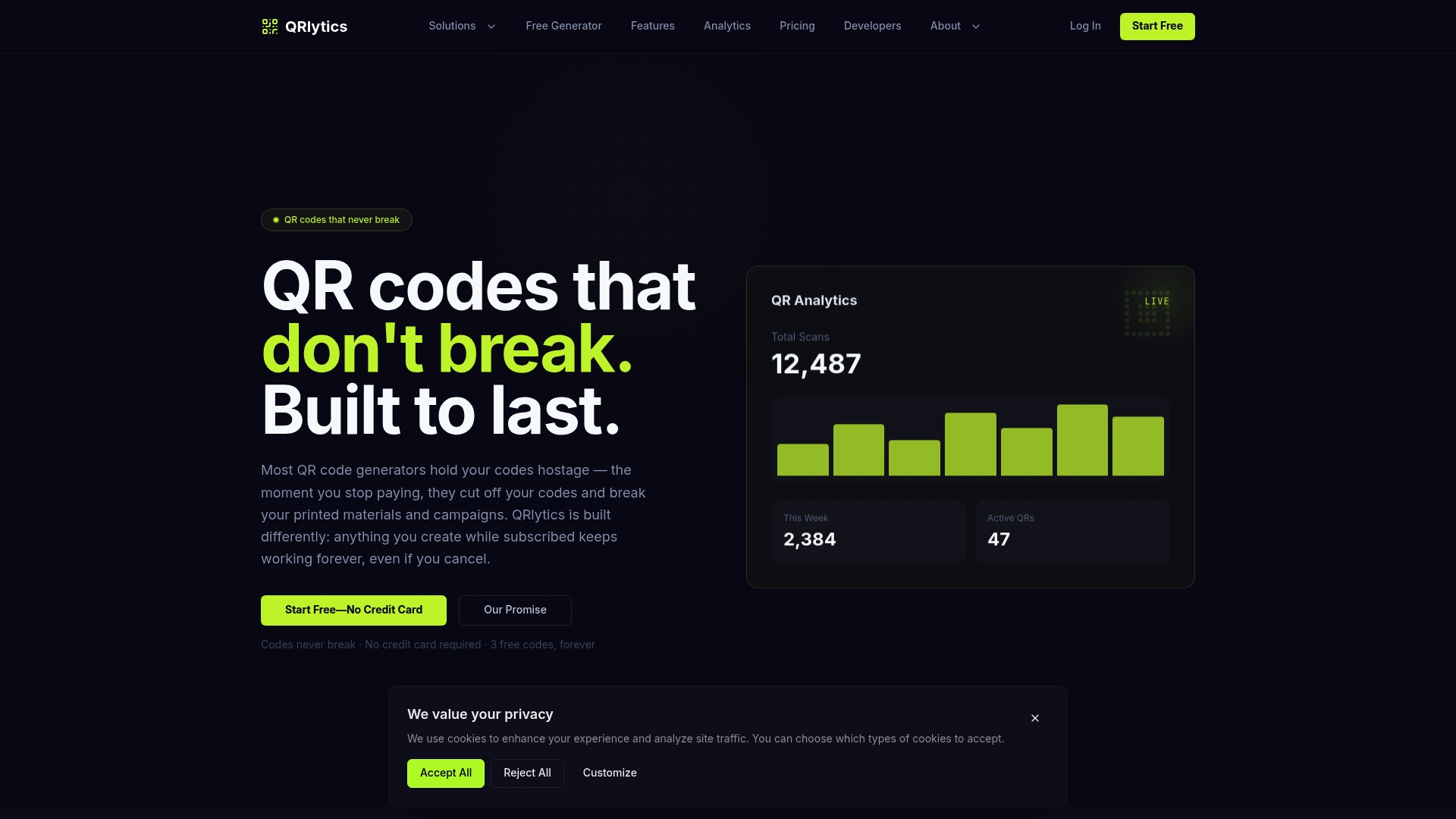
Reprinting a decal because a link changed is the exact problem QRlytics is built to remove. Codes created on an active plan keep working permanently, even if billing lapses later, so a campaign printed today does not become dead weight next year. You get dynamic URL updates, real-time analytics, GDPR-compliant tracking, and scan heatmaps by route or region, all without touching the vehicle again.
That means:
- Updating a campaign’s landing page without reprinting a single decal.
- Reviewing scan heatmaps to see which routes or placements actually convert.
- Exporting scan and conversion data as CSV for attribution reporting.
Readers ready to test this can start with the free QR code generator or go straight to the dynamic QR code generator for campaign-ready tracking. For fleets planning ongoing use, the Free and Pro plans cover everything from a single pilot vehicle to a full rollout.
Sources
- North Korean Kimsuky Actors Leverage Malicious QR Codes in Spearphishing Campaigns Targeting U.S. Entities
- Boost consumer engagement and measure OOH ad exposure with dynamic QR codes
- FBI issues urgent warning over ‘quishing’ scam — don’t fall for this | Tom’s Guide
- Vehicle VIN QR Codes | Hera Support Center
FAQ
Can you put a QR code on a vehicle?
Yes, businesses and fleet operators routinely place QR codes on vans, cars and buses for advertising, lead capture and operational uses such as VIN-linked service records. Choosing a dynamic code keeps the destination editable and gives you scan data to measure results.
What is the FBI warning about QR codes?
The FBI warned that state-sponsored actors have used malicious QR codes in phishing campaigns to steal credentials and bypass multi-factor authentication, as described in its alert. The practical takeaway is to avoid scanning unsolicited codes and to verify a landing page before entering any personal or login details.
How do I get a QR code for my car?
You can generate one through a QR code platform, choosing a dynamic code if you want to update the destination or track scans later. Many fleet management tools also offer built-in QR generation tied to a vehicle’s VIN, as shown in Hera’s support documentation.
Why do people have barcodes on their cars?
Barcodes and QR codes on cars are usually linked to VIN records, inspection status, maintenance history or advertising campaigns, giving instant access to information without paperwork. Some regions are also trialling QR codes as a replacement for traditional inspection stickers.
Should I use a static or dynamic QR code on my vehicle?
Dynamic codes are the better choice for campaigns, promotions or anything that might need a destination change, since the underlying link can be updated without reprinting. Static codes suit a genuinely permanent reference, though many fleets choose dynamic even for that to keep future options open.