2 Methods to Keep a Dynamic QR for a PDF Live After Cancellation
A dynamic QR for a PDF is a scannable code whose destination you can change later, so you can update the document without reprinting a single flyer or sign. The right setup pairs that flexibility with two things too many providers skip: a permanent redirect and real scan analytics. Get those two right and everything else falls into place.
TL;DR:
- Dynamic QR codes allow updating the destination PDF without reprinting, with the best platforms offering permanent redirects and analytics.
- Keep PDF files under 10 MB, optimize images, and put key information on the first page to ensure fast loading on mobile devices.
- Use clear placement at eye level, appropriate sizing based on estimated scanning distance, and contrast testing to maximize scan rates.
- Always test redirects on mobile networks before printing and maintain a spreadsheet of codes and current URLs to prevent link confusion.
- Choose providers that guarantee code permanence even if subscriptions lapse, ensuring printed materials remain functional long-term.
Table of Contents
- What is a dynamic PDF QR code, and how does it differ from static?
- How do I create a dynamic QR code that links to a PDF?
- What PDF size and format work best for mobile scanning?
- How do I update the linked PDF without breaking the printed code?
- What scan analytics should I track, and how do I stay GDPR-aware?
- How do I place and size printed QR codes for the best scan rate?
- Why permanence guarantees change how you should choose a QR provider
- Try a permanence-first dynamic QR for your next PDF
- Sources
- FAQ
What is a dynamic PDF QR code, and how does it differ from static?
A static QR code embeds the PDF’s data directly into the pattern itself, meaning the file it links to can never change without producing a brand new code. A dynamic QR code instead points to a short redirect URL, which then forwards the scanner to whatever destination you set. Change the destination on your dashboard, and every printed copy of that code now leads somewhere new, instantly.
This distinction is the whole reason dynamic wins for anything printed. Static codes also tend to look denser and more cluttered because they carry the full PDF path in the pattern, whereas dynamic codes stay clean and scan-friendly since they only encode a short link.
The practical benefits stack up quickly:
- Updateability: swap a menu, manual, or brochure without a new print run.
- Smaller, cleaner codes: a short redirect URL produces a simpler pattern that scans faster.
- Analytics: every scan against a dynamic code can be logged, unlike static ones.
- Version control: one code can point to v1 today and v3 next quarter.
Restaurants updating seasonal menus, manufacturers revising product manuals, and event organisers correcting a printed programme all rely on this same mechanic.
How do I create a dynamic QR code that links to a PDF?
There are two workable methods, and the right one depends on how much control you want over hosting.
Method A: Upload the PDF directly into a QR platform’s host.
- Prepare a clean, optimised PDF (more on file size below).
- Upload it to your QR generator’s hosting.
- Generate the dynamic QR code, which points to a redirect URL the platform manages.
- Test the scan on at least two phone models before printing.
- Download a high-resolution version, ideally vector or 1000px or more, for print use.
Method B: Point the dynamic QR to a PDF already hosted elsewhere, such as your website or cloud storage. This suits teams who already manage document versioning through their own CMS or drive, since it keeps analytics flowing through one redirect while the actual file lives wherever your existing workflow expects it.
A free generator is often enough for a single-use flyer or a personal project with no ongoing update need. Once permanence, uptime guarantees, or campaign-level reporting matter, look for a platform that guarantees the redirect itself keeps working, since some dynamic QR platforms even allow onboarding without a credit card so you can test the whole workflow before committing to anything.
Pro Tip: Always scan-test your dynamic QR on mobile data, not just Wi-Fi, before it goes to print. A redirect that loads fine on a fast office connection can stall badly on a patchy 4G signal at a trade show.
What PDF size and format work best for mobile scanning?
Mobile users abandon slow-loading documents fast, so file preparation matters as much as the code itself. A PDF under 5 to 10 MB loads acceptably on most mobile connections; anything heavier risks visitors giving up before the first page renders.
A few practical fixes solve most size problems:
- Compress large scanned images rather than embedding full-resolution originals.
- Use a linearised PDF, which lets the first page display while the rest loads in the background.
- Put the most important information (a menu’s daily specials, a manual’s safety notice) on page one.
- Avoid embedding fonts unnecessarily if a standard font will do.
Design matters too. Keep strong contrast between the code and its background, preserve a white quiet zone around the edges, and if adding a logo overlay, keep it small and central so it does not interfere with the corner alignment markers scanners rely on.
How do I update the linked PDF without breaking the printed code?
The entire point of a dynamic QR is that the printed pattern never changes, only the destination behind it does. On most redirect-based platforms, you log in, open the code’s settings, and swap either the uploaded PDF or the target URL. The printed code keeps scanning exactly as before.
A few habits keep this safe long term:
- Use date-stamped filenames (
menu-2026-03.pdf) so old versions never get confused with the current one. - Point to a canonical landing page rather than a raw file link where possible, so future swaps do not depend on exact file paths.
- Apply cache-busting (adding a version parameter to the URL) if visitors report seeing an outdated PDF after an update.
- Re-scan the code immediately after any change, from a phone, not just a desktop preview.
Codes can stop working for reasons that have nothing to do with your PDF: an account lapsing, a subscription cancellation, or a provider deleting the redirect domain. This is the scenario that ruins entire print runs overnight, and it is precisely why permanence guarantees matter more than most people realise until they lose one.
Pro Tip: Keep a spreadsheet mapping each printed QR code to its current destination URL. When you manage more than a handful of codes across menus, manuals, and signage, this single habit saves hours of guesswork during updates.
What scan analytics should I track, and how do I stay GDPR-aware?
Useful dynamic QR platforms report scan counts, unique scans, time and date of each scan, approximate location through heat maps, and device type. Together, these tell you not just that the code worked, but where and when it actually got used.
That data earns its keep when you act on it: move a poorly performing code to a more visible spot, tweak the call-to-action text next to it, or A/B test two placements against each other over a week.
Location heat maps and device-type breakdowns let you see exactly which placements and formats drive real scans, rather than guessing from print run numbers alone.
Privacy discipline matters just as much as the numbers. A basic checklist:
- Anonymise or truncate IP addresses rather than storing them in full.
- Collect only aggregated metrics, never personal identifiers, unless you have explicit consent.
- Add a short privacy note wherever you collect more than basic scan counts.
- Choose a platform offering GDPR-compliant tracking by default rather than retrofitting compliance later.
How do I place and size printed QR codes for the best scan rate?
Placement and sizing decisions made before printing prevent almost every scan failure reported after the fact.
- Follow the rough rule of 1cm of code width per 10cm of scanning distance, so a code meant to be scanned from arm’s length needs to be printed at a sensible minimum size.
- Place codes at eye level or on a flat surface, never on a curved or reflective one, such as a wine glass or foil wrapper.
- Pair the code with a short, direct instruction such as “Scan for the full menu” rather than a vague “Scan me”.
- Check bleed and safety margins during proofing so the quiet zone around the code never gets trimmed off.
- Run a final contrast test under the actual lighting conditions the code will live in, not just under office lights.
A short pre-print checklist covering scan tests, safe margins, and lighting checks catches the mistakes that ruin an otherwise good print run.
Why permanence guarantees change how you should choose a QR provider
Plenty of platforms quietly deactivate codes the moment a subscription lapses, and creators only discover it once printed materials go dark. That is the actual industry problem worth solving, not just an edge case. A permanence guarantee, paired with dynamic URL updates, analytics, customisation, and no credit card required to start, changes the calculation for anyone printing at scale. When a procurement decision hinges on whether next year’s reprint budget survives a billing hiccup, that guarantee stops being a nice extra and becomes the deciding factor.
— The
Try a permanence-first dynamic QR for your next PDF
Free dynamic QR generators can be genuinely useful for a one-off flyer, but many advertise editable destinations and logo overlays without addressing what happens the moment a subscription payment fails or gets cancelled. Qrlytics takes the opposite approach: codes created during an active subscription keep working permanently, even after cancellation, so your printed materials never go dark over a billing issue.
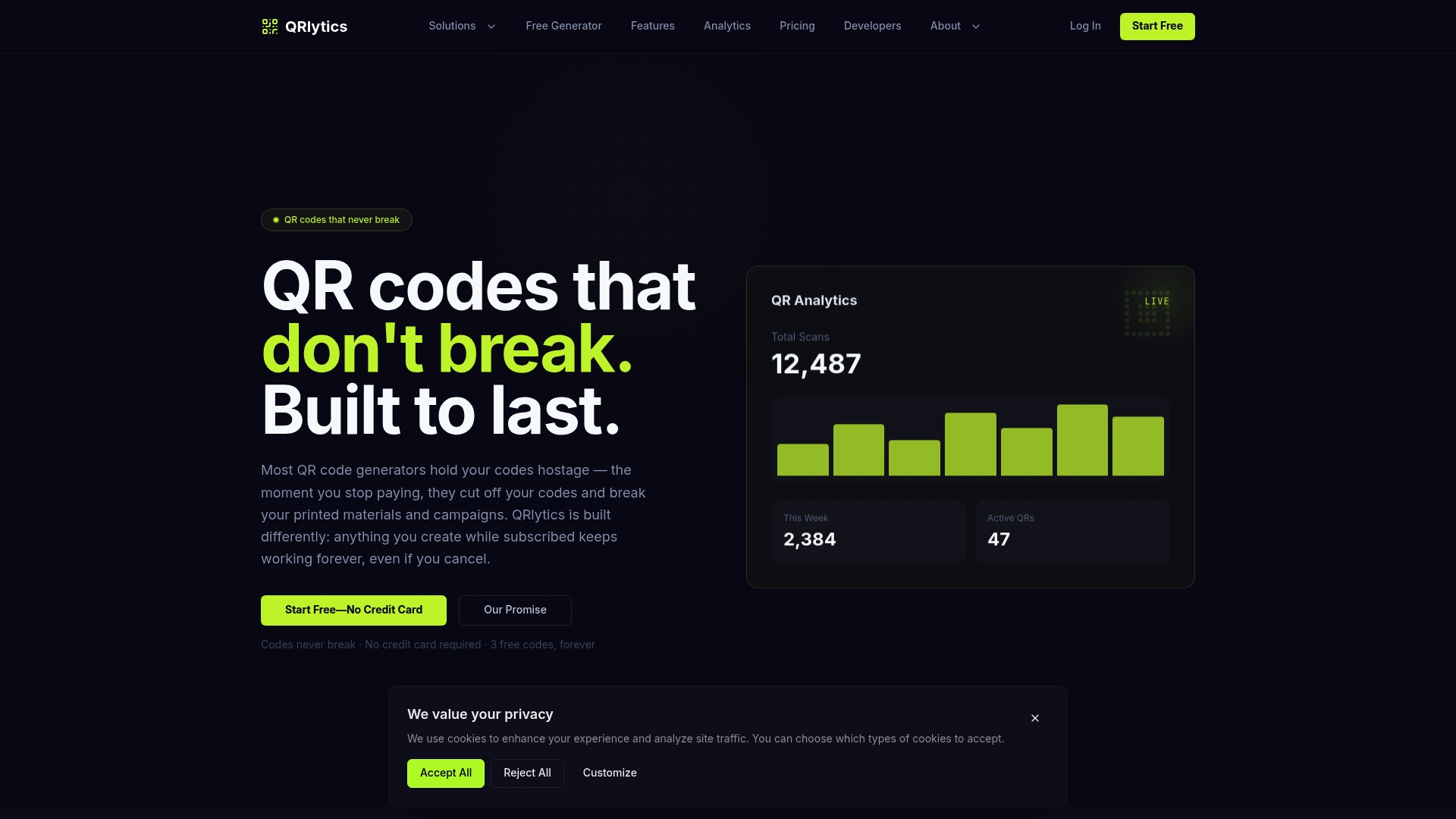
The free plan lets you create and test a dynamic QR code with no credit card required, so you can upload a PDF, generate the code, and check the redirect before deciding on anything paid. Once you need deeper reporting or higher volume, the Pro plan unlocks fuller scan analytics and GDPR-compliant tracking, with pricing available on the pricing page. Start with a single PDF, run a real scan test today, and watch the analytics roll in before your next print order goes to the printer.
Sources
For placement and sizing detail beyond this guide, see QR code best practices for marketers and the print sizing rule for designers. Marketers building out full campaigns can also read how to generate QR codes: the marketing pro’s guide, and for visual assets that pair well with scannable PDFs, why visual content drives more engagement is worth a look.
- Free Dynamic QR Code Generator — Editable QR Codes, No Sign Up, Custom Logo
- Trustpilot reviews — TrueQRCode
FAQ
Can I make a QR code for my PDF?
Yes. Upload the PDF to a QR platform’s hosting or point a dynamic QR code at a PDF already hosted on your own site, then download the generated code for print or digital use.
Can I make a dynamic QR code in Adobe?
Adobe Express does not generate dynamic QR codes natively, but integrations exist that let designers verify and fix codes within their Adobe Express workflow before and after printing.
Can I create a dynamic QR code for free?
Yes, several platforms including Qrlytics offer a free tier that creates working dynamic QR codes without requiring a credit card, though permanence guarantees and deeper analytics typically sit behind a paid plan.
What is the best free option for a PDF QR code?
There is no single best free option. Compare permanence policies and check independent Trustpilot reviews for uptime and support before relying on any free generator for business use.
Can I update the PDF a dynamic QR points to after printing?
Yes, that is the entire purpose of a dynamic QR. Log in to your platform’s dashboard, swap the uploaded PDF or destination URL, and the printed code keeps working without any reprint needed.