Why QR codes expire and how to keep campaigns active

TL;DR:
- Most static QR codes do not expire, but their linked URLs can break due to domain or site changes. Dynamic QR codes depend on provider stability, and lapse in subscription or provider shutdown can cause code failure. To prevent expiry, brands should manage provider terms, monitor scan analytics, and maintain a centralized asset register with regular audits.
You print 10,000 brochures, distribute them at a major event, and three months later discover your QR code points nowhere. The scan simply fails. That nightmare scenario is more common than most marketing teams realise, and the consequences extend well beyond wasted print budgets. Understanding why QR codes expire, and how to prevent it from happening to your campaigns, is one of the most practical skills a brand manager can develop.
Table of Contents
- How QR codes work: The technical basics
- Why do QR codes actually expire?
- Static vs dynamic: Longevity and risks compared
- Preventing QR code expiry: Practical steps for lasting campaigns
- How QR code analytics can signal expiry issues
- What most marketers miss about QR code longevity
- Keep your QR codes and campaigns active with QRlytics
- Frequently asked questions
Key Takeaways
| Point | Details |
|---|---|
| QR code expiry risk | Codes can expire due to provider policies, broken links, or lapsed accounts. |
| Static vs dynamic | Static codes are permanent but limited, dynamic codes offer analytics yet depend on provider continuity. |
| Best practices | Choose reputable platforms, monitor analytics, and document all codes to prevent expiry surprises. |
| Analytics warning signs | Watch for scan drop-offs and errors to quickly remedy code failures. |
How QR codes work: The technical basics
With that initial confusion laid out, it is important to understand what QR codes actually are and how their technical makeup affects longevity.
A QR code is essentially a machine-readable image that stores data. That data can be a plain URL, a phone number, a block of text, or campaign-specific information. When someone scans the code with a smartphone camera or dedicated app, the device reads that stored data and acts on it, most often by opening a web address in a browser.
There are two fundamental types of QR codes, and the distinction matters enormously for campaign planning:
- Static QR codes: The destination URL or data is encoded directly into the image itself. Once generated, it cannot be changed without producing an entirely new code. The image is permanent, but the destination must never change.
- Dynamic QR codes: The code stores only a short redirect URL controlled by a service provider. That redirect points to a destination that you can update at any time without changing the printed code image. This is the foundation of lasting QR code campaigns.
- Scan redirection: With dynamic codes, every scan passes through the provider’s servers. The provider resolves the redirect and sends the user to your chosen destination. This is why the provider’s reliability is so critical.
The redirect layer gives dynamic codes their flexibility, but it also creates a dependency. If the provider’s infrastructure goes down, or if your account becomes inactive, that redirect breaks, and every printed code stops working instantly.
Why do QR codes actually expire?
Now that you are clear on how QR codes work, let us tackle the direct causes of expiry that threaten campaign stability.

Here is the truth that trips up many experienced marketers: static QR codes themselves almost never expire. The pattern of pixels encoded in the image does not degrade or switch off. However, the links they reference can and do break. A domain expires, a product page is removed, or a URL structure is changed during a website redesign. The code still scans perfectly. It just takes users somewhere broken or missing.
Dynamic codes face a different and arguably more disruptive risk. Because they rely on a third-party service to manage the redirect, the following causes are responsible for the vast majority of campaign failures:
- Subscription lapse: Many dynamic QR code providers deactivate codes when a payment fails or a subscription is cancelled. All your printed materials immediately stop functioning.
- Provider shutdown: Smaller or free-tier services can shut down with little warning. If the provider closes, every code they managed becomes non-functional overnight.
- Account closure: Staff changes, company restructuring, or simply forgetting login credentials can result in an account being closed or suspended, taking all associated codes with it.
- URL shortener limits: Some tools use general-purpose URL shorteners to create the redirect layer. These services often impose usage limits or have their own expiry rules.
- Deliberate expiration: Some platforms build in automatic expiry for limited-time campaigns. This is useful when planned, but catastrophic when overlooked and applied to materials still in circulation.
“The root of almost every expired QR code failure is not a technical glitch. It is an overlooked dependency between the printed asset and the service keeping it alive.”
Reviewing campaign analytics best practices is one way to keep tabs on whether your destination URLs are actually performing. In the context of QR code marketing, it is equally important to review the specific terms of service of any platform generating and managing your codes. Look for explicit statements about code lifespan, what happens upon account cancellation, and whether there is any grace period.
Static vs dynamic: Longevity and risks compared
With an understanding of what can go wrong, the next step is choosing the QR code type that best matches your campaign objectives and risk profile.
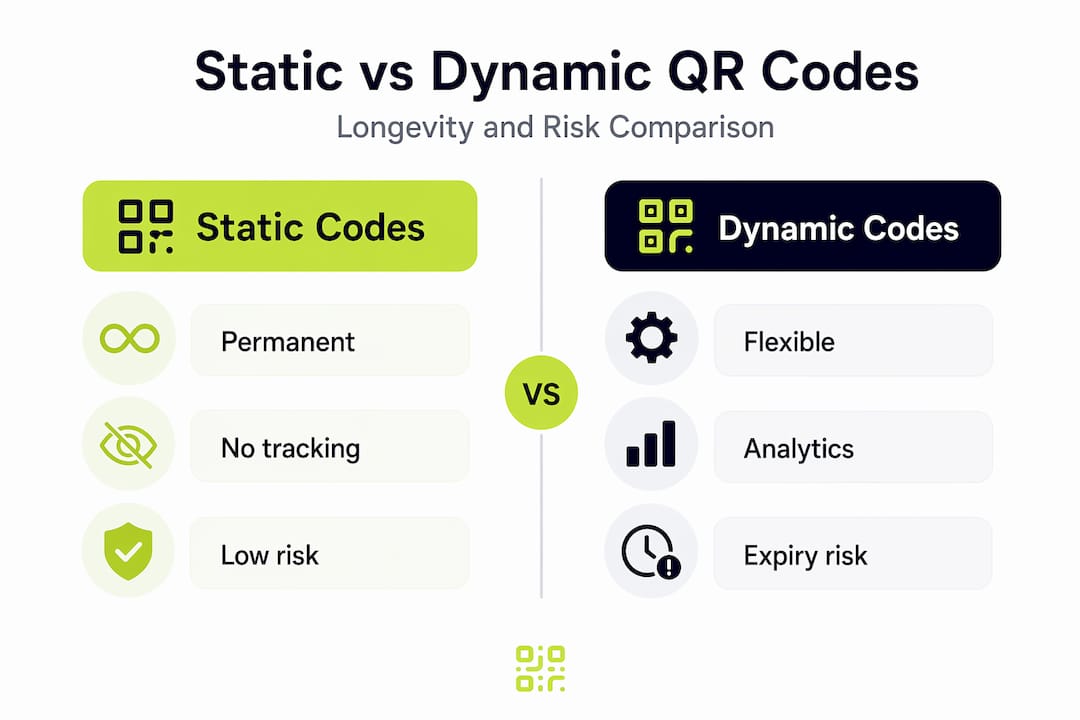
| Attribute | Static QR codes | Dynamic QR codes |
|---|---|---|
| Cost | Often free or very low cost | Subscription-based service |
| Expiry risk | Low (code itself is permanent) | Higher if provider lapses |
| Editability | None, destination is fixed | Redirect URL can be updated anytime |
| Scan analytics | None | Full scan data, device, location, time |
| Best for | Wi-Fi passwords, fixed URLs | Marketing campaigns, printed materials |
| Provider dependency | None | High, requires reliable service |
| Longevity guarantee | Depends on destination URL | Depends on provider terms |
Static codes suit very simple, stable applications where no tracking is needed. Dynamic QR codes are the only sensible choice for any campaign where you need to update destinations, track performance, or rely on materials remaining active for months or years. The trade-off is real, though. You are trusting a provider to keep the lights on.
The digital marketing best practices guidance that applies here is straightforward: treat your QR code service the same way you treat your hosting provider. You would not run a business website on a platform known for unexplained outages. Apply the same standard to the infrastructure behind your printed codes.
Pro Tip: Always request written or clearly documented confirmation of a provider’s code longevity policy before printing at scale. A provider who cannot answer “what happens to my codes if I cancel?” is not a provider you should trust with critical campaign assets.
Preventing QR code expiry: Practical steps for lasting campaigns
Understanding risks is only useful if you can actively prevent your codes from going dark. Here is an actionable checklist for staying in control.
Good QR code hygiene is not difficult, but it does require deliberate process. These steps apply whether you are managing a single seasonal campaign or hundreds of always-on codes across multiple channels:
- Audit provider terms before committing: Confirm whether codes remain active after subscription cancellation, what notice period is given, and whether there is a data export option so you can migrate if needed.
- Maintain active subscriptions: Set calendar reminders 30 and 60 days before subscription renewal dates. Assign account ownership to a role, not an individual, so staff changes do not result in orphaned accounts.
- Test regularly on physical materials: Scan your printed codes at least once per month. A working code is not proof that the destination is correct; verify the full user journey from scan to landing page.
- Avoid relying on free tools for critical campaigns: Free QR code generators often have undocumented expiry policies, usage limits, or simply disappear. Reserve them only for throwaway or low-stakes applications.
- Build a QR code asset register: Maintain a central log that records every code generated, its destination URL, the campaign it belongs to, the print volume, and the expiry date or renewal trigger.
For deeper guidance on managing printed materials over time, the approach outlined in tracking QR code campaigns is directly relevant. You can also find useful frameworks in QR code campaign tips from practitioners who manage codes at scale.
Pro Tip: Keep your QR code register in a shared team document, not in one person’s inbox or memory. When responsibilities shift, that register becomes the difference between a smooth handover and a silent campaign failure.
The guidance on building marketing qualified leads reinforces a point that is easy to miss: the value of a QR code is not in the scan, it is in the journey that follows. A broken code does not just lose a scan, it breaks the entire conversion path.
How QR code analytics can signal expiry issues
Preventing expiry is easier with the right monitoring tools. Analytics show you the warning signs before your campaign goes dark.
Even with careful preventative measures in place, things can still go wrong. A destination URL might be changed by a different team member, a landing page might go offline during a site migration, or a provider might experience unexpected downtime. Analytics are your early warning system.
The following signals are worth monitoring closely:
| Signal to watch | What it might indicate |
|---|---|
| Sudden scan count drop | Code or destination URL has become inactive |
| Spike in error or bounce rate | Destination is loading incorrectly or returning a 404 |
| Unusual device or location data | Bot traffic or testing activity masking real scan failure |
| Zero scans over an extended period | Code may no longer be visible in circulation or is broken |
| Consistent scan count then sudden zero | Subscription lapse or account closure causing redirect failure |
Tracking QR code scans at the individual code level, rather than just at campaign level, gives you the granularity to spot these issues quickly. When you monitor through scanning analytics for QR codes, you gain real-time visibility into scan trends, allowing you to intervene before significant print ROI is lost.
When analytics flag a problem, the response process should be swift. Identify the affected code, diagnose whether the issue is at the redirect layer or the destination, fix or update the destination URL if using a dynamic code, and verify the resolution through a fresh scan test. Document the incident and add a check to your regular audit schedule. Reviewing Google Analytics for campaign health alongside your QR platform data gives you a full picture, connecting scan data to on-site behaviour.
What most marketers miss about QR code longevity
Drawing all the practical strategies together, it is worth stepping back to examine why this issue persists in even the most experienced marketing environments.
The uncomfortable reality is that QR code expiry is not a technology problem. It is a process problem. Most marketing teams treat QR code generation as a one-off task: you need a code, you generate it, you print it, and you move on. The code is assumed to be permanent, especially if it works at the point of printing. That assumption is where campaigns quietly fail.
We see this pattern repeatedly. A brand invests substantially in a product catalogue, a retail display, or an event handout. The QR codes scan perfectly on the day of launch. Six months later, following a staff change or a billing oversight, the entire set of codes silently stops working. No alert. No obvious warning. Just a broken experience for every person who scans from that point forward.
What makes this particularly damaging is that the failure is invisible from the outside. The printed material still looks professional. The code image is still there. Users who scan and find nothing simply move on. You never see the lost conversions because there is no data to capture them.
The savviest marketing teams treat their QR codes the way they treat any critical digital asset: with documented ownership, scheduled audits, and a clear protocol for what happens when something changes. They use lasting QR code tracking strategies as a framework, not just a checklist.
True longevity also means choosing providers who are transparent about their infrastructure commitments. A provider who guarantees that codes created during an active subscription remain functional indefinitely, regardless of future billing status, gives your team a fundamentally different safety net than one who says nothing on the subject. That distinction is not a minor feature. For any brand that invests in print, it is a foundational requirement.
Keep your QR codes and campaigns active with QRlytics
If you are ready to safeguard your campaigns and never lose print ROI to expired codes, QRlytics provides a complete solution.
QRlytics was built specifically to address the reliability gap that leaves marketers exposed. Codes created during an active subscription remain functional permanently, regardless of subsequent billing status. That is a guarantee most platforms simply do not offer.
Beyond permanence, QRlytics gives you real-time QRCode analytics and tracking, full redirect URL management through the dynamic QR code generator, and GDPR-compliant global scan data including heat maps. You can start immediately with the free QR code generator, no credit card required, and scale to full campaign management as your needs grow. Your printed materials deserve infrastructure that is as reliable as the brand behind them.
Frequently asked questions
Do all QR codes expire automatically?
No, static QR codes themselves do not expire, but dynamic codes may be disabled if provider terms or subscriptions end. The destination URL a static code points to can also break independently of the code image.
How can I tell if my QR code is about to expire?
Monitor scan activity with analytics tools and check your provider’s account dashboard for code status or renewal alerts. A sudden and unexplained drop in scan volume is often the first practical warning sign.
What happens when a QR code expires?
Scanners will usually see an error or be directed to an inactive or broken link, resulting in lost campaign engagement. The printed code image itself remains unchanged, meaning users have no visual indication that anything is wrong.
Will printed QR codes work forever?
A printed QR code image will remain intact, but it is only useful if the underlying link or service stays live and accessible. For dynamic codes, this means keeping your provider account active and the redirect destination maintained.
How do I prevent QR codes on marketing materials from expiring?
Choose a reliable provider with a documented longevity policy, track code performance using analytics, and maintain an up-to-date asset register with renewal reminders for all active codes. Regular physical scan tests on printed materials are equally important.