Marketers: Branded QR Codes That Survive Print and Tracking

A branded QR code is a standard QR code styled with your logo, colours or frame while keeping every module scannable. The rule that matters most: keep contrast high, choose error correction level Q or H whenever you embed a logo, and always test a printed sample before you commit to a full run. If your destination might change or you need scan data, use a dynamic code rather than a static one.
TL;DR:
- Using a high error correction level such as H is essential when embedding a logo in a branded QR code to maximize scan reliability.
- Always test printed samples on multiple devices and ensure the quiet zone is at least four modules wide to prevent scanning failures.
- Dynamic codes are preferable for campaigns where destination URLs may change or tracking is needed, allowing edits without reprinting.
- Strong contrast, ideally 7:1 luminance ratio, between the modules and background significantly improves scan success, especially on lower-vision users’ devices.
- A platform like QRlytics guarantees permanent code functionality and editable destinations, reducing reprint risks and enabling reliable campaign tracking.
Table of Contents
- What branded QR codes are and when static or dynamic fits
- Design rules: logos, error correction and contrast that actually scans
- Export, print and test: the workflow that prevents misprints
- Tracking, analytics and campaign management for branded codes
- Security and legitimacy: protecting customers from fake codes
- How a dedicated platform solves permanence and tracking risk
- What most branded QR advice gets backwards
- Try QRlytics before your next print run
- Sources
- FAQ
What branded QR codes are and when static or dynamic fits
Branding a QR code means adding your logo, brand colours or a custom frame without breaking the pattern a scanner reads. Done well, it signals to customers that the code is genuinely yours rather than a generic black-and-white square. That small trust signal matters: readers are more likely to scan something that looks intentional and on-brand, a point echoed in broader discussion of brand recognition and how visual consistency shapes customer behaviour.
The choice between static and dynamic codes depends on what you need after printing:
- Static codes encode the destination permanently, cost nothing extra to generate, and suit one-off uses like a fixed legal document or a permanent engraving.
- Dynamic codes redirect through a short link you control, so you can edit the destination after printing and pull scan analytics.
- Choose dynamic for any campaign where the offer, landing page or tracking need might change, and static only when the content will never need to move.
Design rules: logos, error correction and contrast that actually scans
QR codes carry built-in error correction, meaning they can still be read even when part of the pattern is obscured, damaged or covered by a logo. For any branded code carrying a logo, use Q or H, since lower levels leave too little tolerance once artwork covers part of the pattern.
- Set error correction to H when embedding a logo. This gives the code the largest safety margin against the area your artwork removes.
- Keep the logo between 15% and 25% of the code’s width, with 20 to 22% as the reliable sweet spot for balancing visibility and scan performance, a range echoed in practical generator guidance for logo-embedded codes.
- Centre the logo on a small opaque plate rather than letting it bleed into surrounding modules.
- Never cover the three finder patterns (the squares in three corners) or the quiet zone, the clear margin around the code that scanners rely on to locate it.
- Keep the quiet zone at a minimum of four modules wide, as required by the QR code standard, so scanners can distinguish the code from surrounding artwork.
Contrast is just as decisive as logo size. Dark modules on a light background remain the safest combination, and production teams should treat 4:1 as an absolute floor while aiming for 7:1 in practice, since many pastel or mid-tone brand palettes fail under real camera conditions, according to contrast guidance for QR codes. Low-vision and motor-limited users benefit from the same choices: strong contrast, generous sizing and a printed fallback URL beneath the code, as accessible QR design guidance recommends, so anyone who cannot scan can still type the address.
Pro Tip: Measure luminance, not colour. Two shades can look distinct to the eye yet register as nearly identical in luminance, so run your final palette through a luminance calculator before sending artwork to print.

Export, print and test: the workflow that prevents misprints
Screen previews lie. A code that scans perfectly on a laptop can fail once it’s shrunk onto a business card or stretched across a banner, so a short verification routine before printing saves reprints later, a checklist covered in more depth in QR code best practices for marketers.
- Export as SVG for anything going to print, since vector files scale without losing sharp edges around the finder patterns.
- Use high-resolution PNG for digital placements like emails or social posts, and PDF when handing files to a print shop.
- Respect the four-module quiet zone on every export, even when the surrounding layout looks crowded.
- Test on-screen first, then print a physical sample at the final intended size, not a scaled mock-up.
- Scan the printed sample on both an iPhone and an Android device, since camera software and QR readers vary between platforms.
- If a scan fails or hesitates, work through the fixes in order: reduce the logo, increase the overall code size, raise the contrast, or re-export at a higher resolution.
Skipping the device matrix test is the most common reason branded codes fail after a print run has already gone out.
Tracking, analytics and campaign management for branded codes
A branded code only becomes a marketing channel once you can see what happened after someone scanned it. Dynamic codes route through a short link, so the underlying destination stays editable and every scan is logged, a workflow detailed in a practical guide to QR code tracking.
- Total scans and unique scans show reach versus repeat engagement from the same audience.
- Device split (iOS versus Android) tells you which camera behaviour to prioritise when testing new artwork.
- Geographic distribution highlights where a physical placement is actually driving traffic.
- Referrer or source data separates results from a poster, a flyer or a packaging insert when you run several placements at once.
Editable destinations also make A/B testing possible: point the same printed code at two different landing pages across a campaign window and compare conversion without reprinting anything. Collect only what the campaign needs, avoid gathering more personal data than the use case justifies, and keep tracking practices aligned with applicable privacy law. Feed scan patterns back into your next placement decision rather than treating the dashboard as a one-off report, an approach laid out further in QR analytics for campaign measurement.
Security and legitimacy: protecting customers from fake codes
QR codes are also a target for scammers, a practice regulators call “quishing.” The US Postal Inspection Service warns that criminals paste fraudulent stickers over legitimate codes or send unsolicited codes by message, directing victims to credential-harvesting or malware sites, according to its guidance on quishing. The FTC issues the same warning and advises checking the destination URL before tapping through, avoiding codes from unsolicited messages, and keeping device software and multifactor authentication current, as detailed in its consumer alert on QR code scams.
- Use a recognisable, previewable short domain so customers can sanity-check the destination before scanning.
- Place codes where tampering is visible, such as printed directly into packaging rather than on a removable sticker.
- Train frontline staff to check physical codes periodically for overlays, especially at unattended locations like tables or kiosks.
- If a customer reports a suspicious code, investigate the physical placement immediately, advise them to review recent bank or card statements, and report the incident to IC3 or the FTC where warranted.
How a dedicated platform solves permanence and tracking risk
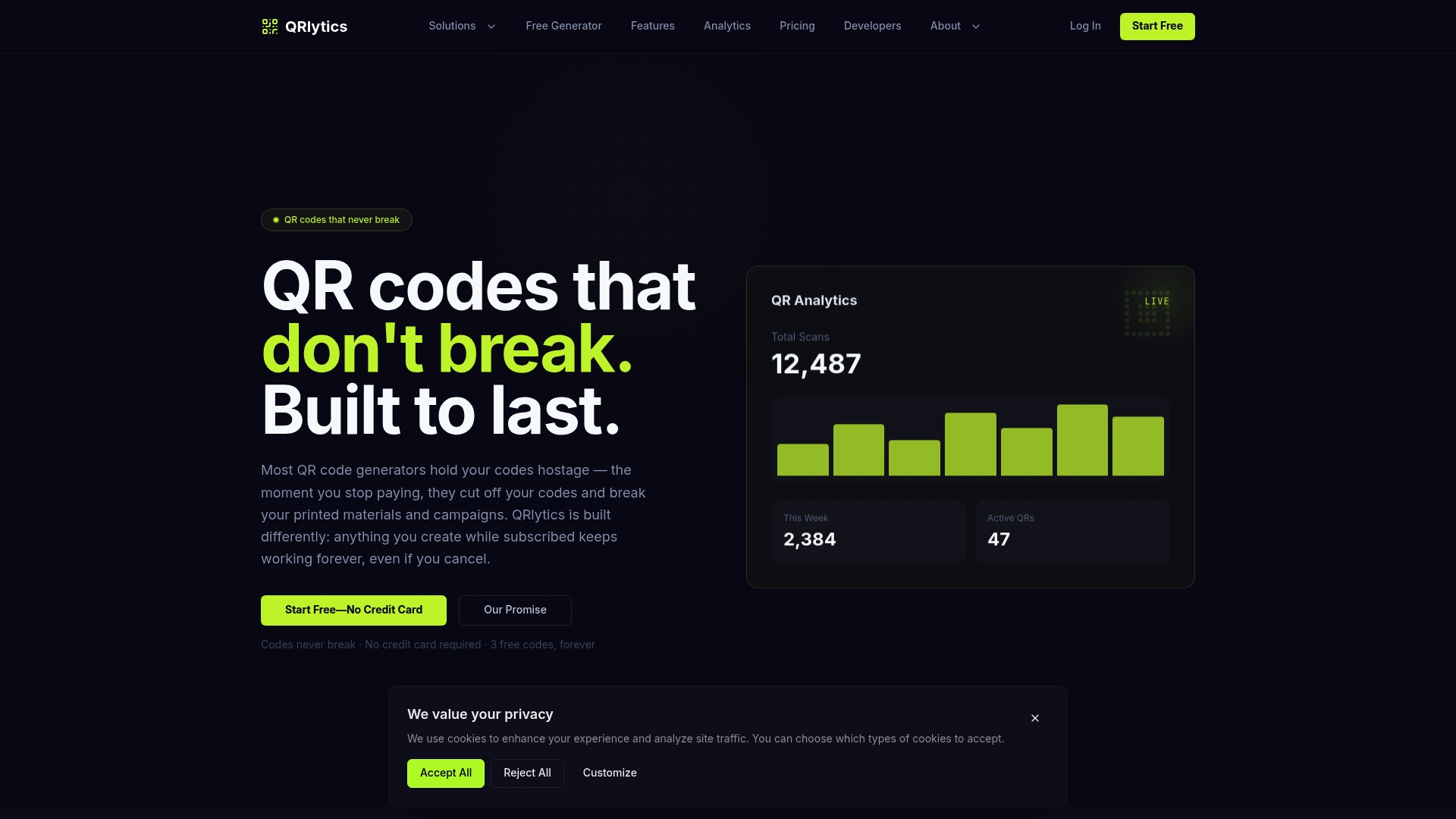
Most free QR generators shut codes off the moment a subscription lapses or a payment fails, which can turn a printed run of posters, packaging or signage into dead weight overnight. QRlytics guarantees that any code created during an active subscription keeps working permanently, even if billing later stops, removing that reprint risk from the campaign entirely. The platform pairs that permanence with dynamic URL updates, so a destination can change after the code is already printed, alongside real-time analytics and GDPR-compliant tracking for teams that need to report on scans without over-collecting personal data.
Codes created during an active subscription remain functional forever, regardless of later billing status.
Onboarding starts with a free tier that needs no credit card, and heavier users can move to paid plans or enterprise options as campaigns scale, with API access available for teams automating code generation. For marketers running several placements at once, that combination means fewer reprints, editable destinations after launch, and exportable data for reporting on return on investment.
What most branded QR advice gets backwards
Most guidance on branded QR codes obsesses over how the code looks and treats scanning as an afterthought. That ordering is wrong. A code that fails to scan reliably has zero brand value no matter how well the logo sits inside it, so contrast and error correction deserve more attention than font choice or frame style to ensure reliable scanning.

The bigger blind spot is permanence. Marketers spend real budget on print runs, then generate the underlying code through a free tool with no guarantee it will still resolve in six months. A poster or packaging run has a shelf life measured in months or years, and a code that quietly stops working part way through that life is a design failure regardless of how the artwork looks.
Prioritise in this order: verify the code scans reliably on a printed sample first, lock in a platform that won’t let the destination die later, and treat the branding itself as the last decision, not the first.
— The
Try QRlytics before your next print run
If reprint risk and dead codes are the real cost of getting branding wrong, the fix is choosing infrastructure that doesn’t let a code expire once a bill goes unpaid. QRlytics keeps every code created during an active subscription working permanently, lets you edit the destination after printing, and gives you scan analytics without asking for a credit card to start.
Generate a branded, trackable code with the free QR code generator, or compare the Free and Pro plans if you’re managing multiple campaigns and need advanced analytics or API access. Either way, you’ll know the code you print today still works when the campaign ends.
Sources
- Quishing (US Postal Inspection Service)
- Scammers hide harmful links in QR codes to steal your information (FTC)
- Accessible QR code design for low vision, colour blindness, and motor limits (Fast QR blog)
- Free QR Code Generator with Logo (Flyn)
FAQ
How can I create a branded QR code?
Generate the code from a QR platform, upload your logo, and set error correction to level Q or H so the pattern tolerates the logo’s coverage. Adjust colours for strong contrast, export as SVG or high-resolution PNG, and scan a printed sample on both iPhone and Android before finalising the design.
What is the FBI warning about QR codes?
Authorities including the US Postal Inspection Service have warned about “quishing,” where scammers place fraudulent stickers over legitimate codes or send malicious codes to steal credentials or install malware, as described in official guidance on the scam. The advice is to inspect the destination URL before proceeding and to avoid scanning codes from unsolicited messages.
Who makes the best branded QR codes?
There’s no single official ranking, but the strongest branded codes come from platforms that combine reliable design controls, such as logo sizing and contrast settings, with permanence guarantees so the code keeps working after printing. QRlytics focuses specifically on that permanence, alongside dynamic destination updates and analytics.
How can I tell if a QR code is legitimate?
Check whether the code sits flush with its surface rather than looking like a sticker placed over something else, and preview the destination URL before tapping through if your scanner offers that option. The FTC advises against scanning codes sent through unexpected messages and recommends keeping device software updated as a general precaution, per its consumer alert on QR scams.