Universal QR code functionality explained for businesses
TL;DR:
- Universal QR codes enable a single scanable code to support multiple payment schemes or access permissions, simplifying operations and enhancing customer experience. They embed structured routing data within the code to automatically direct transactions or access requests, reducing visual clutter and ensuring reliability through error correction. Widely adopted systems like Singapore’s SGQR exemplify their benefits, offering operational efficiency and unified analytics across diverse platforms.
Universal QR code functionality is defined as a single scannable code that consolidates multiple payment schemes, services, or access permissions into one unified code, removing the need for separate codes per platform. For businesses and marketing professionals, this matters because it directly reduces operational complexity and improves the customer experience at every scan point. Singapore’s SGQR system and Showpass’s universal ticketing codes are two of the clearest real-world demonstrations of this principle in action. Understanding how this technology works, and where it applies, gives you a measurable advantage in how you design customer-facing campaigns and physical touchpoints.
What is universal QR code functionality and how does it work?
Universal QR code functionality refers to the capacity of a single QR code to support multiple services simultaneously by embedding routing information directly within its data payload. The key to this is not the visual pattern of the code itself, but the structured data encoded inside it. When a customer scans the code, their app reads the payload, identifies which services or schemes are supported, and routes the transaction or access request automatically.
Here is how the process works in practice:
- The merchant or operator generates a universal QR code. The code’s payload contains structured data referencing multiple payment schemes or service endpoints, formatted according to an agreed standard such as EMVCo.
- The customer scans the code with their preferred app. The app decodes the QR data and checks which schemes it supports against those listed in the payload.
- The app routes the transaction automatically. There is no manual selection required from the customer. The payment app auto-routes the transaction to the correct scheme without user confusion.
- The transaction or access event completes. The merchant receives confirmation through whichever scheme processed the payment or granted access.
This routing mechanism is what separates a universal code from a standard QR code pointing to a single URL. Interoperability is achieved by agreeing on payload formats within the QR data, allowing any compatible app to interpret and route scans correctly without needing distinct codes per service.
Pro Tip: When generating QR codes for multi-scheme environments, confirm that your QR code platform supports dynamic payload updates. This allows you to add or remove supported schemes without reprinting physical materials.
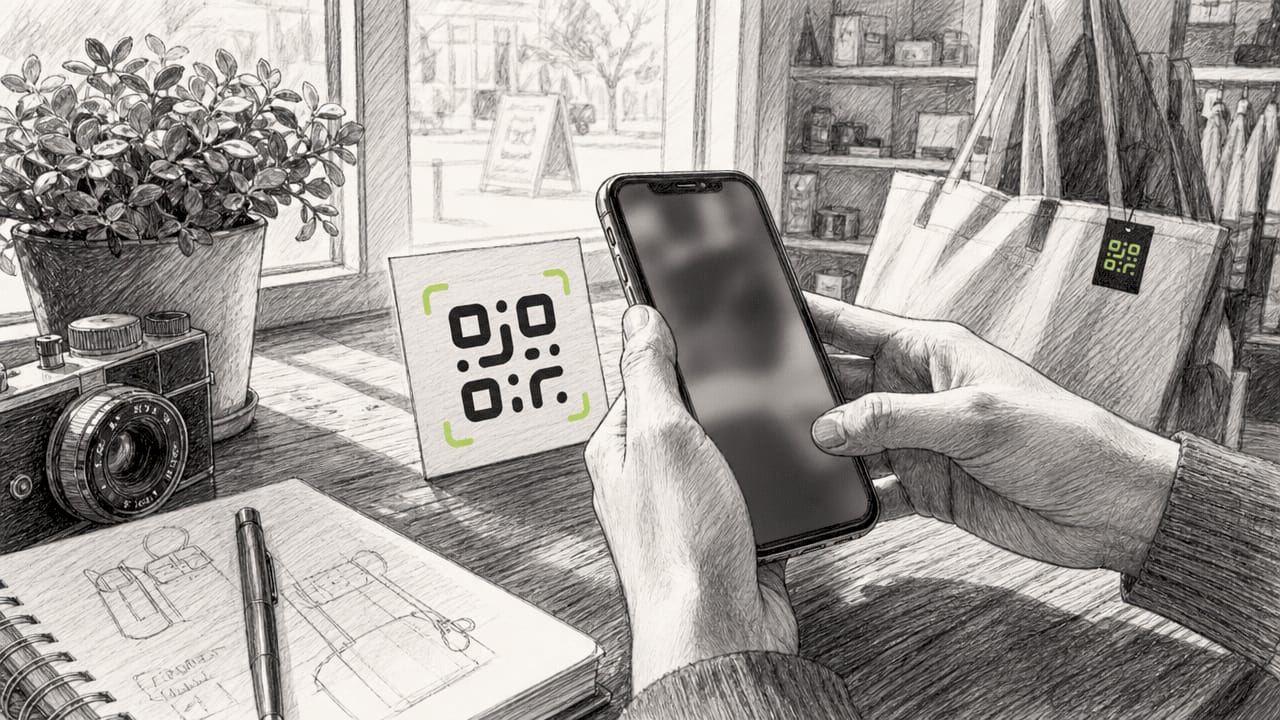
Singapore’s SGQR is the most cited example of this standard applied at national scale. SGQR combines many payment apps and schemes into a single label, with embedded routing information that allows one scan to work across platforms. The same principle applies in access control and ticketing contexts, where a single code can represent permissions across multiple entry points or event types.
What are the practical benefits for businesses and marketers?
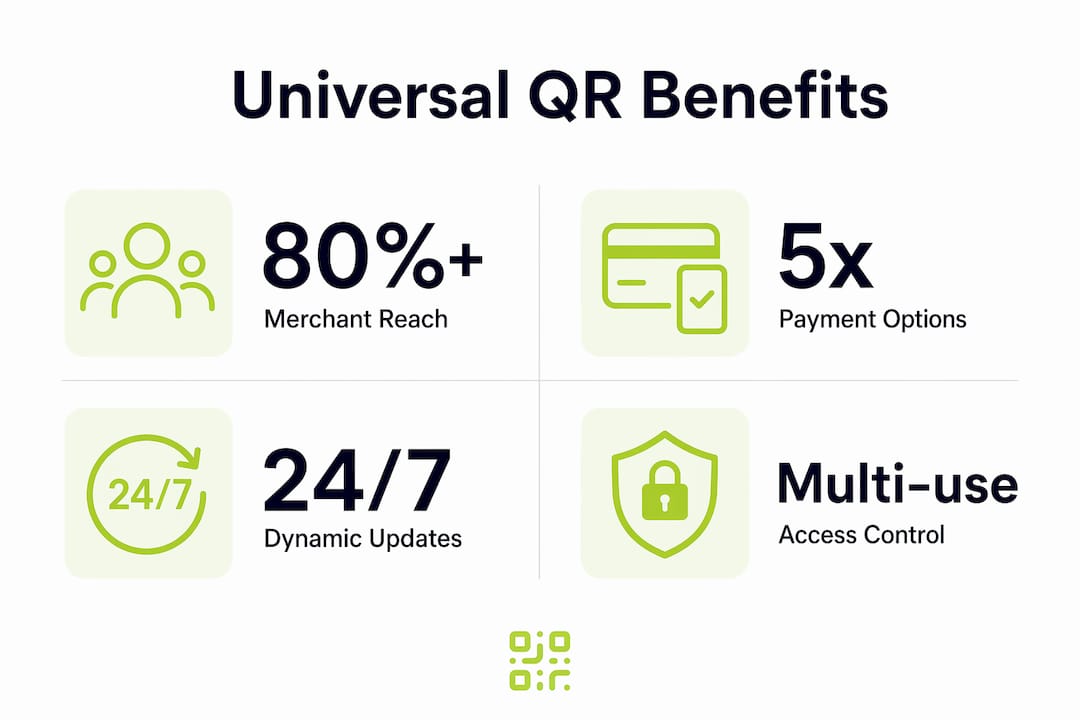
The business case for universal QR codes is direct. A single printed label replaces the need for multiple separate QR codes, reducing checkout clutter and simplifying reconciliation processes. For marketers managing physical signage, retail displays, or event materials, this translates to fewer assets to produce, fewer errors to manage, and a cleaner visual experience for customers.
The core benefits worth noting are:
- Reduced visual clutter. One code replaces several, making signage cleaner and more professional. Customers are less likely to scan the wrong code or feel uncertain about which one to use.
- Improved customer engagement. A frictionless scan experience keeps customers moving through your funnel without interruption. QR code reliability is further supported by Reed-Solomon error correction, which means up to 30% of a code can be damaged or obscured and it will still scan correctly. This matters enormously for printed materials in high-traffic environments.
- Operational efficiency. Fewer codes mean fewer URLs to manage, fewer analytics streams to reconcile, and less time spent on maintenance. For teams running cross-channel campaigns, this consolidation is a genuine time saving.
- Cross-channel marketing support. A single universal code can serve across print, digital, and in-store contexts simultaneously. Embedding it within a QR code tracking system gives you unified scan data across all those touchpoints.
- Interoperability across payment and access platforms. Customers using different apps or wallets all get the same experience from one code, which removes the friction that causes abandoned transactions.
The statistic that anchors this benefit is straightforward: SGQR+ rolled out in November 2024 with support for Alipay, WeChat Pay, UnionPay, ShopeePay, GrabPay, and Google Pay linked to Mastercard and Visa. That is six major international schemes supported by a single code. For any business operating in or targeting markets with diverse payment preferences, that level of coverage from one printed label is a significant operational advantage.
How do universal QR codes compare to traditional single-service codes?
A traditional single-service QR code points to one destination or supports one scheme. It is static in most implementations, meaning the destination is fixed at the time of creation. If you need to support three payment apps, you print three codes. If you need to update the destination, you reprint.
Universal QR codes solve both problems. The comparison below makes the distinction clear:
| Feature | Single-service QR code | Universal QR code |
|---|---|---|
| Services supported | One | Multiple, via embedded routing |
| Physical signage required | One per scheme | One for all schemes |
| User experience | App-dependent, may require selection | Automatic routing, no user action needed |
| Update flexibility | Static; requires reprint to change | Dynamic updates possible without reprinting |
| Analytics consolidation | Separate per code | Unified across all schemes from one code |
| Error correction | Standard Reed-Solomon | Standard Reed-Solomon |
The practical implication of this table is that single-service codes create a fragmented experience, both for the customer and for the team managing the campaign. QR code consistency across channels becomes significantly harder to maintain when you are managing multiple codes for the same physical location or campaign. Universal codes remove that fragmentation at the source.
What are the common applications of universal QR code functionality?
Universal QR code uses span payments, ticketing, access control, and marketing. Each application shares the same underlying principle: one code, multiple services, automatic routing.
Payments at scale. Singapore’s SGQR is the benchmark example. Merchants display a single label and customers pay using whichever app they prefer, from GrabPay to Google Pay, without any additional steps. The system is administered nationally and built on EMVCo standards, making it replicable in any market that adopts a compatible framework.
Event ticketing and membership. Showpass’s universal QR code is linked to the buyer’s account and can represent memberships, tickets, and products under a single scannable code. A festival-goer, for example, carries one code on their phone that covers entry, merchandise collection, and VIP access. This removes the need for multiple tickets or wristbands and speeds up queue management significantly.
Access control. QR code access control systems issue one code for turnstiles, elevators, and doors, with configurable settings for time, frequency, and area permissions. A single employee or visitor code can grant access to specific floors, meeting rooms, and car parks, all from one scan. This reduces administrative overhead and improves security audit trails.
Marketing campaigns. A single universal code embedded in a print advertisement can route different users to different landing pages based on the app they use to scan, or deliver a consistent experience across all of them. When combined with large-format print at events, one well-placed universal code can handle check-in, promotions, and post-event follow-up simultaneously.
Pro Tip: For marketing campaigns, pair your universal QR code with a dynamic URL platform so you can update the destination after print. This protects your investment in physical materials if campaign details change.
The applications of universal QR codes are expanding as more platforms adopt interoperability standards. For marketers, the most immediate opportunity is in consolidating campaign assets and gaining unified scan analytics from a single code rather than managing fragmented data across multiple.
Key takeaways
Universal QR code functionality works because a single code’s embedded routing payload directs each scan to the correct service automatically, removing friction for users and complexity for operators.
| Point | Details |
|---|---|
| Routing lives in the payload | The QR code’s data structure, not its visual pattern, determines which services it supports. |
| One code replaces many | Universal codes eliminate the need for separate codes per payment scheme or access point. |
| Error correction adds reliability | Up to 30% of a QR code can be damaged and still scan, making universal codes dependable in physical environments. |
| Real-world adoption is proven | Singapore’s SGQR and Showpass demonstrate universal QR codes working at national and event scale. |
| Dynamic updates protect print investment | Pairing universal codes with a dynamic platform means destinations can change without reprinting materials. |
Why universal QR codes are worth taking seriously right now
Having worked closely with how businesses deploy QR codes across print, digital, and in-store channels, the pattern I see most often is this: teams invest in physical materials, then discover their QR code setup is fragmented, untracked, or tied to a platform that can deactivate codes the moment a subscription lapses. That is a preventable problem.
What strikes me about universal QR code functionality is that it solves two problems at once. It simplifies the customer-facing experience and it reduces the operational burden on the team managing the codes. The SGQR model is instructive here because it shows what happens when a standards body and a government commit to interoperability. Merchants stopped managing a wall of QR codes and started managing one. Customer confusion dropped. Transaction completion improved.
The mistake I see marketers make is treating the QR code as the end point rather than the start of a data trail. A universal code that routes correctly but generates no analytics is a missed opportunity. The real value comes when you combine multi-scheme routing with scan-level data: who scanned, when, where, and on which device. That data informs your next campaign, your next print run, and your next budget conversation.
My honest advice is to adopt universal QR code standards now, before your competitors do, and to pair them with a platform that guarantees code permanence and gives you the analytics to act on what you learn. The technology is mature. The standards exist. The only variable is whether your tools are up to the task.
— The
How Qrlytics helps you create and track universal QR codes
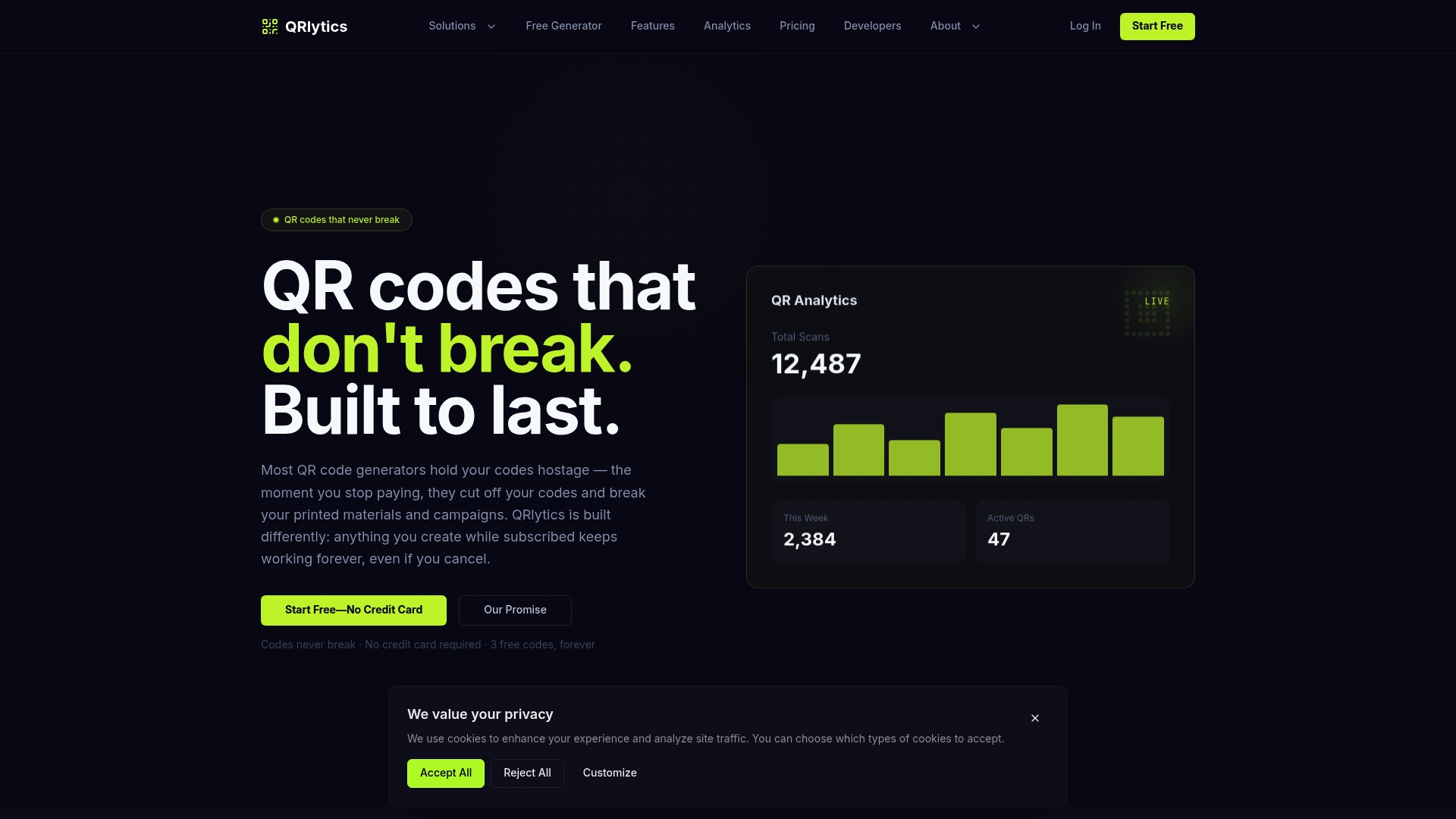
Qrlytics is built for businesses and marketers who need QR codes that work reliably, long term, and with full visibility into performance. Unlike free generators that deactivate codes when subscriptions lapse, Qrlytics guarantees that codes created during an active subscription remain functional permanently. You can update redirect URLs without reprinting, track every scan with GDPR-compliant analytics, and view global performance through heat maps.
For teams exploring universal QR code functionality, Qrlytics provides the infrastructure to generate, manage, and measure codes across campaigns. Start with the free QR code generator to create your first code instantly, no credit card required. For campaigns requiring dynamic routing and full scan analytics, the dynamic QR code generator gives you editable, trackable codes built for long-term use.
FAQ
What is universal QR access?
Universal QR access refers to a single QR code granting entry or permissions across multiple systems or locations, such as doors, lifts, and turnstiles, without requiring separate codes for each. Access control systems configure one code with time, frequency, and area permissions to cover all required entry points.
How does a universal QR code route to the correct service?
The QR code’s data payload contains structured routing information referencing multiple schemes or services. When scanned, the customer’s app reads the payload, identifies which schemes it supports, and routes the transaction automatically without requiring any manual selection from the user.
What is SGQR and why does it matter?
SGQR is Singapore’s national unified QR payment standard, combining multiple payment apps and wallets into a single merchant label. It demonstrates universal QR code functionality at national scale and serves as the clearest model for how interoperability standards reduce merchant complexity and improve customer payment journeys.
Can a universal QR code be updated after printing?
Yes, when generated through a dynamic QR code platform, the redirect URL or routing destination can be updated without changing the printed code. This protects your investment in physical materials and allows campaigns to evolve without reprinting.
Are universal QR codes more reliable than standard codes?
Universal QR codes use the same Reed-Solomon error correction as standard codes, meaning up to 30% damage is tolerable before a code fails to scan. Their reliability advantage comes from consolidation: one well-maintained code is easier to monitor and replace than several separate codes across multiple platforms.