What is first-party scan data: a guide for UK analysts
First-party scan data is data your brand collects directly when a consumer interacts with a brand-controlled touchpoint — a QR code on packaging, a loyalty barcode at the till, a mobile app scanner, or a POS-linked customer identifier. You own it. You control the consent process. You know exactly where it came from.
That provenance is what makes it valuable. Unlike retailer POS data, which tells you what sold, first-party scan data tells you who engaged, when, where, and via which campaign creative. Those intent signals are activation-ready: you can feed them directly into attribution models, personalisation engines, and audience segments.
This guide covers how scan data differs from store scanner and third-party panel data, what UK GDPR requires, practical collection channels, an implementation checklist, and a worked example using Qrlytics.
- First-party scan data is brand-owned and consent-documented.
- It supplies context and intent that POS data cannot.
- It is subject to UK GDPR and requires a documented lawful basis.
- QR codes are the most flexible collection channel for most UK marketers.
Pro Tip: Treat first-party scan data as a strategic asset from day one. The value compounds as your event schema matures and your activation connectors improve.
Table of Contents
- How first-party scan data differs from POS and third-party scanner data
- UK GDPR and privacy checklist for scan data collection
- How to implement a first-party scan data pipeline
- How Qrlytics captures GDPR-friendly first-party scan data
- Key takeaways
- Why first-party scan data deserves a place in your measurement strategy
- Qrlytics makes first-party scan data collection straightforward
- FAQ
How first-party scan data differs from POS and third-party scanner data
Scanner data has long underpinned marketing research in two main forms: store scanner (POS) data owned by the retailer, and household scanner panels run by research firms. Both provide UPC-level transaction detail, but neither is owned by the brand, and neither captures the journey that preceded the purchase.
First-party scan data sits in a different category entirely. The brand controls the collection point, the consent flow, and the data model.
| Dimension | First-party scan data | Retailer POS/store scanner | Third-party scanner panel |
|---|---|---|---|
| Ownership | Brand | Retailer | Research/data vendor |
| Consent provenance | Brand-documented | Retailer-managed | Aggregated/resold |
| Context and intent | Campaign, creative, daypart, URL | SKU, price, volume | Household, category |
| Identity linkage | Loyalty ID, hashed device ID | Loyalty card (retailer’s) | Panel member ID |
| Typical use cases | Attribution, personalisation, retargeting | Sales reporting, ranging | Market share, elasticity |
Retailer POS data measures what sold but lacks the category, intent, and journey context that branded first-party scan data provides. Scanner data also frequently falls short when analysts need forward-looking consumer insights or want to understand why a product performed as it did.
The label “first-party” relates to the collecting entity. The same raw behavioural signal can be first-, second-, or third-party depending on who collected it and under what arrangement.
Pro Tip: When triangulating sales, always match first-party scan events to POS or revenue records rather than assuming a 1:1 relationship. A scan confirms engagement, not necessarily a completed purchase.
UK GDPR and privacy checklist for scan data collection
First-party collection makes provenance and lawful basis easier to document, but you still need to satisfy UK GDPR requirements. The checklist below covers what analysts and delivery teams must verify before activating scan data.
- Processor contracts — any downstream platform (CDP, DSP, analytics suite) that handles scan data must operate under a Data Processing Agreement.
For GDPR-compliant marketing practices, the key principle is that consent must be freely given, specific, informed, and unambiguous. If you are running event activations, GDPR compliance for events adds further considerations around on-site consent capture and data portability.
Pro Tip: If you are enriching scan events with location or POI data, assess whether the combined dataset creates re-identification risk. Pseudonymisation of the scan record alone may not be sufficient if the location data is granular enough to identify an individual.
How to implement a first-party scan data pipeline
Follow this sequence to move from pilot to production.
- Activate — connect your event store to your CDP, DSP, or personalisation engine via API or CSV export; use real-time QR data streams to trigger time-sensitive campaigns.
Key KPIs to monitor:
Maintain event schema consistency across campaigns. A single missing campaign ID field can break an entire attribution run.
How Qrlytics captures GDPR-friendly first-party scan data
A modern QR platform can provide dynamic destination URLs, campaign tagging, real-time event streams, and consent-aware tracking — all the building blocks of a first-party scan data programme. When evaluating a platform, look for:
- Dynamic QR codes — update destination URLs without reprinting; essential for long-running campaigns on physical materials.
- Export connectors — direct integration with CDPs or analytics suites reduces manual data handling and the risk of processing errors.
Qrlytics covers all of these. Its QR codes with analytics product provides real-time scan tracking, global heat maps, CSV export, and API access, with GDPR-compliant tracking built in. Codes created during an active subscription remain functional permanently, which matters for campaigns printed on packaging or point-of-sale materials with long shelf lives.
To validate scan data against revenue, join your Qrlytics event export (filtered by campaign ID) to your POS transaction table on a timestamp window — typically a 24–72 hour attribution window depending on your category’s purchase cycle. The campaign ID is the stable join key across both datasets.
For QR scan data enrichment and audience segmentation, Qrlytics’s blog provides step-by-step guidance on appending POI and CRM signals to raw scan events.
Key takeaways
First-party scan data is a brand-owned, consent-documented asset that provides the intent signals and provenance that POS and third-party panel data cannot.
| Point | Details |
|---|---|
| Provenance is the core advantage | You control the consent record, the collection point, and the data model — making GDPR compliance documentable. |
| Instrument your event schema first | Define code IDs, campaign tags, and consent fields before generating codes; retroactive fixes are costly. |
| Triangulate with POS | Match scan events to transaction records using campaign ID and a defined attribution window to validate signals. |
| Document lawful basis | Record whether you rely on consent or legitimate interests for each data type before activating any scan programme. |
| Qrlytics as a starting point | Qrlytics provides dynamic QR codes, real-time analytics export, pseudonymised tracking, and API access for GDPR-compliant first-party scan data collection. |
Why first-party scan data deserves a place in your measurement strategy
The conventional wisdom in measurement circles is that more data is better data. First-party scan data challenges that assumption usefully. It is narrower than a retailer panel — you only see your own touchpoints — but it is far richer in context. You know the campaign, the creative, the time, and the place. That specificity is what makes it useful for decisions, not just reporting.
The post-cookie environment has accelerated interest in owned identifiers, but the more durable argument for first-party scan data is simpler: it reflects consumers who chose to engage with your brand. That intent signal is genuinely different from a passive transaction record. Retailers sell you aggregated POS data; a scan event is a consumer raising their hand.
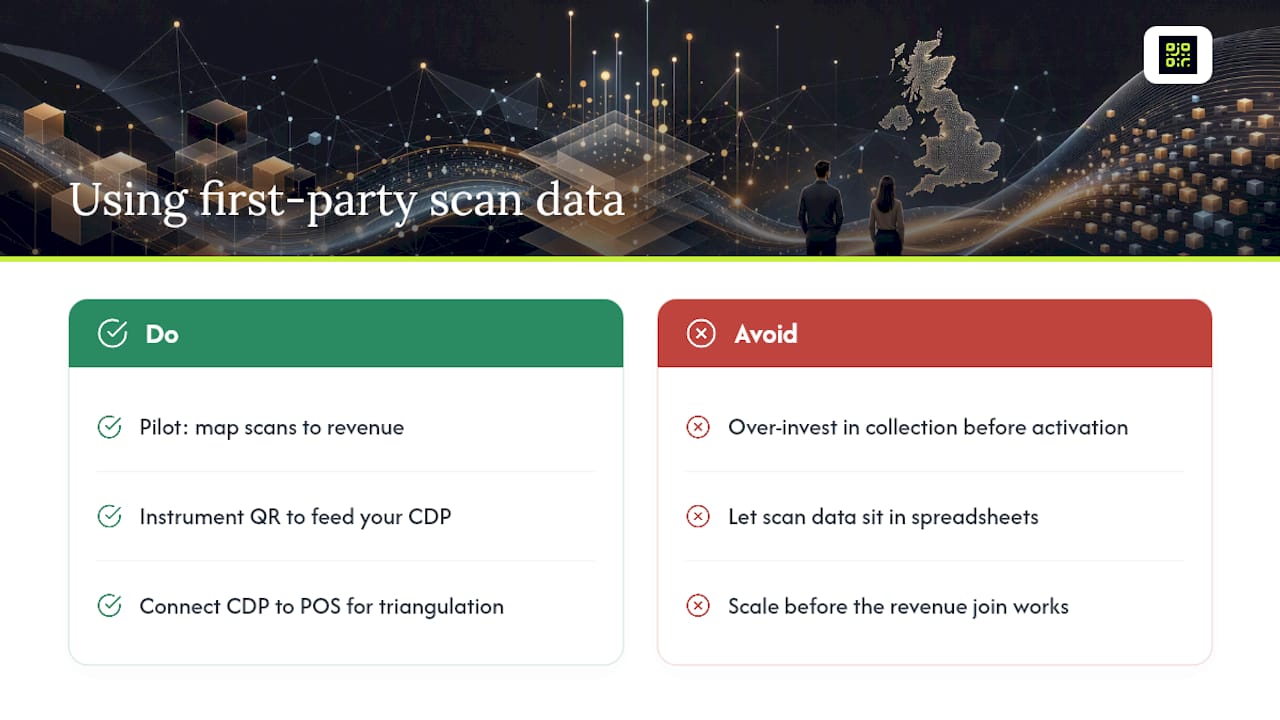
The risk is over-investing in collection before you have the activation infrastructure to use it. A well-instrumented QR programme that feeds a CDP and connects to your POS for triangulation is worth more than a large, poorly governed scan dataset sitting in a spreadsheet. Start with a pilot that maps scans to revenue. Scale only after that join works reliably.
Qrlytics makes first-party scan data collection straightforward
Collecting compliant, analytics-ready scan data does not require a complex data engineering project. Qrlytics gives you dynamic QR codes with permanent redirect functionality, real-time scan analytics, GDPR-compliant pseudonymised tracking, and CSV or API export — all without a credit card to get started.
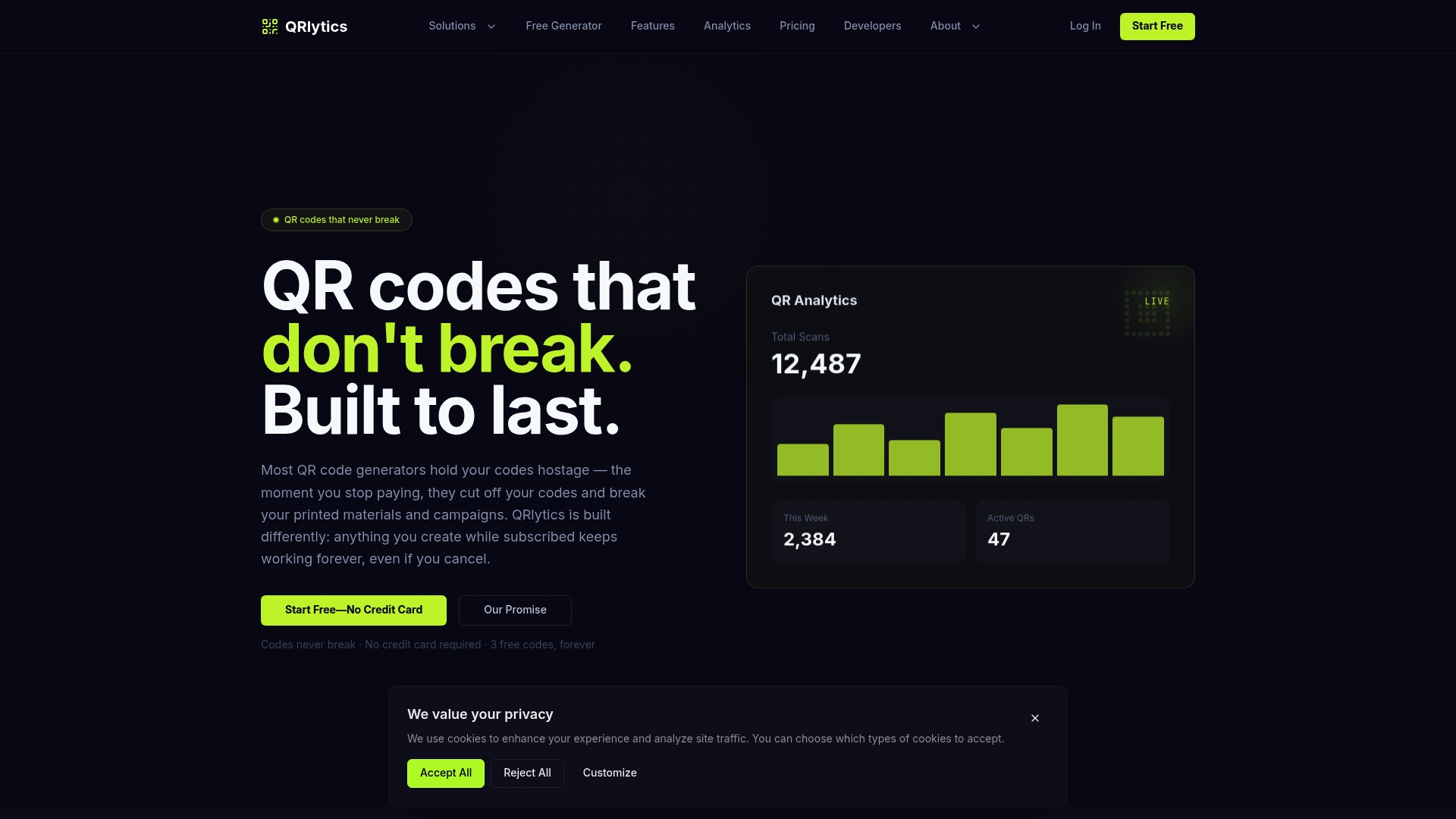
The free QR generator lets you create your first tracked code in minutes. When you are ready for campaign tagging, dynamic URL updates, and full event-level exports, the dynamic QR code generator gives you the production-grade tools your analytics pipeline needs. No lock-in, no expiring codes, and no hidden setup fees.
FAQ
What is first-party scan data in simple terms?
First-party scan data is information your brand collects directly when a consumer scans a brand-controlled code or touchpoint, such as a QR code or loyalty barcode. You own the data, you documented the consent, and you control how it is used.
How does first-party scan data differ from POS scanner data?
POS scanner data is owned by the retailer and shows what sold at the till, with no campaign or intent context. First-party scan data is owned by the brand and includes the campaign ID, creative variant, timestamp, and location that explain why a consumer engaged.
What lawful basis applies under UK GDPR for scan data collection?
Consent or legitimate interests are the two most common lawful bases. Consent is generally required for marketing communications; legitimate interests may apply to analytics use cases, but you must complete a balancing test and document it.
Can Qrlytics be used to collect GDPR-compliant first-party scan data?
Yes. Qrlytics provides pseudonymised scan tracking, real-time analytics export via CSV and API, dynamic QR codes with campaign tagging, and audit logs — the core features needed for a GDPR-compliant first-party scan data programme in the UK.
What is the difference between first-party and second-party scan data?
First-party scan data is collected by your brand at your own touchpoints. Second-party scan data is first-party data from another organisation shared directly with you under a data-sharing agreement, typically a retail partner or publisher. The consent basis and data-sharing contract must be reviewed before activation.