What is event QR monitoring: a practical guide

TL;DR:
- Event QR monitoring uses unique codes to track attendee check-ins and engagement in real time. It improves efficiency, security, and marketing attribution by providing instant data and flexible, secure systems. Proper setup ensures accurate, lawful, and actionable insights for event organizers and marketers.
Event QR monitoring is the practice of using uniquely generated QR codes at physical events to capture real-time data on attendee interactions, check-in status, and campaign engagement. Each attendee receives a personal QR code linked to a secure identifier in your backend system. When scanned, that code confirms registration, logs attendance, and feeds live data into your dashboard. The result is a complete attendee tracking workflow that replaces slow, error-prone manual processes with accurate, instant records. For event organisers and marketing professionals, this is the difference between guessing what happened at your event and knowing exactly what did.
What is event QR monitoring and how does it work technically?
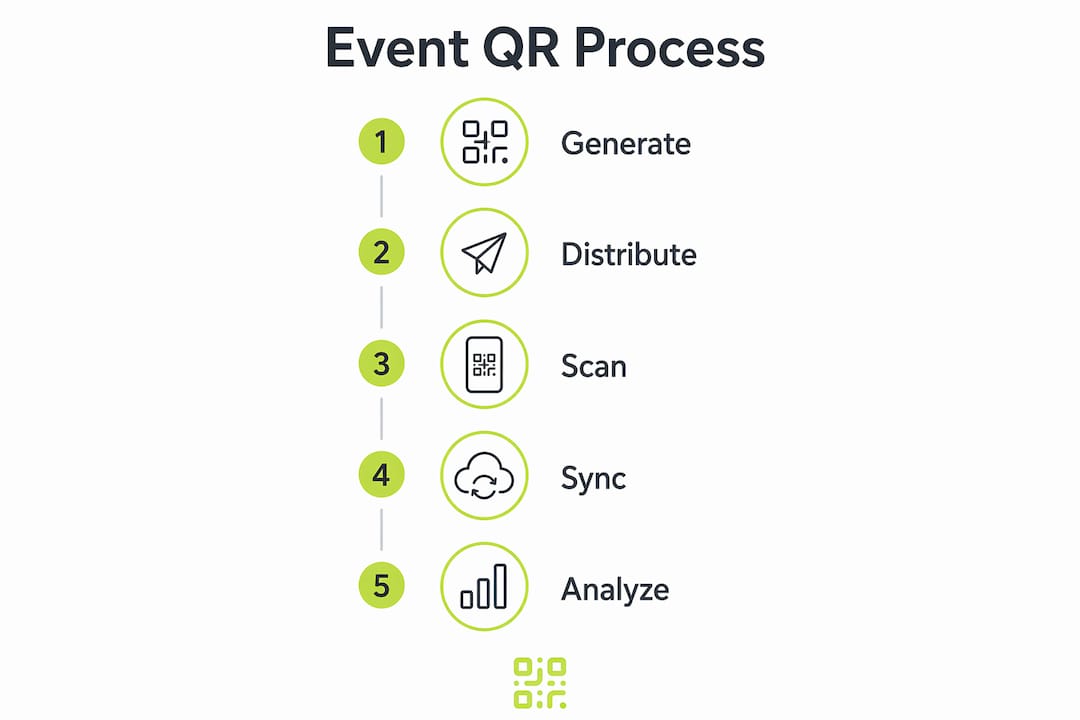
Event QR monitoring operates through a chain of linked steps, from code generation to real-time data sync. Understanding each step helps you build a system that performs reliably under pressure.

Each attendee receives a unique QR code before the event. That code encodes only an opaque identifier, typically 8–16 characters long. No personal data sits inside the code itself. Names, email addresses, and registration details remain secured on your backend server, queried only at the moment of scanning.
On event day, a staff member scans the code using a dedicated app. The app reads the identifier, sends a query to the backend, and receives a confirmation within milliseconds. The attendee’s status updates to checked in, and the dashboard reflects this instantly. Some systems also trigger badge printing at this point, removing another manual step from the process.
Two technical standards define whether your system runs smoothly at scale:
- QR code size: Professional event scanning requires a minimum size of 3×3 cm for reliable reads at entry points.
- Validation latency: Backend confirmation must complete in under 500ms to prevent queues forming at busy entrances.
- Multiple scanning lanes: At events exceeding 1,000 attendees, sub-second validation and multiple devices are necessary to avoid bottlenecks.
- Offline mode: Venue Wi-Fi fails at roughly one in three events. Systems that cache attendee lists locally on scanning devices maintain consistent throughput regardless of connectivity.
Pro Tip: Test your scanning setup in the actual venue before doors open. Wi-Fi signal strength varies dramatically between a quiet venue and one filled with thousands of devices competing for bandwidth.
Security and compliance in event QR code tracking
QR code monitoring introduces specific security risks that organisers must address before event day. The most significant is “quishing,” a form of phishing that uses malicious QR codes to redirect attendees to fraudulent websites. Quishing attacks require server-side validation, cryptographic signing, and official HTTPS domains to counter effectively.
A secure event QR system follows these steps:
- Generate codes on a verified platform. Avoid URL shorteners or unverified generators. Security experts warn that unverified QR generators lack enterprise-grade governance and increase phishing risk significantly.
- Use cryptographic signatures. Each code should carry a server-validated signature that confirms it was issued by your system, not a counterfeit.
- Keep personal data off the code. Storing attendee data on the backend means a stolen or photographed QR code reveals nothing sensitive about the attendee.
- Enforce HTTPS on all redirect URLs. Any scan that lands on an HTTP destination is a security gap. Official domains with valid certificates are non-negotiable.
- Monitor scan patterns in real time. Repeated scans of the same code or unusual access spikes signal potential fraud. Your dashboard should flag these automatically.
Event QR compliance also covers data protection law. GDPR requires that attendee data collected through QR scans is stored lawfully, with clear consent and a defined retention period. Platforms that offer touchless access via QR codes with built-in GDPR-compliant tracking remove much of this compliance burden from your team.
Pro Tip: Print a visible notice near each scanning point explaining what data is collected and why. Transparency builds attendee trust and satisfies GDPR’s information obligation in one step.
The real benefits of event QR codes for organisers and marketers
The operational case for QR code monitoring at events is clear. A QR code check-in processes each attendee in under 3 seconds, cutting check-in times by over 90% compared to manual sign-in. At an event of 500 people, that translates to roughly 45 minutes saved at the door alone. That time saving reduces staffing costs and eliminates the frustrated queues that colour attendees’ first impression of your event.
The marketing benefits run deeper than speed. Real-time scan data lets you monitor attendance patterns live, identify which sessions are filling fastest, and redeploy staff before a problem develops. You stop reacting to issues after the fact and start managing them as they emerge.
For marketing professionals, the data returned by QR monitoring supports genuine ROI measurement:
- Time-stamped attendance records show exactly when each attendee arrived and which sessions they attended.
- Device and location metrics reveal whether attendees scanned from iOS or Android, and from which geographic region.
- Scan-to-action paths show the journey from initial scan to a specific landing page, resource download, or registration form.
- Session popularity data identifies which content attracted the most engagement, informing future programme planning.
- Campaign attribution links specific QR codes to specific marketing channels, so you know which campaign drove which attendees.
This level of detail transforms your event from a one-day activity into a measurable marketing channel. When you can show a client or stakeholder exactly which campaign drove attendance and which sessions generated the most engagement, the conversation about event value changes entirely. Pairing this with QR code analytics gives you a single view of performance across every code you deploy.
Best practices to maximise scan rates and attendee engagement
A well-built QR monitoring system only delivers value if attendees actually scan the codes. The design and placement of your codes determines whether that happens.
Generic “Scan me” prompts consistently underperform. Value-driven calls to action that communicate an immediate benefit, such as “Scan to claim your speaker slides” or “Scan to enter the prize draw,” produce measurably higher engagement. The attendee needs a reason to lift their phone.
Placement matters as much as messaging. Position codes at natural pause points: session entrances, catering stations, exhibition stands, and registration desks. Attendees are stationary and receptive at these moments. Codes placed on moving banners or at awkward angles rarely get scanned.
Dynamic QR codes give you flexibility that static codes cannot. Dynamic codes let you update the destination after printing, so if a landing page URL changes or you want to redirect post-event traffic to a follow-up resource, you do not reprint a single sheet. This is particularly valuable for multi-day events where content evolves.
UTM parameters and unique codes per channel complete the attribution picture. Assign a distinct QR code to each marketing channel, email, social media, printed collateral, and on-site signage. When you review your QR code tracking data after the event, you see precisely which channel drove which scans. That granularity is what separates a campaign debrief with real answers from one built on assumptions.
Pro Tip: Run a small A/B test on your call-to-action copy before the event. Print two versions of the same code with different prompts and place them in equivalent locations. The scan rate difference will tell you which message resonates with your audience.
For more ideas on lifting scan rates, the ways to boost QR scans guide covers proven techniques for event and marketing contexts.
Key takeaways
Event QR monitoring is the most reliable method available for capturing real-time attendee data, reducing check-in friction, and attributing marketing performance at physical events.
| Point | Details |
|---|---|
| Speed and efficiency | QR check-in processes each attendee in under 3 seconds, saving over 45 minutes at a 500-person event. |
| Security by design | Store personal data on the backend only; use cryptographic signing and HTTPS to prevent quishing attacks. |
| Real-time operational control | Live scan dashboards let you adjust staffing and resolve bottlenecks before they affect the attendee experience. |
| Marketing attribution | Unique codes per channel, combined with UTM tags, reveal exactly which campaigns drove attendance and engagement. |
| Dynamic flexibility | Dynamic QR codes allow destination updates after printing, protecting your investment in printed materials. |
Why event QR monitoring deserves more strategic attention
Most event professionals I speak with treat QR monitoring as a check-in tool and nothing more. That framing undersells it considerably. The data flowing through a well-configured QR system is some of the richest first-party data an event organiser can collect. It is time-stamped, behaviour-linked, and tied to a specific individual’s journey through your event.
The security dimension is where I see the most complacency. Organisers invest heavily in physical security but leave their QR infrastructure on free, unverified generators with no cryptographic validation. That is a meaningful gap. As quishing attacks grow more sophisticated, the gap between a secure and an insecure QR setup will translate directly into reputational and legal risk.
Offline capability is the other underrated factor. I have watched check-in systems collapse at sold-out venues because no one planned for Wi-Fi congestion. Caching attendee data locally on scanning devices is not a luxury feature. It is a baseline requirement for any event above a few hundred attendees.
The trend I find most encouraging is the integration of QR monitoring data with broader digital marketing stacks. When scan data feeds into your CRM or email platform in real time, you can trigger personalised follow-up sequences within hours of the event closing. That speed of response, grounded in actual behaviour rather than assumed interest, is where event marketing starts to compete with digital channels on measurability.
My honest recommendation: treat your QR monitoring setup with the same rigour you apply to your event website or your paid media campaigns. The data it produces is worth the investment.
— The
Qrlytics makes event QR monitoring straightforward
Building a reliable QR monitoring setup does not require a complex technical team. Qrlytics provides everything you need to generate, manage, and track QR codes for events of any size.
With Qrlytics, you can create dynamic, trackable QR codes that update their destination without reprinting, track every scan with time-stamped analytics, and maintain GDPR-compliant data handling throughout. Codes created during an active subscription remain functional permanently, so your printed materials never become dead links. The platform requires no credit card to start, and the free QR code generator lets you build and test codes immediately. For event organisers who need dependable performance and clear data, Qrlytics is the practical starting point.
FAQ
What is event QR monitoring?
Event QR monitoring is the use of uniquely generated QR codes to track attendee check-ins, session attendance, and engagement in real time at physical events. Each code links to a secure backend identifier, enabling instant data capture without storing personal information in the code itself.
How does QR code check-in compare to manual sign-in?
QR code check-in processes each attendee in under 3 seconds, cutting check-in times by over 90% compared to manual sign-in. At a 500-person event, that saves approximately 45 minutes at the entry point alone.
What is event QR compliance and why does it matter?
Event QR compliance refers to meeting data protection requirements, including GDPR, when collecting attendee data through QR scans. It requires lawful data storage, clear attendee consent, and secure backend systems that keep personal data off the QR code itself.
What are dynamic QR codes and why use them at events?
Dynamic QR codes allow you to update the scan destination after the code has been printed. This means you can redirect attendees to post-event resources or updated landing pages without reprinting any materials.
How do you prevent QR code fraud at events?
Use a verified platform with cryptographic signing and HTTPS redirect URLs, store all personal data on the backend rather than in the code, and monitor your dashboard for repeated or anomalous scans in real time.