Seasonal QR code strategies: tips for 2026 campaigns
TL;DR:
- Seasonal QR code marketing uses dynamic codes linked to rotating offers during major calendar events. This approach reduces costs, avoids reprinting, and provides valuable scan data for ongoing improvements.
Seasonal QR code marketing is the practice of linking a single, stable QR code to rotating offers and landing pages tied to major calendar events throughout the year. The tips for seasonal QR code strategies that consistently deliver results share one thing in common: they use dynamic QR codes, not static ones, so the physical code never changes but the destination does. Platforms like Qrlytics make this possible by letting you update redirect URLs without reprinting a single poster or menu. The result is a repeatable system that keeps campaigns fresh, cuts print costs, and gives you real scan data to act on every season.
1. What is the best seasonal rotation model for QR code campaigns?
The most effective seasonal rotation model uses six major calendar events per year as its backbone. Those six events are spring renewal, summer kickoff, back-to-school, autumn comfort, the holiday season, and the January reset. Each event gets its own campaign window, and the QR code destination updates to match. Customers see a fresh experience every time, but you never need to reprint the code.

Within each seasonal window, a four-week rotation cycle keeps things moving. Week one runs a mystery reward, week two drops a slow-day deal, week three leans into the seasonal theme, and week four pushes a loyalty offer. This structure prevents creative fatigue on your side and gives customers a reason to scan again the following week.
The model works because it is predictable for your team and surprising for your customers. You plan the full year in one sitting, then execute week by week. The main limitation is that it relies on calendar timing rather than individual customer behaviour, so it suits broad audiences better than highly personalised one-to-one campaigns.
Pro Tip: Map out all six seasonal windows in a single planning session at the start of the year. Assign a theme, offer type, and landing page URL to each week before any creative work begins. This prevents last-minute scrambles and keeps your rotation consistent.
2. How to design seasonal landing pages that convert
A seasonal landing page lives or dies on mobile performance. Mobile-optimised pages with fast load times and clear seasonal branding consistently outperform generic pages in scan-to-conversion rates. The person scanning your code is standing in your shop or reading your packaging. They will not wait three seconds for a page to load.
Every effective seasonal landing page shares these characteristics:
- Seasonal visuals. Use colours, imagery, and copy that match the current period. A back-to-school page should feel different from a holiday page.
- A single, prominent CTA. One clear action per page. “Claim your autumn discount” beats a page with four competing buttons.
- Time-sensitive offers. Deadlines create urgency. “Valid until 30 november” outperforms “available while stocks last.”
- Minimal friction. Avoid asking for an email address before showing the offer. Reduce steps between scan and reward.
- Consistent branding. The page should look like it belongs to your business, not a generic template.
The link between landing page quality and conversion is direct. A well-designed page turns a scan into a sale. A poorly designed one turns a scan into a bounce, and you will see that clearly in your analytics.
Pro Tip: Build a master landing page template for each of your six seasonal windows. Swap the offer, headline, and imagery each week rather than rebuilding from scratch. This cuts production time significantly.
3. What are the essential technical requirements for seasonal QR codes?
Technical reliability is non-negotiable for seasonal campaigns. A QR code that fails to scan in december, when foot traffic peaks, costs you real revenue. High-contrast codes on light backgrounds with a clear quiet zone around the edges scan reliably across all lighting conditions and device types.
The table below summarises the key technical factors and their impact on campaign performance.
| Technical factor | Best practice | Why it matters |
|---|---|---|
| Contrast | Dark code on light background | Ensures reliable scanning in all lighting |
| Quiet zone | Minimum 4 modules of white space around code | Prevents scan errors at edges |
| Code type | Dynamic, not static | Allows seasonal URL updates without reprinting |
| Human-readable URL | Include below the code | Builds trust and aids accessibility |
| Placement | Visible, uncluttered surface | Reduces scan failure from busy backgrounds |
| Size | Minimum 2.5cm x 2.5cm for print | Guarantees readability at normal scanning distance |
Dynamic QR codes are the single most important technical choice you make. A static code locks you into one URL forever. A dynamic code lets you update the destination for every seasonal window without touching the printed material. Qrlytics generates dynamic codes with guaranteed redirect stability, meaning the code keeps working even if your billing situation changes.
Including a human-readable URL beneath the code is a small detail that pays off. Some customers will not scan but will type the address manually. Others want reassurance that the code leads somewhere legitimate before they point their camera at it.
4. Which measurement practices improve seasonal QR code performance?
Measurement turns a seasonal campaign from a guess into a system. Scan analytics, conversion tracking, and customer behaviour metrics tell you which seasonal windows drive the most engagement and which offers fall flat. Without this data, you repeat mistakes every year.
Follow these governance and measurement steps for every seasonal rotation:
- Use unique entry links for each placement. A code on your shop window and a code on your packaging should point to different tracked URLs. This tells you which location drives scans.
- Centralise template approval. Centralised governance prevents off-brand URLs and expired destinations from reaching customers. One person or team approves every redirect before it goes live.
- Track downstream actions, not just scans. A high scan count with zero conversions signals a landing page problem. Connect your QR analytics to your sales or booking data.
- Review performance at the end of each four-week cycle. Compare scan rates, conversion rates, and offer redemption across weeks. Use that data to adjust the next cycle.
- Reuse physical codes across years. Because the destination updates dynamically, the same printed code can run your spring renewal campaign in 2026 and again in 2027. This cuts print waste and cost significantly.
Qrlytics provides real-time scan data including device type, location, and time of scan. That granularity lets you see whether your lunchtime slow-day drop actually drives scans during lunch, or whether customers engage later in the evening.
5. How do seasonal QR campaigns compare to evergreen or one-off campaigns?
Seasonal rotation campaigns outperform both evergreen and one-off QR campaigns on the measures that matter most to marketers. Seasonal rotations reduce design and printing costs compared to one-off campaigns while delivering stronger engagement by matching offers to customer mindsets.
| Factor | Seasonal rotation | One-off campaign | Evergreen campaign |
|---|---|---|---|
| Freshness | High, updates 6+ times per year | High at launch, then stale | Low, content rarely changes |
| Operational cost | Low after setup, no reprints needed | High, new creative and print each time | Low, but limited engagement |
| Customer engagement | Strong, aligned with seasonal mood | Variable, depends on timing | Weak, no temporal relevance |
| Print waste | Minimal, one code reused | High, new materials each campaign | Low, but static |
| Measurement | Ongoing, comparable across seasons | Limited to campaign window | Difficult to attribute |
One-off campaigns demand constant creative and print investment. Every new campaign means new codes, new materials, and new setup. Evergreen codes solve the cost problem but sacrifice relevance. A code that always points to your homepage tells customers nothing new and gives them no reason to scan again.
Seasonal campaigns match the customer’s current mindset, which is why they consistently outperform generic alternatives. A customer scanning a code in late november is already thinking about gifts and celebrations. A holiday-themed offer meets them exactly where they are.
Key takeaways
Seasonal QR code campaigns work best when a single dynamic code rotates through six calendar-driven windows per year, supported by mobile-ready landing pages, reliable technical setup, and consistent scan analytics.
| Point | Details |
|---|---|
| Use a six-event rotation model | Plan spring, summer, back-to-school, autumn, holiday, and January reset campaigns annually. |
| Dynamic codes eliminate reprints | Update redirect URLs seasonally without changing or reprinting the physical QR code. |
| Landing pages must load fast on mobile | Slow or generic pages kill conversions; match visuals and offers to the current season. |
| Centralise governance to prevent errors | One approval process for all redirect URLs stops off-brand or expired links reaching customers. |
| Measure every cycle to improve the next | Track scans and conversions per week to identify which offers and placements perform best. |
Why predictable rhythms beat constant novelty
The conventional wisdom in QR code marketing pushes constant reinvention. New codes, new creative, new campaigns every few weeks. In practice, that approach exhausts marketing teams and confuses customers who never build a habit of scanning.
What I have seen work consistently is the opposite: a predictable rhythm that customers can almost anticipate. When your spring renewal campaign appears every year in march, regular customers start to expect it. That expectation is not a weakness. It is a loyalty signal. They are already primed to scan before they even see the code.
The mistake most marketers make is conflating freshness with novelty. You do not need a completely new concept every season. You need a fresh offer within a familiar structure. The six-event rotation model gives you exactly that. The structure stays constant; the content changes. Your team knows the system, your customers trust the experience, and your analytics build year-on-year comparability.
The one area where I would urge caution is governance. The moment multiple team members or locations start updating redirect URLs independently, you get inconsistencies. One location runs the right holiday offer; another still points to a summer page in december. Centralising that approval process, even informally, prevents the kind of errors that undermine QR code consistency across a campaign. Start simple, build the habit, then scale the system.
— The
Run your seasonal campaigns with Qrlytics
Seasonal QR code campaigns require a platform that keeps codes active, lets you update destinations without reprinting, and gives you the scan data to improve each rotation.
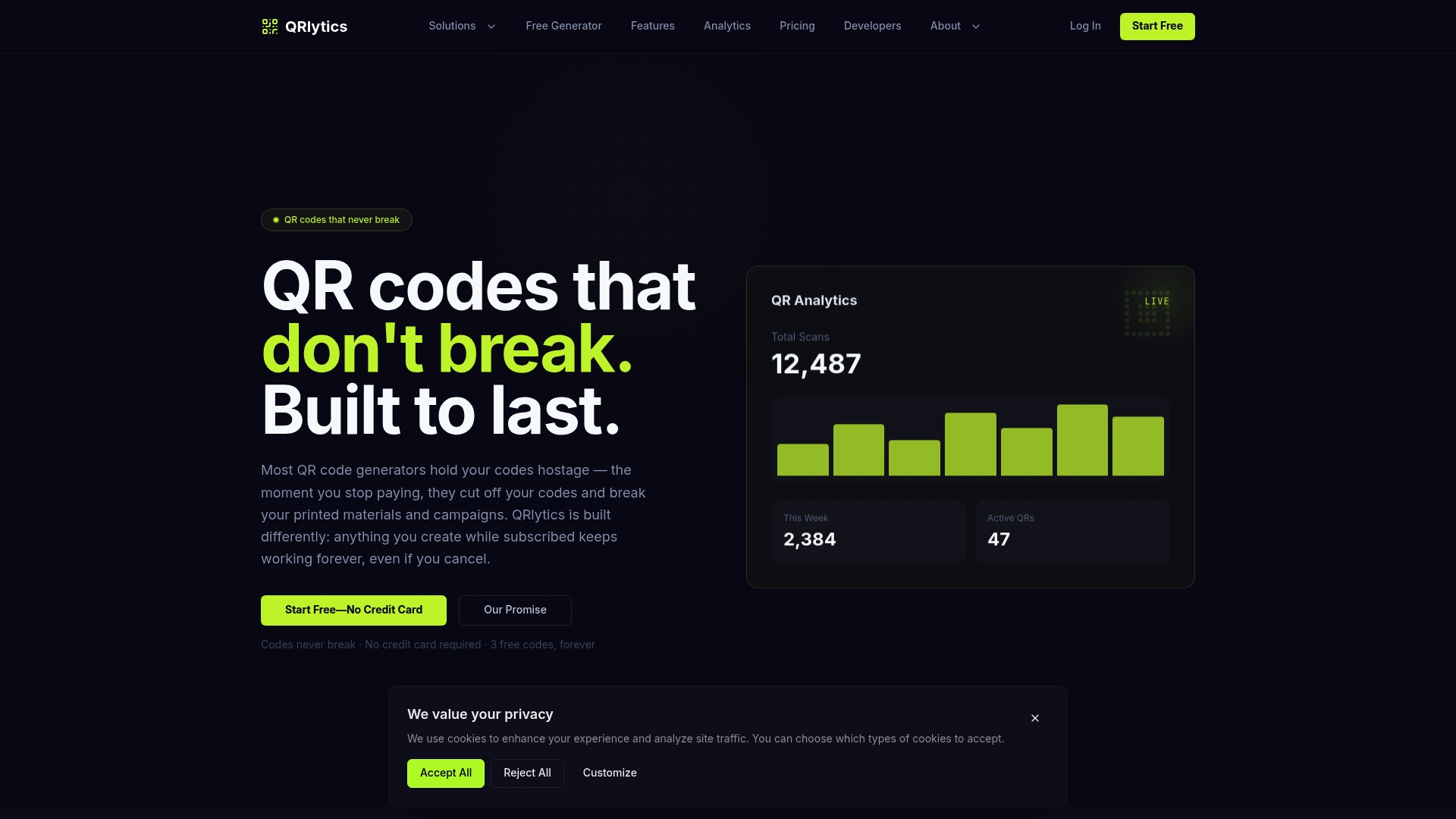
Qrlytics is built for exactly this. The dynamic QR code generator lets you update your redirect URL for every seasonal window in seconds, with no new code and no new print run. The analytics dashboard tracks scans by location, device, and time, so you can see which seasonal offers actually drive results. Codes created on Qrlytics stay active permanently, regardless of billing changes, which means your printed materials keep working year after year. Start with the free QR code generator and build your first seasonal rotation today, no credit card required.
FAQ
What is a seasonal QR code strategy?
A seasonal QR code strategy uses a single dynamic QR code whose destination URL updates to match major calendar events throughout the year. The physical code stays the same; only the linked content changes each season.
How often should I update my QR code content?
A six-event rotation per year, with a four-week cycle of different offers within each event, gives customers regular reasons to scan without overwhelming your team with constant creative work.
Do I need to reprint QR codes for each season?
No. Dynamic QR codes let you change the destination URL without reprinting the code. This is the core operational advantage of seasonal rotation campaigns over one-off printed campaigns.
How do I measure whether my seasonal QR campaign is working?
Track scan volume, conversion rate, and offer redemption for each week of each seasonal window. Platforms like Qrlytics provide real-time campaign tracking that shows you exactly when and where customers are scanning.
What makes a seasonal landing page effective?
Fast mobile load times, clear seasonal branding, a single prominent call to action, and a time-limited offer are the four factors that most directly drive scan-to-conversion performance on seasonal landing pages.