100ms Tap vs 0.5–3s Scan: QR vs NFC for Marketers, Keep Codes Live

NFC wins for fast, high-throughput payments and secure wallet integration; QR codes win for low-cost, widely distributed campaigns and printed marketing. Neither replaces the other outright, and the NFC Forum and ISO/IEC 18004 standards make clear each was built for different jobs. Most businesses end up running both, with a durable QR platform keeping campaign codes alive long after launch.
TL;DR:
- Most businesses run both NFC and QR codes, using NFC for high-speed transactions and QR codes for flexible, low-cost marketing campaigns.
- QR codes can be static or dynamic, with dynamic codes allowing destination updates and better campaign tracking, unlike static codes that become obsolete once printed.
- NFC offers faster interactions suitable for checkout lines, while QR codes excel in packaging, receipts, and printed materials where speed is less critical.
- Implementing dynamic QR codes with a reliable resolver infrastructure is essential to ensure long-term campaign effectiveness and avoid dead links.
- NFC hardware costs can be significant due to certified terminals, whereas QR code deployment mainly involves printing and backend infrastructure for data management.
Table of Contents
- How NFC and QR codes actually work
- Speed, reliability and the user experience
- Advantages and disadvantages: payments vs marketing
- Choosing between NFC, QR, or both
- What it costs to actually deploy either technology
- Security, fraud and privacy: the trade-offs that matter
- Managing QR campaigns at scale
- What a sensible rollout actually looks like
- How Qrlytics fits into your QR strategy
- Sources
- FAQ
How NFC and QR codes actually work
The differences between qr codes vs NFC start with the physics. NFC runs on 13.56 MHz high-frequency radio, a short-range wireless standard governed by specifications from the NFC Forum. It operates in three modes: card emulation (your phone behaves like a contactless card), reader/writer (your phone reads a tag), and peer-to-peer (two devices exchange data directly). Most payment use cases rely on card emulation, either through a physical secure element embedded in the device or through Host Card Emulation (HCE), which lets software handle the secure credential exchange instead of dedicated hardware.
Data on an NFC tag or exchanged during a tap is usually structured as an NDEF record, a lightweight format the NFC Forum defined so different devices and apps can read the same tag consistently. That structure is why a tapped payment terminal, a smart poster, and a transit card can all speak the same underlying language even though they do very different things, a key idea in omnichannel marketing strategies.
QR codes work on entirely different principles. A QR code is a matrix barcode: a grid of black and white squares that encodes data, with three distinctive finder patterns in the corners that help a camera or scanner recognise orientation instantly. The symbology is standardised under ISO/IEC 18004, which defines everything from module sizing to the Reed–Solomon error correction that lets a code still scan correctly even when part of it is scuffed, shadowed, or partially obscured. Four error-correction levels exist, trading data capacity for damage tolerance.
The more consequential distinction for businesses is static versus dynamic QR. A static code encodes the destination URL directly. Change the offer, the landing page, or the campaign, and the printed code is worthless. A dynamic QR code instead encodes a stable resolver address; the code itself never changes, but the destination it points to lives on a server and can be updated at any time. That resolver architecture is what lets a single printed poster serve three different campaigns over its lifetime, something no static code or NFC tag can replicate quite as cheaply.
Speed, reliability and the user experience
Tap beats scan on raw speed, and the gap is not subtle. An NFC interaction, from tap to confirmed read, typically completes very quickly, according to NXP’s application note on NFC performance. A camera-based QR scan, by contrast, usually takes several seconds once you account for pulling out a phone, opening a camera or scanner app, and getting the code framed correctly.

That gap rarely matters for a single transaction. It matters enormously at scale. A busy lunch queue processing one customer every few seconds cannot absorb three extra seconds per person without the whole line backing up.
QR reliability also depends heavily on execution quality, which is where most real-world failures happen. Common culprits include:
- Poor print resolution that blurs the finer modules of the code.
- A missing or undersized quiet zone, the blank margin ISO/IEC 18004 requires around the code for the scanner to lock on.
- Heavy branding or logo overlays that reduce contrast below reliable scanning thresholds.
- Autofocus struggles on cheaper phone cameras in low light or at odd angles.
None of these are exotic problems, and all of them are avoidable with basic print QA. NFC has its own friction, mainly around precise placement. Devices need to be within roughly a few centimetres of each other, so a tag mounted at the wrong height or behind thick packaging can fail to read even when the technology itself works fine.
The practical rule is straightforward: reach for NFC where throughput is the constraint, such as transit gates or retail checkout lanes. QR remains perfectly acceptable, even preferable, wherever the interaction is unhurried, such as table payments, posters, receipts, or product packaging.
Advantages and disadvantages: payments vs marketing
Payments and marketing pull qr codes vs NFC in different directions, and conflating them is where a lot of deployment decisions go wrong.
NFC for payments
- Fast, near-instant taps that suit high-volume checkout environments.
- Native support for wallet apps and EMV contactless standards, so it plugs into infrastructure banks and card networks already trust.
- Stronger on-device security by default, since tokenisation and secure elements (or HCE) keep raw card data off the air waves entirely.
- Higher deployment cost in some contexts. Reader hardware and certified terminals are not free, and retrofitting older point-of-sale systems can be a real budget line.
- Very short read range, often just a few centimetres, which demands precise tag or terminal placement and leaves little room for user error.
QR for marketing and payments
- Minimal hardware requirement. Any printed surface or screen becomes a touchpoint, which Stripe highlights as a major cost advantage for smaller merchants and pop-up sellers.
- Flexible placement across packaging, posters, receipts, invoices, and digital ads, with dynamic QR letting the destination evolve without reprinting anything.
- Built-in analytics potential: because dynamic codes route through a resolver, every scan can be logged, timestamped, and mapped by location.
- Slower per-transaction speed compared with a tap, which matters in queue-sensitive settings.
- Vulnerability to tampering. A static code can, in principle, be covered with a fraudulent sticker redirecting to a malicious page, a risk that dynamic, verified resolvers largely close off.
- Dependence on a working camera and, for dynamic codes, an active internet connection at the point of scan.
Stripe’s own guidance leans towards NFC for speed-oriented, integrated point-of-sale experiences, treating QR as a lower-cost supplement for cases like table payments or bridging an offline print asset to an online destination. That framing holds up well against how most retailers actually deploy the two.
Choosing between NFC, QR, or both
The right answer depends less on which technology is “better” and more on which constraints matter most for a specific rollout. Five criteria do most of the work in that decision.
- Throughput. How many interactions need to happen per minute at the busiest point? Above a certain queue velocity, NFC’s roughly 100 millisecond handshake against QR’s 0.5 to 3 second scan window becomes the deciding factor, not a footnote.
- Hardware budget. NFC needs certified readers or terminals; QR needs nothing beyond a printed surface and a smartphone camera most customers already carry.
- Offline capability. Static QR codes and NFC tags with locally stored data can both function without connectivity. Dynamic QR resolvers and HCE-based NFC wallets generally cannot.
- Security requirements. Where tokenised, card-grade security matters most (high-value payments, access control), NFC’s secure element model has the edge. Where the asset is a marketing touchpoint rather than a financial transaction, that extra security layer is often unnecessary weight.
- Analytics need. If a campaign’s success depends on knowing who scanned what, where, and when, dynamic QR paired with a proper scan-to-conversion measurement approach is far easier to instrument than NFC.
Mapped against real verticals, the picture gets concrete quickly:
Quick-service food and hospitality. Table payments and menu access favour QR, since customers are seated and unhurried; the counter checkout line, where speed governs customer satisfaction, favours NFC.
Retail. NFC dominates at the till for contactless card and wallet payments. QR earns its place on shelf tags, packaging, and receipts, where it links to product information, reviews, or loyalty sign-up without needing any reader hardware.
Events and ticketing. Entry gates processing hundreds of people per hour need NFC’s speed. Pre-event marketing, programme guides, and sponsor activations work far better as QR codes distributed across print and digital channels.
Packaging. QR is almost always the pragmatic choice here. It is cheap to print at scale and pairs naturally with dynamic destinations that can evolve from a product launch page into a loyalty offer without a single label reprint.
Invoices and online to offline bridges. A printed invoice or physical mailer with a dynamic QR code linking to an online payment portal is a low-cost way to connect a paper process to a digital one, exactly the kind of bridge Stripe flags as a sensible QR use case.
The operational advice that cuts across all of these is to pilot small before committing budget. Launch a dynamic QR campaign on receipts or posters, track scans through to conversion, and only add NFC hardware at the specific chokepoint where measured queue time or drop-off actually justifies the spend. Scaling the technology mix that the data supports beats guessing upfront every time.
What it costs to actually deploy either technology
QR deployment costs are close to negligible for the physical asset itself, print, packaging, or digital placement, but the real spend sits in the backend. A dynamic QR strategy needs a hosted resolver that stays online, resolves quickly, and lets you edit destinations without touching the printed material. That is infrastructure, not a one-off design fee, and it is the part most guides skip.
NFC costs run the other direction. The tags themselves are cheap in bulk, often a few pence each, but reader hardware, certified payment terminals, and any retrofitting of legacy point-of-sale systems add up fast, particularly for a business running dozens of locations.
Compatibility is worth checking before either rollout goes live. Nearly all modern smartphones, iOS and Android alike, support NFC reading natively, and most support QR scanning directly through the native camera app without a separate scanner. Older Android handsets and budget devices are where gaps still show up, either through missing NFC chips or camera autofocus that struggles with small or low-contrast QR codes.
Operationally, both technologies need routine checks that are easy to skip and expensive to ignore:
- QR assets need periodic scan testing after printing, especially with new stock, laminate, or branding overlays that can quietly drop contrast below scannable thresholds.
- Printed codes should be spot-checked for tampering, since a sticker covering the original code is a real, low-tech attack vector.
- NFC tags near heat, moisture, or heavy handling need a replacement schedule, since physical wear degrades the antenna over time.
- Offline fallbacks matter for both: a static backup QR code or a manual payment path when a resolver or terminal goes down avoids losing a sale entirely.
Security, fraud and privacy: the trade-offs that matter
NFC’s security model leans on tokenisation and EMV standards, the same architecture behind contactless bank cards, so raw card numbers are never actually transmitted during a tap. The choice between a hardware secure element and Host Card Emulation is a genuine trade-off: secure elements offer stronger isolation from the phone’s operating system, while HCE is cheaper to implement and update but relies more heavily on the app layer being secure. NFC’s short range is also, counterintuitively, a security feature. It makes skimming or accidental reads considerably harder simply because an attacker needs to get within a few centimetres.
QR’s biggest fraud risk is visual: a malicious sticker placed over a legitimate code can redirect a scan to a fake payment page. The mitigation is architectural rather than cosmetic. Dynamic, transaction-specific resolvers with short-lived destinations close most of that gap, and pairing every QR-driven payment flow with HTTPS and a verified merchant page removes the easiest wins for a scammer. Routine visual tamper checks on high-traffic printed codes, posters and till displays especially, catch the rest.

Privacy deserves equal weight alongside fraud. Any QR or NFC deployment that logs scan or tap data should apply data minimisation, collecting only what a campaign genuinely needs, and run tracking under GDPR-compliant analytics with transparent consent rather than silent collection. A customer scanning a poster should have a reasonable idea that the scan might be logged, and why.
Managing QR campaigns at scale
Printed QR codes have a lifecycle problem most marketing plans never account for: the code goes to print, the campaign ends, and six months later someone scans a leftover poster and lands on a dead page. Permanence and dynamic control solve that, and it is the gap Qrlytics was built to close. Codes created during an active paid plan stay functional indefinitely, regardless of later billing changes, which matters enormously for anything printed on packaging, signage, or long-shelf-life materials that outlive a single campaign cycle.
Pro Tip: Before committing a print run to any QR code, confirm the destination is dynamic and hosted on infrastructure with guaranteed redirection uptime. A poster is only as reliable as the resolver behind it.
A serious QR management platform should give marketers:
- Real-time scan analytics broken down by time, device, and outcome.
- Geographic heat maps showing where engagement actually clusters.
- CSV export for feeding scan data into broader reporting tools.
- CMS-style destination editing, so a live campaign can pivot without a reprint.
When comparing vendors, four questions cut through most of the noise: does the provider guarantee code permanence beyond billing changes, what privacy controls exist around scan tracking, what uptime does the resolver promise, and how fast is redirection under real load? Resolver uptime and redirect latency are the operational risks that quietly undermine an otherwise well-designed campaign.
What a sensible rollout actually looks like
Most small businesses overthink this decision before they have any data to work from. Start with dynamic QR on receipts and posters, since the hardware cost is near zero and you can measure scan-to-conversion from day one. Only pilot NFC at the single busiest checkout or kiosk where tap speed genuinely changes queue behaviour, rather than rolling it out everywhere at once. Track scans per asset, conversion rate, queue time, and any tamper or fraud incidents for the first few weeks. That handful of numbers tells you far more about where NFC actually earns its cost than any vendor pitch will.
— The
How Qrlytics fits into your QR strategy
If your business is leaning towards QR for marketing, receipts, packaging, or online-offline bridges, the question stops being “QR or NFC” and becomes “which QR platform won’t let my printed materials go dead.” That is a key problem some QR platforms solve: codes created during an active paid plan keep working indefinitely, so a poster or product label printed today is not gambling on a subscription staying current forever.
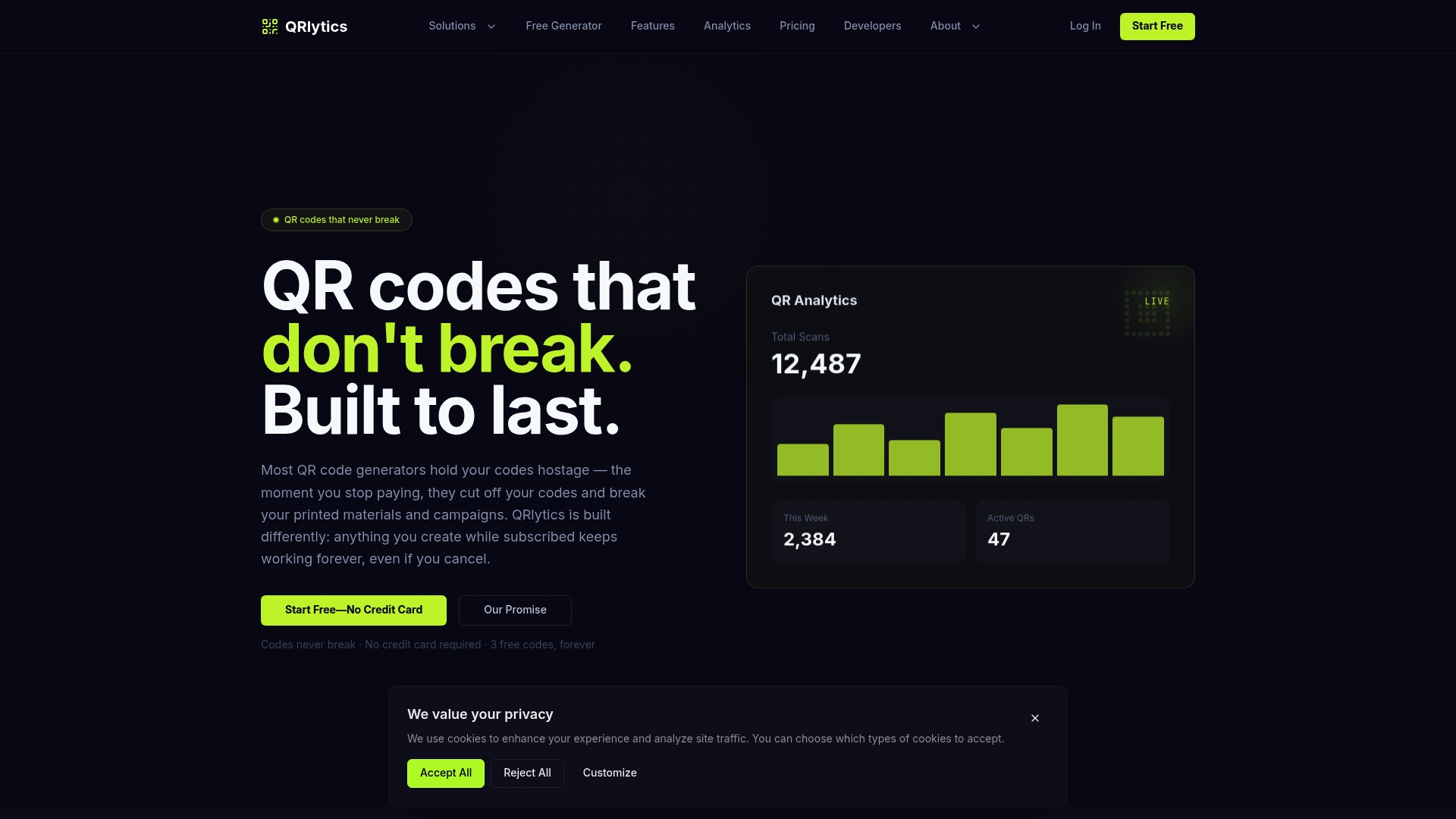
Beyond permanence, some QR platforms give you dynamic URL updates so a live campaign can change destination without a reprint, GDPR-compliant analytics with scan heat maps for tracking where engagement actually happens, and branding controls so codes match your visual identity rather than looking like a generic barcode. For teams building an ongoing QR tracking practice, that combination of permanence and real-time data removes the biggest risk in any print-based campaign: a dead link on a live asset.
Start with the free QR code generator to test a single campaign, or move straight to the dynamic QR code generator if you already know you’ll need to update destinations and track scans over time. No credit card is required to get started.
Sources
- NXP application note (NFC performance)
- The difference between NFC and QR code payments | Stripe
- ISO/IEC 18004: QR code bar code symbology specification
- NFC Forum – Learn NFC technology
FAQ
Which is better, NFC or QR code?
Neither is universally better. NFC wins on speed and native payment security for high-throughput checkouts, while QR wins on cost, reach, and marketing flexibility, and most businesses benefit from running both.
Do I really need NFC on my phone?
Not for QR-based interactions, since any smartphone camera can scan a QR code, but you do need an NFC-enabled device to tap for contactless payments or read NFC tags directly.
What are the drawbacks of NFC?
NFC’s short range demands precise placement within a few centimetres, and certified terminals or readers can carry meaningful hardware costs for businesses retrofitting older point-of-sale systems.
What is the disadvantage of QR code payment?
QR payments are slower per transaction than an NFC tap and, if codes aren’t managed through a dynamic, verified resolver like Qrlytics, they can be vulnerable to tampering or dead links after a campaign ends.