QR code audience segmentation: a practical guide
TL;DR:
- QR code audience segmentation groups scanners by shared characteristics like location and behaviour to improve targeted marketing. Using real-time data from scans, marketers create segments, assign tailored messages, and adjust campaigns dynamically for better engagement. Dynamic QR codes and UTM parameters enable ongoing optimization and accurate source attribution for more effective campaigns.
QR code audience segmentation is the practice of dividing QR code scanners into distinct groups based on shared characteristics from scan data, such as location, device type, and landing page viewed, enabling marketers to deliver custom messaging to each group. This is the marketing discipline’s answer to a simple problem: not every person who scans your code has the same intent. Platforms like Qrlytics, Amplitude, and Adobe Express each offer tools that make this kind of targeting practical at scale. The result is a shift from broadcasting one message to everyone, to sending the right message to the right subgroup, which drives measurably better campaign performance.
What is QR code audience segmentation and how does it work?
QR code audience segmentation splits your scanner base into groups using behavioural and contextual signals inferred from each scan event. The industry term for the broader practice is “audience segmentation,” and QR codes are simply the data collection mechanism that feeds it. When someone scans a code, they generate a data point that includes where they are, what device they are using, what time they scanned, and which landing page they reached. Each of those signals becomes a segmentation variable.

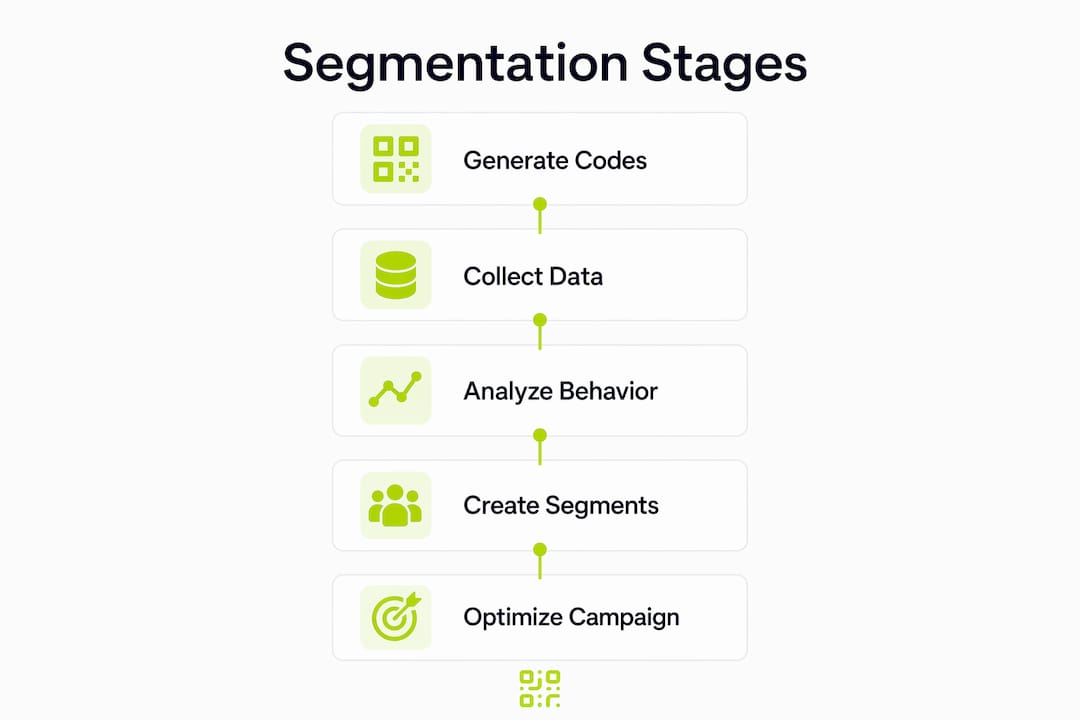
The segmentation process works in three stages. First, you generate unique QR codes for each campaign placement or channel. Second, your analytics platform collects scan data in real time. Third, you group scanners by shared characteristics and route them to tailored experiences. Qrlytics supports all three stages through its dynamic QR code system and real-time scan analytics dashboard.
What data from QR code scans enables audience segmentation?
Scan data falls into four main categories, each with a different segmentation value.
- Location data: The city, region, or country where the scan occurred. This is the most reliable demographic proxy available from a QR scan and works well for geo-targeted offers.
- Device type: Whether the scanner used iOS or Android, and whether they were on a smartphone or tablet. Device data informs creative decisions, such as whether to serve an App Store or Google Play link.
- Time of scan: Day of week and hour of day. A scan at 11pm on a Saturday signals very different intent from one at 9am on a Tuesday.
- Landing page and post-scan behaviour: Which URL the scanner reached, how long they stayed, and whether they converted or abandoned. This is the richest segmentation signal.
Behavioural segmentation, including conversion rates, browsing depth, and repeat scans, creates the most valuable QR code segments. Segmenting first-time scanners from repeat scanners alone can double the relevance of your follow-up messaging. A first-time scanner may need an introductory offer; a repeat scanner is already warm and needs a loyalty reward or upsell.
| Data type | Segmentation use | Reliability |
|---|---|---|
| Location | Geo-targeted offers and localised content | High |
| Device type | Platform-specific creative and app links | High |
| Time of scan | Behavioural intent and scheduling | Medium |
| Post-scan behaviour | Funnel stage and conversion likelihood | Very high |
Pro Tip: Connect your QR scan data to a tool like Amplitude to build behavioural cohorts from post-scan events. This turns raw scan counts into meaningful audience profiles.
How to define and create actionable QR code audience segments
Effective segmentation requires clear, actionable criteria focusing on placement, campaign, and user behaviour rather than broad demographics alone. A segment is only useful if you can do something different for it. If you cannot write a distinct message or design a distinct landing page for a group, that group is not a segment. It is just a filter.
Follow these steps to build segments that hold up in practice:
- Define your segmentation criteria before launch. Choose two or three variables: campaign source, scan location, and post-scan action are the most reliable starting points. Deciding this upfront means your QR codes and landing pages are built to capture the right data from day one.
- Generate a unique QR code for each placement. A code on a poster in Manchester should differ from one in a London tube station. Unique codes per placement let you attribute every scan to a specific source and build location-based segments automatically.
- Set a minimum segment size before acting on it. Audience segmentation works best when segments are actionable, distinct, and scalable enough to justify tailored messaging. A segment of twelve scanners does not justify a bespoke landing page. A segment of 500 does.
- Label segments by funnel stage. Group scanners into “awareness” (first scan, no conversion), “consideration” (multiple scans, no purchase), and “intent” (scanned and clicked a product page). Each stage needs a different message.
- Map each segment to a specific landing page or offer. Mapping QR-identified segments to different landing pages aligned with likely user intent maximises campaign relevance and conversion.
Pro Tip: Resist the urge to create more than five or six segments per campaign. Over-segmentation spreads your budget thin and makes it harder to reach statistical significance in your results.
What are the benefits of QR code audience segmentation for campaigns?
Segment-specific campaigns drive higher engagement and ROI compared with generic, broad campaigns by delivering relevant offers to customer subgroups. Businesses see measurable improvements in conversion rates and campaign responsiveness through QR audience segmentation. That improvement comes from three concrete advantages.
- Reduced wasted spend. When you know a segment scanned from a retail display in Birmingham, you stop serving them a generic national offer. You serve them a store-specific promotion. Every impression becomes more efficient.
- Real-time feedback loops. Because scan data is immediate, you can identify underperforming segments within hours of launch and redirect budget or swap landing pages without reprinting a single piece of collateral.
- Personalisation at scale. Dynamic QR codes let you update the destination URL after print. This means a single printed poster can serve different landing pages to different segments based on scan time, location, or device, without any physical change to the material.
“The moment of scanning is high-intent. Landing pages must deliver to maintain engagement and collect meaningful segmentation data.” — Adobe Express
The personalisation benefit is particularly significant for businesses running multi-channel campaigns. A QR code on a direct mail piece, a billboard, and a product package can each feed a different segment with a different message, all tracked through one analytics dashboard.
How to implement QR code audience segmentation: a step-by-step guide
Implementation follows a clear sequence. Skipping any step creates gaps in your data that make segmentation unreliable.
- Generate unique QR codes for each channel and placement. Use a platform like Qrlytics to create dynamic codes that can be updated after deployment. Assign a descriptive name to each code so your analytics stay organised.
- Add UTM parameters to every destination URL. UTM parameters such as
utm_source,utm_campaign, andutm_contentdifferentiate traffic from each QR placement in Google Analytics or any other analytics tool. This is the backbone of attribution. - Design mobile-first landing pages for each segment. QR campaigns require mobile-friendly landing pages aligned with the code’s call to action. A page that loads slowly or requires desktop navigation kills the scan-to-conversion rate immediately.
- Track scan metrics in real time. Use Qrlytics’ analytics dashboard to monitor scan volume, location heat maps, device breakdown, and time patterns. Check performance within the first 48 hours of any campaign launch.
- Adjust based on segment performance. Swap landing page URLs for underperforming segments using dynamic QR code settings. You can do this without changing the printed code.
| Approach | Static QR codes | Dynamic QR codes |
|---|---|---|
| URL update after print | Not possible | Possible at any time |
| Scan analytics | Limited or none | Full real-time data |
| Segment-specific routing | Fixed at creation | Adjustable post-launch |
| Best for | One-off, low-stakes uses | Ongoing segmented campaigns |
For a deeper look at QR code tracking techniques, Qrlytics’ blog covers attribution, UTM setup, and analytics interpretation in practical detail.
Key takeaways
QR code audience segmentation delivers measurable campaign improvements when segments are built on behavioural and contextual scan data, kept to a manageable number, and matched to distinct landing pages.
| Point | Details |
|---|---|
| Core definition | Segmentation groups scanners by location, device, behaviour, and funnel stage for targeted messaging. |
| Best data type | Post-scan behaviour, including conversions and repeat scans, produces the most useful segments. |
| Segment viability | Every segment needs a minimum size and a distinct message to justify the resource investment. |
| UTM parameters | Adding UTM tags to QR destination URLs is non-negotiable for accurate source attribution. |
| Dynamic codes | Dynamic QR codes allow post-print URL updates, making real-time segment adjustments possible. |
Why most marketers are still doing this wrong
The biggest mistake I see is treating QR code segmentation as a reporting exercise rather than a campaign design decision. Marketers set up a QR code, check the scan count, and call it analytics. That is not segmentation. Segmentation starts before the code is printed.
The second mistake is building segments that are too small to act on profitably. Marketers use metrics like customer acquisition cost and customer lifetime value to validate and prioritise segments, and avoid ineffective micro-segmentation. If your segment of “left-handed iOS users who scanned on a Wednesday” has forty people in it, you have a curiosity, not a campaign.
The third mistake is ignoring the landing page entirely. Strong CTAs and mobile-friendly pages are essential to capture high-intent moments following a QR scan. A brilliant segmentation strategy collapses the moment a scanner lands on a page that takes four seconds to load or asks them to fill in a form before seeing the offer.
Data privacy is also shifting the ground beneath this practice. GDPR compliance is not optional for UK and European campaigns. Any platform you use for QR scan analytics must handle data lawfully. Qrlytics operates with GDPR-compliant tracking built in, which removes one significant compliance risk from your stack.
The marketers who get this right treat each QR code as a data collection instrument first and a navigation tool second. When you design with that mindset, segmentation becomes a natural output of the campaign rather than an afterthought.
— The
Qrlytics makes QR audience segmentation straightforward
Qrlytics is built for marketers who need reliable QR codes with the analytics depth to support real segmentation work.
The platform generates both free and dynamic QR codes that support real-time URL updates, so you can adjust segment routing after your materials are printed. Every scan feeds into a live analytics dashboard covering location heat maps, device data, time patterns, and conversion tracking. Codes created during an active subscription remain functional permanently, which means your printed campaigns never break due to a billing issue. No credit card is required to start. If you want to see how QR scan analytics can feed your segmentation strategy directly, Qrlytics is the place to begin.
FAQ
What is QR code audience segmentation?
QR code audience segmentation is the practice of grouping QR code scanners into distinct subsets based on shared characteristics from scan data, such as location, device type, and post-scan behaviour, so marketers can deliver targeted messages to each group.
What data do QR codes collect for segmentation?
QR codes collect location, device type, time of scan, and post-scan behaviour including page visits and conversions. Post-scan behavioural data produces the most useful segments for campaign targeting.
How many segments should a QR campaign have?
Most campaigns perform best with three to six segments. Fewer segments are easier to act on, and each segment needs a minimum viable size to justify a distinct landing page or offer.
Do I need dynamic QR codes for audience segmentation?
Dynamic QR codes are strongly recommended because they allow you to update destination URLs after print, enabling real-time segment adjustments without reprinting materials.
How do UTM parameters help with QR segmentation?
UTM parameters appended to QR destination URLs attribute each scan to a specific source, placement, or campaign in your analytics platform, which is the foundation of accurate QR audience segmentation.