GDPR-compliant QR codes: a step-by-step guide for marketers
TL;DR:
- Running a QR code campaign without ensuring GDPR compliance risks personal data processing before consent, potentially leading to fines. Proper preparation includes clear notices, valid opt-in mechanisms, and dynamic codes to update consent flows without reprinting. Ongoing monitoring and technical testing are essential to maintain lawful, trustworthy data collection practices.
Running a QR code campaign without a clear GDPR compliance plan is a risk many European marketers underestimate. You print thousands of flyers, launch a product campaign, and embed a QR code that quietly collects IP addresses, device data, and location signals the moment someone scans it. That data collection may be happening before any consent is given. Regulators are paying attention, and the consequences range from formal warnings to significant fines. This guide walks you through every practical step, from preparation to ongoing monitoring, so your QR campaigns are both effective and lawful.
Table of Contents
- Understanding GDPR risks in QR code campaigns
- What you need before launching GDPR-compliant QR codes
- Step-by-step: implementing QR codes the GDPR-compliant way
- Verifying compliance: monitoring and fixing common issues
- Why most QR code compliance advice falls short: our take
- Make your QR strategy compliant and effective with QRlytics
- Frequently asked questions
Key Takeaways
| Point | Details |
|---|---|
| QR campaigns raise data risks | Even basic QR code analytics often qualify as personal data, demanding full GDPR compliance. |
| Preparation is critical | Establish clear notices, consent, and withdrawal channels before launching any QR-based marketing. |
| Step-by-step keeps you safe | Following a structured deployment and consent model helps avoid non-compliance and reputation damage. |
| Audits close compliance gaps | Regular reviews and consent flow checks prevent hidden violations and boost customer trust. |
Understanding GDPR risks in QR code campaigns
Most marketers think of QR codes as simple links. Point your phone, open a webpage, done. But what happens in the background is more complex. Every scan can generate a stream of data points that, under GDPR, may qualify as personal data.
Here is what a typical QR scan can collect:
| Data type | Example | Personal data risk |
|---|---|---|
| IP address | 192.168.1.1 | High: often directly identifiable |
| Device type | iPhone 15, Android | Medium: combined with other data |
| Location | City, region, country | High: especially precise geolocation |
| Timestamp | Date and time of scan | Medium: behavioural profiling risk |
| Browser/OS | Chrome on iOS | Medium: fingerprinting risk |
| Referral path | Campaign source tag | Low to medium |
As GDPR analytics compliance research confirms, QR-linked analytics often involve IP addresses and identifiers that may constitute personal data processing, requiring a lawful basis or consent depending on configuration and jurisdiction. This is not a grey area. It is a clear obligation.
The risk of pre-consent data collection is particularly serious. If your QR code redirects users through a tracking layer before they reach any consent notice, you may already be processing personal data unlawfully. Many campaign managers do not realise this is happening because the tracking is built into the redirect URL itself.
“For GDPR transparency and lawful processing, businesses should provide clear pre-scan/post-scan information and use a proper consent mechanism when the QR-linked flow involves consent-required processing.” GDPR tips for QR scan data
The consequences of getting this wrong are real. Regulatory scrutiny is increasing across the EU and UK. Beyond fines, a compliance failure can damage customer trust, particularly when users discover their data was collected without proper notice. Understanding QR code analytics best practices is no longer optional for serious marketers. It is a baseline requirement.
Some platforms, including certain well-known link shorteners, offer QR tracking solutions with analytics built in. But having analytics available does not mean those analytics are configured in a GDPR-compliant way. That responsibility sits with you, the data controller.

Now that you know what is at stake, let us break down what you actually need before implementing QR codes in your campaigns.
What you need before launching GDPR-compliant QR codes
Preparation is where most compliance failures begin. Marketers focus on design and distribution, and the legal groundwork gets skipped or rushed. Before a single QR code goes to print, you need several things in place.
Your pre-launch compliance checklist:
- A clear and concise privacy notice that describes what data is collected, why, and for how long
- A valid consent mechanism, with opt-in only (no pre-ticked boxes)
- A process for users to withdraw consent easily
- Documentation of your lawful basis for processing
- A QR code management tool that supports dynamic URLs and GDPR-friendly analytics
- A record of when and how consent was obtained
Guidance for QR scan data collections emphasises visible disclosures before scanning, concise notices describing purposes, granular opt-in consent, and a clear withdrawal mechanism. Each of these elements needs to be in place before launch, not added as an afterthought.
One of the most important decisions at this stage is whether to use static or dynamic QR codes. Here is how they compare for compliance purposes:
| Feature | Static QR code | Dynamic QR code |
|---|---|---|
| URL can be updated | No | Yes |
| Analytics tracking | Limited | Full |
| Consent flow can be updated | No | Yes |
| Privacy notice can be revised | No | Yes |
| Compliance corrections post-print | Not possible | Possible |
Dynamic QR codes are strongly preferable for any campaign involving data collection. If your privacy notice changes, or if you need to update your consent flow, a dynamic code lets you make those changes without reprinting materials. You can manage consent for QR code analytics and adjust updating QR destinations at any time, which is a significant compliance advantage.
Pro Tip: Use a GDPR cookie banner solution on your QR landing page to handle consent for cookies and tracking scripts separately from your main privacy notice. This layered approach gives users clearer choices and reduces your compliance risk.
Documentation matters as much as the technical setup. Keep records of your consent language, the dates it was in use, and any changes made. If a regulator asks, you need to demonstrate that you had a lawful basis for every processing activity tied to your campaign.
With preparations in place, it is time to walk through the GDPR-compliant QR code implementation process step by step.
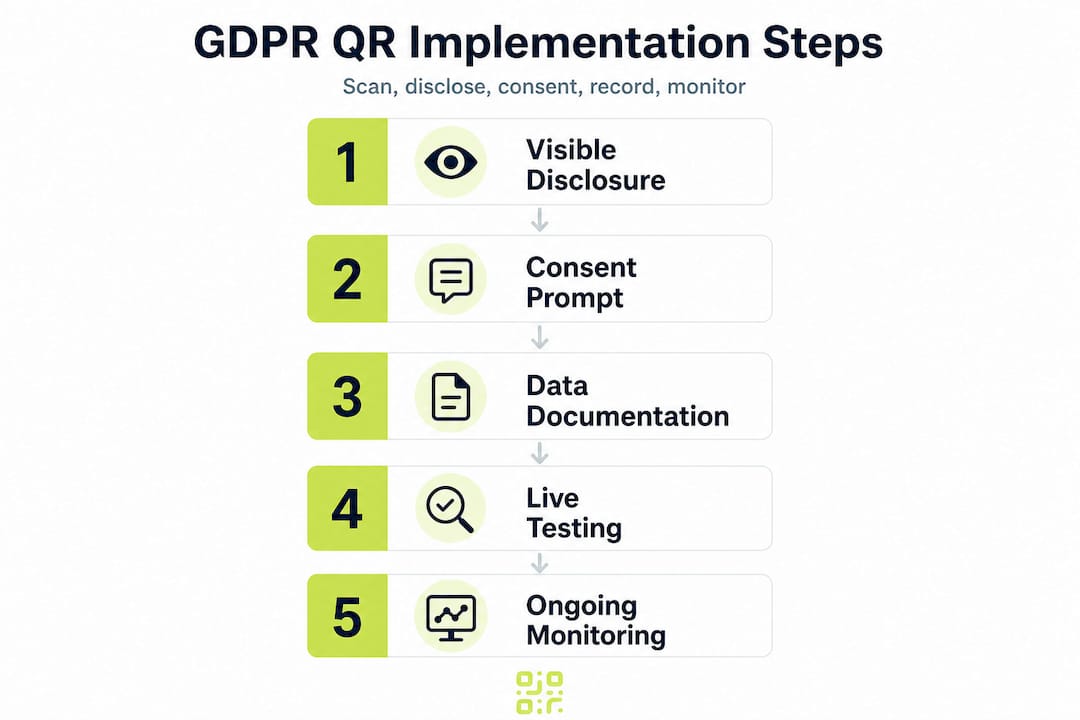
Step-by-step: implementing QR codes the GDPR-compliant way
This is where theory becomes practice. Follow these steps for every QR code campaign that involves data collection or tracking.
-
Design your pre-scan notice. Before anyone scans your code, they should know what happens when they do. Add a short statement near the QR code on your printed or digital material. For example: “Scanning this code will collect anonymised usage data. See our privacy policy for details.” Keep it brief but honest.
-
Configure your landing page consent flow. When the user arrives on your landing page, present a clear consent prompt if you are collecting personal data for analytics or marketing. Use opt-in only. Never pre-tick consent boxes. Offer granular choices where possible, for example, separating analytics consent from marketing consent.
-
Limit data collection to what you need. Configure your analytics tool to collect only the data points required for your stated purpose. If you only need to know which city a scan came from, you do not need to store full IP addresses. Minimise collection at the configuration level, not just in your privacy notice.
-
Set up a clear opt-out mechanism. Every user must be able to withdraw consent as easily as they gave it. Include a visible link to your privacy settings or consent management page on your landing page and in any follow-up communications.
-
Test the full user journey before launch. Scan your own QR code on multiple devices and walk through the consent flow as a user would. Check that the privacy notice appears correctly, that consent options work, and that opting out actually stops data collection.
-
Document everything. Record the consent language used, the date of launch, the data points collected, and the retention period. This documentation is your evidence of compliance.
The ICO guidance on direct marketing is clear: direct marketing requires compliance with consent rules and must honour opt-outs. This applies whether you are sending follow-up emails after a QR scan or using scan data to build audience segments.
Pro Tip: Use a GDPR legal checklist to cross-reference your implementation against regulatory requirements. Even experienced teams miss steps when working under campaign deadlines.
Understanding how to track QR code campaigns effectively while staying compliant is genuinely achievable. The goal is not to avoid analytics. It is to collect data lawfully, transparently, and with user trust. When done correctly, compliant QR campaigns can drive engagement just as effectively as unconstrained ones.
Once your campaign is up and running, maintaining compliance is not over. Monitoring and improvement are next.
Verifying compliance: monitoring and fixing common issues
Launching a compliant campaign is step one. Keeping it compliant over time is where many businesses fall short. Consent flows break. Tracking scripts update. Privacy notices go stale. Regular monitoring catches these issues before they become regulatory problems.
Your ongoing compliance monitoring checklist:
- Review consent logs monthly to confirm opt-in rates and withdrawal requests are being recorded
- Audit your tracking configuration quarterly to ensure no new data points have been added without review
- Test the opt-out mechanism regularly to confirm it still functions correctly
- Check that your privacy notice reflects current data processing activities
- Review any third-party tools embedded in your QR landing page for new tracking behaviour
Common mistakes that create compliance gaps include:
- Pre-consent data collection: Tracking scripts that fire before the user has seen or accepted a consent prompt
- Vague consent language: Notices that describe data use in broad terms rather than specific purposes
- Weak opt-out: Withdrawal options that are hard to find or that do not actually stop data processing
- Outdated privacy notices: Notices that no longer reflect the tools or data points in use
Forensic compliance audits show that pre-consent tracking is one of the most common issues uncovered, and fixing it consistently improves opt-in rates while reducing regulatory risk. This is not a theoretical exercise. Real campaigns have been found to collect data before any consent interaction, simply because the analytics tag loaded before the consent banner.
A common misconception is that anonymised analytics are automatically outside GDPR scope. This is not always true. As new EDPB guidelines on pseudonymisation clarify, if analytics include quasi-identifiers or data that can be linked to an individual via other datasets, regulators may still treat it as personal data.
“Anonymised QR analytics must be truly non-identifying. If analytics include quasi-identifiers or can be linked via other data, regulators may still view it as personal data.”
| Anonymisation level | GDPR applicability | Example |
|---|---|---|
| Fully anonymous | Outside GDPR scope | Aggregated scan counts only |
| Pseudonymised | GDPR applies | Hashed IP with device type |
| Identifiable | GDPR fully applies | Full IP, precise location, timestamp |
Use GDPR-friendly QR code tools that give you control over what data is collected and how it is stored. When choosing code types for compliance, factor in the analytics capabilities and data minimisation options of your chosen platform. Understanding GDPR in e-commerce contexts can also provide useful parallels for QR-driven campaigns.
Having seen what proper compliance looks like in practice, it is time to challenge some assumptions and share an expert perspective.
Why most QR code compliance advice falls short: our take
Most guides on GDPR and QR codes focus on what to include in a privacy notice. That is useful, but it misses the bigger problem. The real compliance gap is not in the language of your notice. It is in the milliseconds between a scan and a consent interaction.
In practice, many QR campaigns collect data the instant a user follows the redirect, before any consent notice appears. The analytics tag, the session tracker, the retargeting pixel. All of these can fire before the user has read a single word of your privacy policy. This is the pre-consent leak that most compliance checklists do not address.
Forensic compliance audits consistently reveal this pattern. Businesses believe they are compliant because they have a consent banner. But the banner loads after the tracking scripts. The order of operations matters enormously, and it is rarely discussed in standard compliance guides.
Our view is that genuine compliance requires live testing, not just documentation. You need to scan your own QR code with a network monitoring tool and watch what data leaves the device before consent is given. If anything is transmitted, you have a problem to fix.
We also believe that opt-in clarity should be prioritised over opt-in volume. Some marketers try to maximise consent rates by making the accept button prominent and the decline option hard to find. This approach creates legal risk and erodes user trust. A clear, balanced consent prompt with genuinely equal options will serve your business better in the long run.
For campaigns where full anonymisation is achievable, pursue it. Aggregated scan counts, regional heat maps without individual tracking, and session-free analytics are all viable options that reduce your compliance burden significantly. Where you do need personal data, collect the minimum, retain it for the shortest possible period, and make withdrawal genuinely easy. Explore advanced tracking and compliance approaches that balance insight with privacy by design.
Make your QR strategy compliant and effective with QRlytics
If you are ready to put these steps into practice, QRlytics is built to support exactly this kind of compliant, professional QR campaign.
QRlytics gives you dynamic QR codes that you can update at any time, so your consent flows and privacy notices stay current without reprinting. The platform’s GDPR-ready QR code analytics are designed with data minimisation in mind, giving you the campaign insights you need without unnecessary data collection. You can start with the free QR code generator, no credit card required, and explore the full QR code tracking platform at your own pace. Compliance does not have to slow your campaigns down. With the right tools, it becomes part of how you build lasting customer trust.
Frequently asked questions
Do QR code scans always involve personal data under GDPR?
Not always, but they frequently do. QR-linked analytics often involve IP addresses and device identifiers that qualify as personal data, particularly when tracking or analytics features are enabled.
Is showing a privacy notice before QR scanning enough for GDPR?
A pre-scan notice is necessary but not sufficient on its own. You must also obtain valid opt-in consent when the QR-linked flow involves data processing for tracking or marketing purposes.
Can I use QR codes for direct marketing without consent?
No. Direct marketing via QR codes requires valid consent under GDPR and PECR, and users must always have a clear and easy way to opt out.
Are “anonymous” QR analytics always outside GDPR scope?
Not necessarily. If your analytics data includes quasi-identifiers or linkable data, regulators may still treat it as personal data, even if you consider it anonymised. True anonymisation requires that no individual can be identified, directly or indirectly.