Prevent QR Link Rot for Marketers, Without Reprinting Codes

The fastest way to prevent QR link rot is to print codes that point to a redirect layer you control, then back that layer with an ownership and monitoring routine rather than a static, hard-coded URL. Platforms like QRlytics build this approach into the product by guaranteeing that codes created during an active subscription keep redirecting permanently. The rest of this guide covers why rot happens, how to catch it early, and a checklist you can run before anything goes to print.
TL;DR:
- Route printed codes through redirects on a domain you own, so destination changes need no reprint and a third party shutdown cannot disable them.
- Use 301 redirects for permanent moves and 302 for temporary ones, avoid soft 404s, and keep each redirect chain to one hop where possible.
- Track scan counts alongside final HTTP status codes, investigate sudden volume drops or 4xx and 5xx spikes, and test printed codes on iOS and Android.
- Before printing at scale, scan codes at intended size and distance, check the mobile page, and monitor a pilot batch for a few days.
- Keep a central register with a named owner for every code, review scan data monthly, test active printed units quarterly, and log redirect changes.
Table of Contents
- What QR link rot is and why it matters
- Common causes of QR link rot
- How to detect broken QR links and measure decay
- Prevention best practices: technical configuration and governance
- Testing and quality assurance checklist before print or release
- Accessibility and compliance checklist (Section 508 / ADA best practice)
- Operational maintenance: who owns QR links and what to schedule
- Author perspective: why permanence pays for marketers and operators
- How QRlytics addresses QR link rot
- FAQ
- Sources
What QR link rot is and why it matters
A QR code is just a container for a URL, so the code’s working life is only ever as long as that URL’s working life. Once the destination moves, expires or gets deleted, the printed code still scans perfectly, it just sends people somewhere broken.
Static QR codes bake the destination directly into the pattern, which means any fix requires a reprint. Dynamic, redirect-backed codes point to a stable middle address first, so you can update where that address leads without touching the printed material at all.

The consequences compound quietly. Short term, you get broken user journeys and confused customers. Long term, you lose scan analytics, waste print budgets on materials that no longer work, and risk reputational damage when a flyer, poster or product label leads nowhere.
Common causes of QR link rot
Most QR failures trace back to a handful of predictable, preventable events rather than anything mysterious:
- Domain expiry, hosting migrations or DNS misconfiguration that quietly take a destination offline.
- Page moves or CMS restructuring carried out without setting up matching redirects.
- Third-party shortener or free QR provider accounts that get suspended, deactivated or deleted.
- Poor redirect handling, including soft 404s that return a 200 OK status for content that no longer exists, masking the problem from both users and monitoring tools.
- No named owner or central register, so nobody notices a destination has broken until a customer complains.
Each of these is an operational gap as much as a technical one, which is why prevention needs both a redirect strategy and a governance routine.
How to detect broken QR links and measure decay
Catching rot early depends on watching the right signals rather than waiting for complaints:
- Use scan analytics that log each scan event alongside the final HTTP response code, not just a raw scan count.
- Watch for sudden drops in scan volume or spikes in 4xx and 5xx responses, both of which point to a broken or misconfigured destination.
- Run automated uptime checks and scheduled scan tests that simulate real devices rather than relying on manual review alone.
- Spot-check printed units physically on both iOS and Android to confirm the camera-to-landing-page journey still works as intended.
Google treats 4xx errors as unhelpful signals and will drop affected URLs from its index over time, which is a useful reminder that a broken QR destination carries SEO cost as well as a poor user experience. For every code, log the redirect hop count, the HTTP status returned, and the timestamp it was last confirmed working, so a fix can start from known facts rather than guesswork.
Prevention best practices: technical configuration and governance
Stopping QR link rot reliably means combining the right technical setup with a routine that keeps someone accountable for every code in circulation.
On the technical side:
- Route every printed code through a redirect layer (a dynamic QR) so you can change the destination later without reprinting anything.
- Host that redirect on a domain you own rather than depending on a free third-party shortener that could be suspended or shut down without notice. Coverage following Google’s retirement of goo.gl links showed how quickly shared shortener dependence turns into mass link rot when a provider walks away.
- Apply correct HTTP semantics: 301 for permanent moves, 302 for temporary ones, and never a soft 404 that returns 200 OK for missing content, a pattern Google’s own guidance flags as confusing to both crawlers and monitoring tools.
- Print a short, human-readable URL next to the code with a clear label describing where it leads.
On the governance side, keep a central QR asset register that maps every printed item to its redirect configuration and named owner, and set a review schedule so nobody discovers a dead code from a customer complaint.
Pro Tip: Keep redirect chains to a single hop wherever possible, since each extra hop adds latency and another point where the chain can break.
If you host landing pages on WordPress, configuring redirects correctly at the server level prevents a surprising share of the soft 404 problems that undermine otherwise solid QR campaigns.
Testing and quality assurance checklist before print or release
A short QA pass before anything reaches a printer catches most problems that would otherwise surface weeks later:
- Scan the code at the size and distance it will actually be printed, using default iOS and Android camera apps plus at least one popular third-party scanner.
- Confirm the redirect chain is short and check the final HTTP status code with a simple status-checking tool before approving the design.
- Load the mobile landing page itself to confirm it renders correctly, meets basic accessibility expectations, and that analytics are recording scans as expected.
- Run a small pilot print batch and monitor scan telemetry for a few days before committing to a full print run.
This sequence takes minutes per code but prevents the far costlier scenario of discovering a dead link after thousands of units are already in circulation.
Accessibility and compliance checklist (Section 508 / ADA best practice)
Accessibility and reliability go together: a code that only works for people who can scan it, and only when it works, excludes part of your audience by design.
- Always print a plain-text URL next to the QR code so people who cannot or prefer not to scan can still reach the content directly.
- Add a short descriptive label stating what the code leads to, so assistive technology users and sighted non-scanners both understand the destination before acting.
- Avoid triggering an automatic action straight from a scan; send people to a page with explicit choices instead.
- Section 508 guidance on accessible QR code implementation treats QR codes as electronic content requiring the same text alternatives expected of images and links.
These steps also happen to reduce link rot risk, since a visible plain-text URL gives you a fallback path even if a code itself is damaged, obscured or misprinted.
Operational maintenance: who owns QR links and what to schedule
Long-term link health depends on routine as much as technology. DOE guidance on QR code standards recommends short URLs tested across devices, with a centrally managed account used to keep redirect control in one place rather than scattered across individual campaigns.
- Assign a named owner for every QR asset and record their contact details directly in the register.
- Set a check cadence, such as a monthly telemetry review paired with a quarterly manual scan test.
- Keep a change log recording every redirect update and landing-page change, including who made it and when.
- Define a retirement policy covering when printed material gets pulled, reprinted, or simply redirected to a new destination.
| Cadence | Action | Owner’s task |
|---|---|---|
| Monthly | Review scan telemetry and status codes | Flag anomalies for investigation |
| Quarterly | Manual scan test of active printed units | Confirm landing page and redirect still work |
| On change | Update change log | Record what moved, when, and why |
Author perspective: why permanence pays for marketers and operators
Treating QR codes as disposable graphics is the habit that causes most of this pain. Once you treat them instead as infrastructure, something you build once and maintain rather than print and forget, the reprint costs disappear and the analytics stay intact across a campaign’s entire life. Organisations that manage links this way see steadier measurement, faster incident response when something does break, and campaigns that keep paying back long after the print run is forgotten.
— The
How QRlytics addresses QR link rot
We built QRlytics around the exact failure mode this guide describes: a QR code that stops working because the destination moved, the shortener provider shut down, or a subscription lapsed. Some QR code services offer codes that keep redirecting permanently even after the subscription’s billing status changes, addressing a major cause of wasted print budgets.
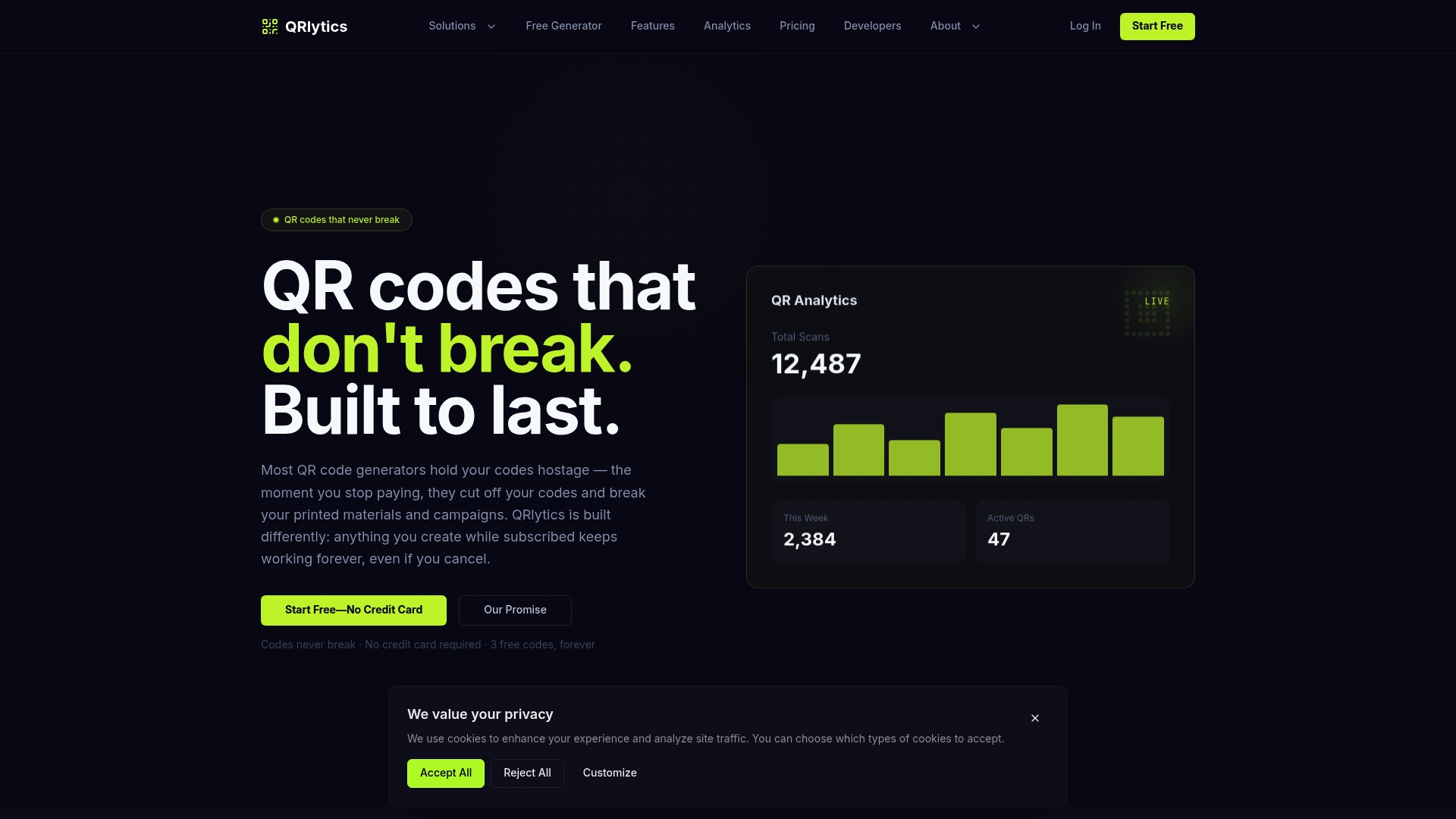
- Update a campaign’s destination after the print run has already shipped, without touching the physical code at all.
- Track every scan with real-time, GDPR-compliant analytics and global heat maps, so you see decay the moment it starts.
- Set up a code in minutes with no credit card required, through our free QR code generator.
If you are planning printed material that needs to outlive a single campaign, our dynamic QR code generator gives you the editable redirect layer this entire guide recommends, and our pricing page outlines the Free and Pro options available when you are ready to scale beyond a handful of codes.
FAQ
Why does link rot happen?
Link rot happens when a web page is moved, renamed, deleted, or its hosting domain lapses, breaking any link that pointed to the original address. For QR codes specifically, it also happens when a third-party shortener or free QR provider suspends or deactivates the account behind the code.
What does “dead link” mean?
A dead link is any URL that no longer leads to its intended content, typically returning an error, a redirect to an unrelated page, or no response at all. For a QR code, a dead link means the physical code still scans correctly but the destination it points to is gone.
Do broken links hurt SEO?
Yes. Google’s own guidance confirms that pages returning 404 or 410 errors are eventually dropped from its index, and soft 404s, where a missing page still returns a 200 OK status, create confusion for both crawlers and users. Keeping redirects clean and correctly coded avoids both problems.
What is it called when a link doesn’t work?
A link that no longer resolves to working content is generally called a dead link, and the broader pattern of links decaying across the web over time is known as link rot. The same terms apply to QR codes, since a QR code is simply a physical container for a URL.
Sources
- Section508
- QR code standards and best practices | Department of Energy
- How HTTP status codes affect Google’s crawlers | Google Developers