7 Step QR Migration for Marketers: Keep Printed Codes Working

You cannot move a printed QR image if it encodes a provider-owned short domain, but you can preserve a dynamic code’s destination when you control the redirect, can export and import the underlying records, or transfer the account itself. Before anything else, scan a representative sample of your codes and check whether the URL they resolve to uses a domain you actually own.
TL;DR:
- Only provider-controlled short domains prevent QR code migration; owning your own domain or CNAME record enables seamless redirection.
- Exporting, importing, or transferring accounts are ways to maintain dynamic QR codes without reprinting, but owning the domain is essential.
- Changing a destination URL in a dynamic QR code is possible through the provider dashboard or DNS adjustments if you control the domain.
- Testing for each device and verifying analytics are critical steps before and after migration to avoid broken links or lost data.
- Static QR codes are not portable; only dynamic codes using a controlled redirect layer can be moved or updated without reprinting.
Table of Contents
- What does it mean to migrate a QR code?
- When migration is actually possible
- Step-by-step migration checklist for dynamic QR codes
- Why domain ownership decides if your migration succeeds
- Testing and verification after a migration
- When printed QR codes simply cannot move
- How QRlytics removes the migration problem entirely
- Our take: treat QR codes as permanent assets, not one-off prints
- Start with a QR code that never needs migrating
- FAQ
- Sources
What does it mean to migrate a QR code?
A QR code is just an image encoding a string of data, usually a URL. It carries no hidden metadata about who generated it or which platform manages it, which is why “migrating” the image itself is the wrong goal. What matters is the destination behind it, and that splits into two very different cases, as QR-code usability guidelines explain.
- Static QR codes encode a fixed destination directly: once printed, that link never changes.
- Dynamic QR codes encode a short URL that redirects to your real destination, so the provider can update where it points.
The catch is ownership of that short domain. When a dynamic code uses a domain the provider controls (something like provider.link/abc123), you cannot take the code with you if you leave. The image stays loyal to a domain you never owned in the first place, a point also made in best practice guidance on QR codes and hyperlinks. Our guide on dynamic versus static QR codes covers this distinction in more depth.
When migration is actually possible
Three routes let you carry dynamic codes forward without reprinting anything, and each suits a different situation.
- Account transfer on the same platform. When your new team, agency or billing entity needs control of existing codes, an in-platform account transfer is the cleanest option if the provider supports it.
- Export and import via CSV or API. Many providers let you pull a list of your dynamic codes and their destinations, then recreate matching entries inside a new account, keeping the printed image but swapping the backend logic.
- Custom domain (CNAME) redirection. When your short links already sit on a domain you own, you repoint that domain’s CNAME record at a new provider, and every printed code built on it keeps working without a single reprint.
The third route is the one that saves marketing budgets. The Department of Energy’s QR code standards note that any change to a destination address breaks a code unless a redirect sits in front of it, which is exactly what a custom domain gives you: a redirect layer you control, independent of whichever platform sits behind it.
Step-by-step migration checklist for dynamic QR codes
Work through these steps in order, and resist the urge to skip the audit stage because it is the one that prevents surprises later.
- Audit every current code. Record the full destination URL, UTM parameters and the campaign each code belongs to.
- Export records from the old provider. Pull CSV files or use the API where available; where no export exists, you will need to recreate codes manually.
- Confirm your domain strategy. Verify you own the short domain, or set up a branded CNAME now if you do not have one.
- Recreate or import codes in the new provider. Preserve the original UTMs and campaign names so historical reporting still lines up.
- Update DNS or redirect settings. Point the old short domain’s CNAME at the new provider so printed codes resolve correctly.
- Test comprehensively. Scan every code type across devices and confirm analytics are logging scans as expected.
- Plan reprints and communication. Where printed assets genuinely cannot carry over, schedule replacements and tell stakeholders before launch day, not after.
Pro Tip: Keep your DNS record’s TTL low for the week of migration so any correction propagates in minutes rather than hours.
This sequence matters because skipping the domain check in step three is the single most common reason migrations fail: teams discover, mid-project, that the “custom domain” they assumed they owned was actually rented from the old provider all along.

Why domain ownership decides if your migration succeeds
A CNAME record is what lets a branded short domain, say links.yourbrand.com, point at whichever QR platform you choose. Change the CNAME target and every printed code built on that domain starts resolving through the new provider, with zero reprinting. Domain ownership, not the platform you started with, is what determines whether your QR assets are portable at all.
Before assuming you are covered, check these three things:
- Who registered the domain. If it sits in your own domain registrar account, you are in control; if it was set up by an agency or the QR provider itself, confirm you have admin access.
- What the current CNAME record points to. A DNS lookup tool will show you exactly where traffic is being routed right now.
- Whether the outgoing provider will release or reassign the CNAME. Some platforms cooperate quickly; others require a support ticket, a notice period, or active subscription status before they will let go of a domain mapping, which is a common and avoidable delay.
Testing and verification after a migration
Treat testing as a checklist, not a formality, because a single missed step can quietly break link integrity for weeks before anyone notices.
- Scan across devices and camera apps. iOS and Android handle QR decoding differently enough that a code tested only on one can still fail on the other.
- Verify landing pages and tracking. Confirm UTM parameters survive the redirect and that analytics events fire as expected.
- Check accessibility and speed. Display the visible short URL alongside the code and confirm the landing page loads quickly on mobile, in line with usability guidance for QR codes.
- Watch analytics for the first week. Set alerts for unexpected drops or spikes so a broken redirect gets caught within hours, not at the end of a campaign.
A redirect you don’t control is a redirect you can lose, which is why best-practice guidance on QR codes and hyperlinks also warns against free, untrusted generators: beyond the migration risk, poorly vetted tools raise privacy and malicious-redirect concerns that a verification pass should also catch. Our guide to tracking scans through to conversion walks through setting up that kind of monitoring, and agencies such as Opti Arts offer complementary attribution reporting if you need campaign-level analytics layered on top.
When printed QR codes simply cannot move
Some printed assets are stuck with a provider-owned domain and no redirect you control. A few fallbacks limit the damage.
- Host an explanatory page if you still control the old destination. Even a simple “this code has moved, scan here instead” page beats a dead link.
- Prioritise reprints by value. Replace the highest-traffic posters, packaging or signage first and let lower-value pieces expire naturally.
- Consider a sticker overlay, cautiously. A new code stuck over the old one works in a pinch, but security guidance flags overlay stickers as a known quishing risk, so only use this on controlled, monitored assets.
- Tell your audience directly. A short note on your website, social channels or packaging insert prevents confused customers from assuming the link is simply broken.
How QRlytics removes the migration problem entirely
We built QRlytics around dynamic URL updates, real-time scan analytics, GDPR-compliant tracking and customisable branding, precisely so destinations can change without touching the printed code (QRlytics). Every code created during an active subscription keeps working permanently, even after cancellation, which closes off the exact failure mode that forces most migrations in the first place.

Our take: treat QR codes as permanent assets, not one-off prints
Set up a custom domain before your first campaign goes to print, not after a provider forces your hand. Log every QR code in your asset inventory alongside the campaign it belongs to, and build a DNS check plus a fresh test scan into your standard post-deployment QA, the same way you would check a new page for broken links.
— The
Start with a QR code that never needs migrating
We designed our platform so a code created during your subscription keeps redirecting correctly for good, regardless of billing status, which means no future migration scramble. 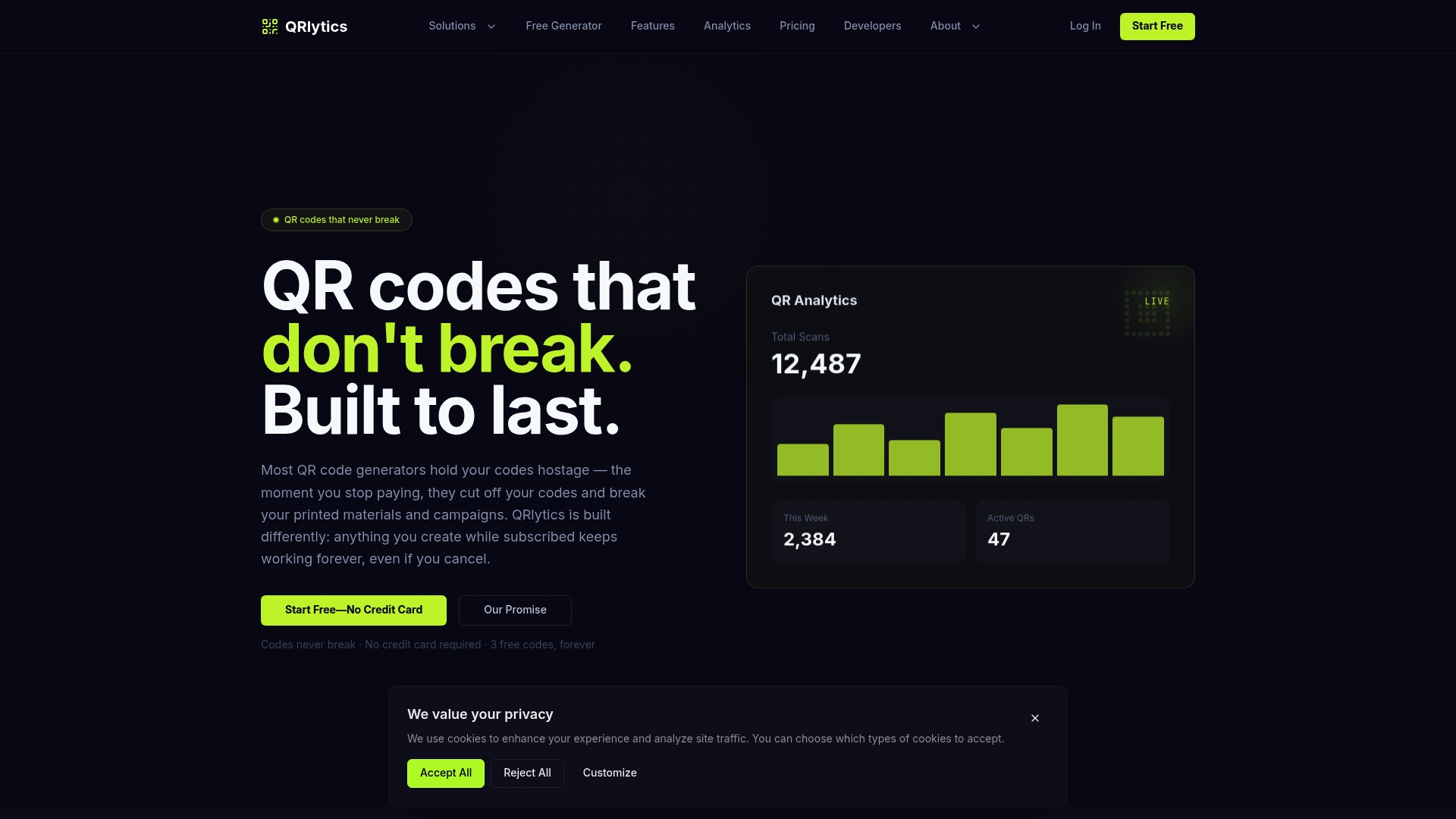
Create your first code on the free plan with no credit card required, or explore the dynamic QR code generator to see how destination updates work in practice.
FAQ
Can QR codes be transferred?
Dynamic QR codes can often be transferred by exporting the underlying records and recreating them in a new account, or by repointing a custom domain you own at a new provider. A static QR code’s image cannot be transferred because its destination is fixed permanently at creation.
Can an existing QR code be redirected?
Yes, but only if it is a dynamic code and you control the redirect, either through the original provider’s dashboard or through a custom domain’s DNS settings. A Department of Energy standards note confirms that any destination change breaks the code unless a redirect layer is already in place.
Can I move a QR code from one website to another?
You can point a dynamic QR code at a new website by updating its destination URL in the provider’s dashboard, no reprinting needed. A static code cannot be moved this way since its destination is baked directly into the printed image.
How do I transfer a QR code to my phone?
If you mean saving a QR image to your phone, simply download or screenshot it from wherever it was generated. This is unrelated to migrating a dynamic code between providers, and it is also distinct from processes like [Google Authenticator’s QR-based account export](https://support.google.com/accounts/answer/1066447), which moves two-factor authentication secrets rather than marketing links.
Sources
- 13 QR-Code usability guidelines
- Best practices for QR codes and hyperlinks
- QR Code Standards and Best Practices | Department of Energy