How to fix broken QR codes before you reprint anything

If your printed QR points to a domain you control, you can usually restore scans without reprinting: fix your DNS or redirect rule and you are often back online within hours. If it points to a hostname owned by a QR provider that has deleted the code, contact the provider and your registrar immediately; reprinting may become your only option if recovery fails. Start with the quick triage checklist below.
TL;DR:
- Restoring a QR code linked to your own domain is quick if you fix DNS records or redirect rules, often within hours.
- For provider-hosted hostnames, support responses vary and deletion of mappings can be permanent, making recovery more uncertain.
- Using permanent redirects and managing QR codes through a control domain reduces failure risks and simplifies updating destinations.
- QR codes created during an active subscription remain functional indefinitely, even if billing lapses, preventing dead codes from expired accounts.
- Maintaining a spreadsheet of all QR mappings and scheduled checks can prevent unexpected failures and improve campaign resilience.
Table of Contents
- Quick recovery steps to run right now
- How to tell whether your domain or your provider is the problem
- Restoring domains, redirects and provider mappings
- Preventing broken QR codes before they happen
- QRlytics as a permanence-first way to manage QR codes
- Recovery or reprint: a quick decision rule
- Try QRlytics without risking your printed materials
- Where these recovery facts come from
- Why most “fix broken QR codes” advice misses the real issue
- Sources
- FAQ
Quick recovery steps to run right now
Before you call anyone, gather facts. Most QR failures are solved faster when you know exactly what the code points to and how it is failing.
- Scan the printed QR with your phone and write down the exact URL or hostname, including any query string.
- Open that URL in a browser and note the HTTP status code and any redirect chain you see.
- If the domain belongs to your organisation, check your registrar account and DNS settings straight away: renew the domain if expired, restore records, and add a redirect to the correct destination.
- If the domain belongs to a QR provider, contact their support team and ask about restoration windows and whether they retain historic mappings; start preparing replacement codes in case recovery is not possible.
- Once you believe the fix is live, test from several devices and networks and confirm with your analytics or server logs that scans are landing correctly.
Pro Tip: Keep a screenshot of the failing scan and the exact timestamp. It speeds up support tickets and gives you a clean before-and-after for your own records.
How to tell whether your domain or your provider is the problem
A QR code is just an image encoding a URL. The server-side mapping or DNS record behind that URL is entirely separate, and it is that mapping, not the printed code, that usually breaks.
- If the hostname matches your own organisation’s domain, you control the fix directly through your registrar and DNS panel.
- If the hostname belongs to a QR generator’s own short domain, you are dependent on that provider’s systems and support process.
- A 3xx response generally means the redirect still exists but may be misconfigured; a 4xx means the destination or mapping is gone; a 5xx often points to a temporary server fault worth retrying.
- Updating a provider mapping is reversible and safe for a printed code, but deleting it is usually not. The merchant redirect API guide shows that updating a redirect URL changes the destination instantly while a delete call removes the mapping permanently, which is exactly why cancelled or expired QR subscriptions so often leave printed codes dead for good.
Restoring domains, redirects and provider mappings
The right fix depends entirely on who owns the broken link. Here is what to do for each path.
For a domain you own:
- Renew the domain immediately if it has expired. Under the Expired Registration Recovery Policy, registrars must permit renewal and restore DNS resolution as soon as commercially reasonable, though resolution can be interrupted during the redemption window, so speed matters.
- Reapply your A or CNAME records and recreate the redirect rule pointing to the live destination.
- Prefer a permanent redirect over a temporary one when the destination change is lasting, since that is the signal search engines and browsers trust for long-term routing.
- Check for redirect loops before declaring victory. The MDN guidance on redirection loops explains that loops can span several servers in a chain, so test the full path rather than just the first hop.
For a provider-hosted hostname:
- Ask support directly whether your code’s mapping still exists or was deleted, since the two outcomes call for very different next steps.
- Request an export of your historic mappings if one is available, so you can rebuild destinations elsewhere.
- Confirm whether a deletion can be reversed internally. Many providers cannot reverse it once it has happened.
Pro Tip: Ask your provider’s support team in writing whether deletion is reversible before you accept “no” as the final answer. A written record also helps if you need to escalate.
Preventing broken QR codes before they happen
The surest fix is avoiding the problem altogether, and that comes down to who owns the link your printed code depends on.
- Put every printed QR on a redirect domain your organisation controls, not a provider’s shared short domain.
- Keep an exported spreadsheet of every code, its destination, and its creation date under version control.
- Use permanent redirects for lasting changes and avoid chaining multiple redirects together, since each extra hop adds a point of failure.
- Run automated checks on live QR destinations on a schedule, and add a QR verification step to your print approval workflow.
A short operational routine keeps this manageable:
- Set a lifecycle policy for each code, including a review date and a reprint threshold if volumes are high.
- Document escalation contacts at your registrar and any QR provider you use, before you need them.
- Run a short recovery drill once a year so your team knows the steps without panicking mid-campaign.
Our guide on updating QR code links without reprinting walks through this process in more detail for live campaigns.
QRlytics as a permanence-first way to manage QR codes
Built-in permanence solves most of the recovery problems above before they start. QRlytics keeps every code created during an active subscription working, even if billing later lapses, which removes the single biggest cause of dead printed QR codes.
- Codes stay functional permanently once created during a subscription, regardless of later billing status.
- Destinations update dynamically, so you can change where a code points without touching the printed image.
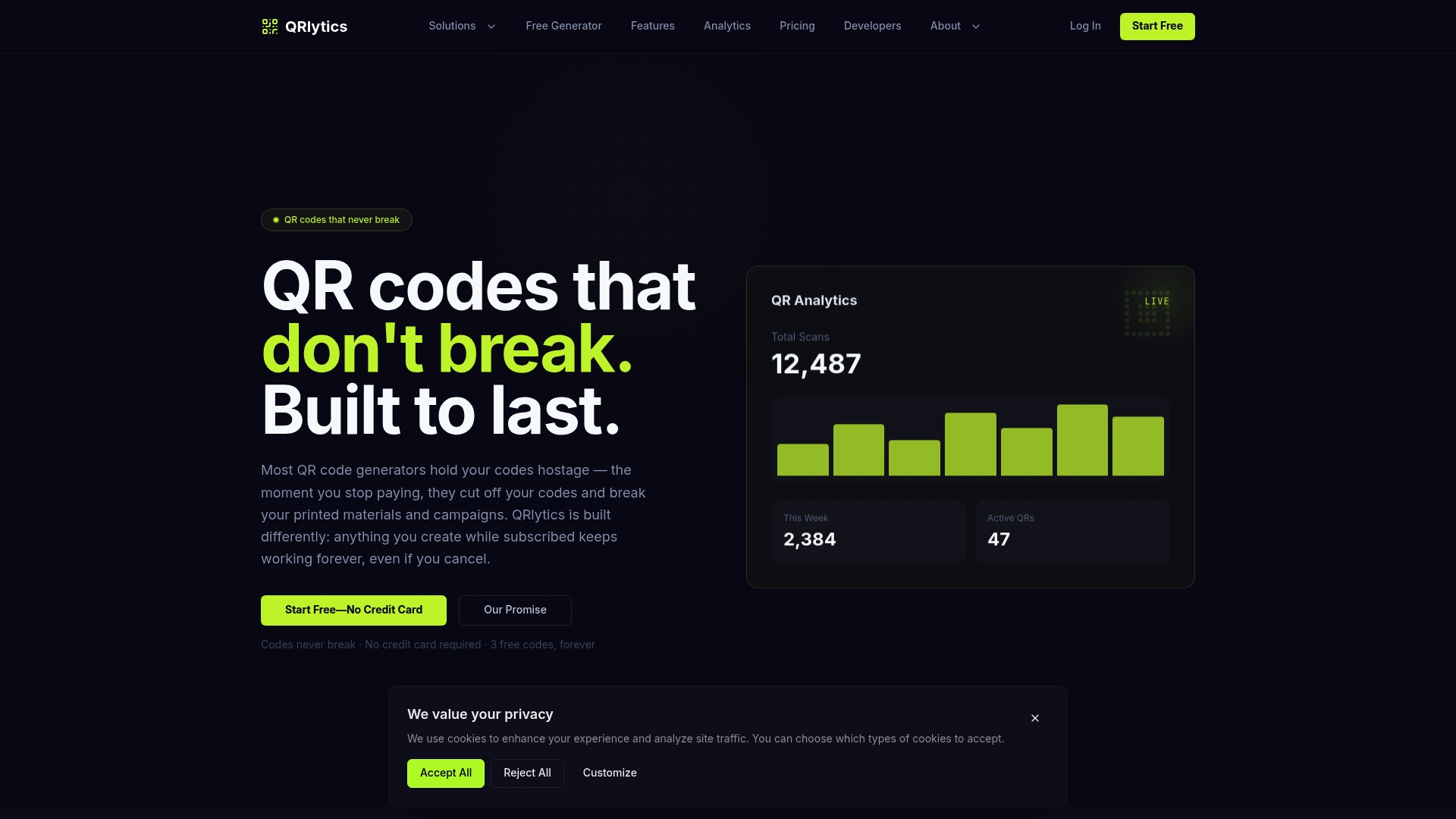
- Real-time analytics and GDPR-compliant tracking let you monitor scan activity and catch a dead link early.
- Branded, customisable codes keep printed materials on-brand while staying editable behind the scenes.
One structural guarantee matters more than any single feature: QRlytics states that codes created during an active subscription keep working permanently, which is the exact opposite of the delete-on-cancellation behaviour that causes most of the recovery scenarios in this guide.
Teams can test the permanence model on a live campaign before committing to a paid plan.
Recovery or reprint: a quick decision rule
Not every broken code is worth fighting for. Weigh the cost and lead time of reprinting against how likely your registrar or provider is to cooperate, and how urgent the campaign is.
- Quantity in circulation: a handful of posters is cheap to reprint; a national product run is not.
- Time sensitivity: a flash sale cannot wait for a support ticket; an evergreen sign can.
- Visibility: if you have no analytics on the code at all, you may not know it is broken until complaints arrive, which should push you toward recovery and better monitoring, not just a reprint.
Add a line to your campaign post-mortem asking whether the code was on an owned domain, and you will know next time which path to expect.
Try QRlytics without risking your printed materials
Printed QR codes are only as reliable as whatever sits behind them, and switching to a platform built around permanence removes most of the guesswork described above. QRlytics’ free tier lets you protect existing printed assets and manage destinations from one dashboard, with no credit card required to start.
If you are comparing dynamic and static approaches, the dynamic QR code generator page explains how editable, trackable codes avoid the exact failure modes covered in this guide. Pricing, including the Free plan and Pro plan, is listed on the pricing page so you can see exactly what each tier includes before you commit.
Where these recovery facts come from
The registrar and renewal guidance above follows ICANN’s Expired Registration Recovery Policy. The redirect and loop behaviour draws on MDN’s documentation on HTTP redirections and Google’s guidance on how crawlers handle HTTP status codes. Provider mapping behaviour is illustrated by a merchant redirect API guide. For measuring scans once a code is restored, see this partner guide on tracking QR code scans.

Why most “fix broken QR codes” advice misses the real issue

Most guidance on this topic treats a broken QR code as a technical accident, something to patch and move past. The real issue is structural: most QR platforms are built so that cancelling a subscription or missing a payment deletes the mapping behind your printed codes, not just pauses it. That is a business model choice dressed up as a technical limitation.
The uncomfortable truth is that organisations rarely find out their codes are at risk until a campaign is already live and scans start failing. A spreadsheet of mappings and a registrar contact list cost nothing to maintain, yet almost no marketing team keeps either until after the first outage. If there is one habit worth adopting from this guide, it is treating your QR mapping list the way you treat your domain renewal dates: checked on a calendar, not discovered during a crisis.
— The.
Sources
- Merchant redirect QR codes — API guide
- How HTTP status codes affect Google’s crawlers
- Redirections in HTTP - MDN
FAQ
Why did my QR code suddenly stop working?
The printed image itself did not change, so the fault lies in the server mapping or DNS record behind it. This usually means an expired domain, a deleted provider mapping, or a broken redirect rule, and identifying which one applies determines your next step.
Can a deleted QR code mapping be restored?
It depends on the provider. Some retain historic mappings and can restore them on request, but deletion is often permanent, as shown in documented merchant redirect API behaviour where updates persist but deletions remove the route entirely.
How long do I have to renew an expired domain before losing it?
Registrars operate defined post-expiration and redemption windows under the Expired Registration Recovery Policy, during which renewal is still possible, though DNS resolution may be interrupted. Contact your registrar as soon as you notice the code has failed rather than waiting.
Will QRlytics keep my QR codes working if I stop paying?
Yes. QRlytics states that any code created during an active subscription keeps working permanently, even after cancellation, which is the core difference it offers compared with providers that delete codes on lapsed billing.
What is the fastest way to avoid reprinting after a QR failure?
Point printed codes at a redirect domain your organisation controls and keep an exported list of every mapping, so you can fix the destination without changing the printed image. Tools like the dynamic QR code generator are built specifically to let you update destinations this way.